Own More Than One ‘Scope? You’ve Got Nothing On This Guy!

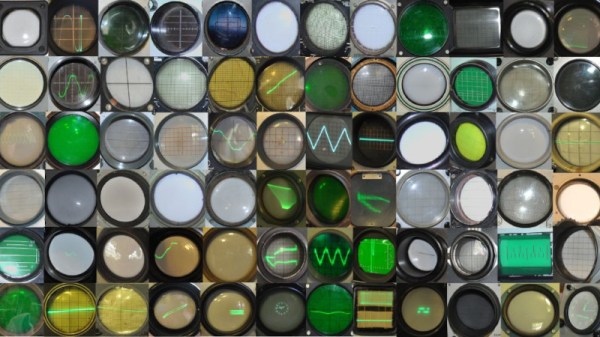
We’re guessing that quite a few of our readers have a surprising amount of redundant test gear, and we ourselves have to admit that more than one instrument adorns our benches. But we are mere dilettantes, amateurs if you will, compared to [Volke Kloke]. He’s got 350 of them in his average American home, and we have to say, among them are some beauties.

The linked newspaper article is sometimes frustratingly light on the details, but fortunately he has a website all of his own where we can all get immersed in the details. Of particular interest is an instrument which doesn’t even have a CRT, the General Radio 338 string oscillograph used a mirror drum to catch a standing wave in a tungsten wire, but there are plenty more. Is your first ‘scope among them?

As we now live in the age of cheap digital ‘scopes, at any surplus sale you’ll see plenty of CRT-based instruments going for relative pennies. Of those, the more recent and high-end ones are still extremely useful instruments, and it’s not just misty-eyed reminiscing to say that they remain a worthy addition to any bench.

Want to know about early ‘scope tech? We’ve taken a look before.
A Tale Of Two Pulse Modulators

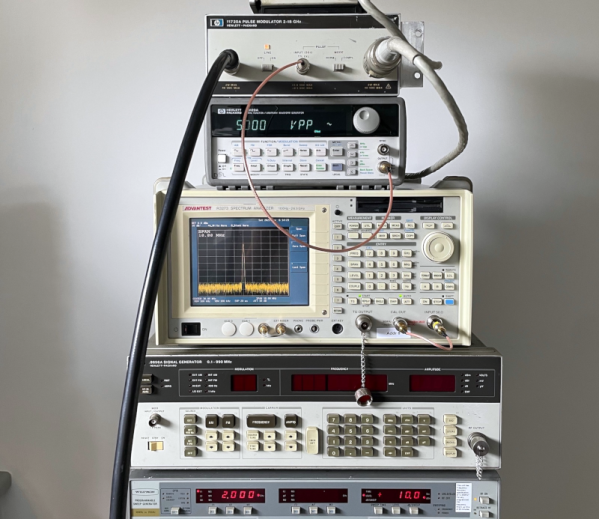
In the realm of test equipment, there are a number of items that you don’t know you need until you need one. That’s probably the case with the HP11720A pulse modulator. [Tom] acquired two of these even though, by his own admission, he had “no need for these things.” We’d like to say we don’t get that, but — alas — we do.

The good news, though, is he used one of them to measure the quality of some coax cable and shared the exercise with us in the post and a video, which you can watch below. The device can generate pulses with extremely fast rise and fall times (under 10 nanoseconds) at frequencies from 2 to 18 GHz. These were often used in pulsed radar applications and probably cost quite a bit more new than [Tom] shelled out for them.

Continue reading “A Tale Of Two Pulse Modulators”

USB Meets Core Memory In A Vintage ‘Scope

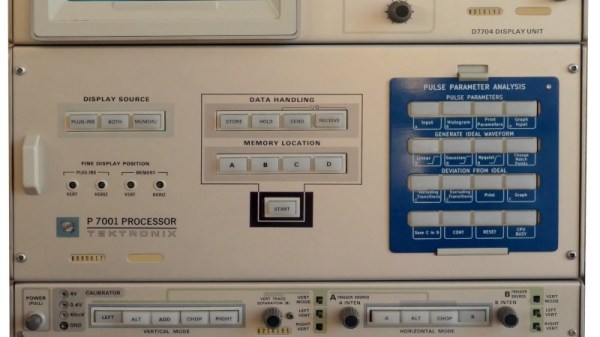
It’s normal today for even relatively modest instruments to have some form of computer control capability over Ethernet or USB. But five decades ago this was by no means a given, and when Tektronix shipped their P7001 digitiser module for their high-end oscilloscopes in 1971, they were initially designed to interface with a minicomputer. Not everybody has a PDP/11 lying around in 2023, but [Holger Lübben] wasn’t fazed by this. He set about creating a USB interface for this ancient piece of test equipment.

At its heart is a Teensy 4.1 which does the job of interfacing with the Tektronix 16-bit bus through a level shifting transceiver. The software for the Teensy comes with some demos, but sadly not the Tek BASIC of the original. We’re particularly impressed with the care to make the card frame for the module resemble as closely as possible an original Tektronix product.

We’re guessing very few of you will have this ancient test module on your bench, but the depth into which he goes over its internal design and programming makes this very much worth a read. If you fancy more vintage Tek goodness, take a look at this current probe.

Homemade Scope Does Supercapacitor Experiments

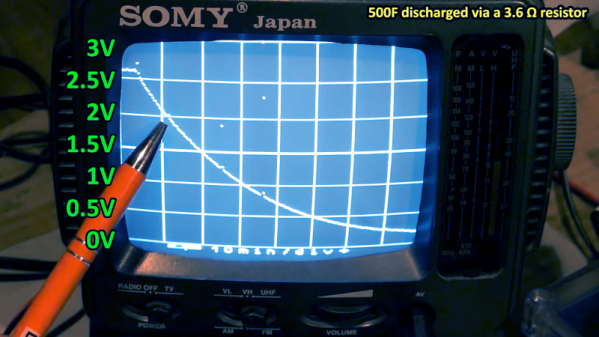
We’ve always been a little sad that supercapacitors aren’t marked with a big red S on a yellow background. Nevertheless, [DiodeGoneWild] picked up some large-value supercapacitors and used his interesting homemade oscilloscope to examine how they worked. You can watch what he is up to in his workshop in the video below.

Supercapacitors use special techniques to achieve very high capacitance values. For example, the first unit in the video is a 500 F capacitor. That’s not a typo — not microfarads or even millifarads — a full 500 Farads. With reasonable resistance, it can take a long time to charge 500F, so it is easier to see the behavior, especially with the homemade scope, which probably won’t pick up very fast signals.

For example, A 350 mA charging current takes about an hour to bring the capacitor up to 2.6 V, just under its maximum rating of 2.7 V. Supercapacitors usually have low voltage tolerance. Their high capacity makes them ideal for low-current backup applications where you might not want a rechargeable battery because of weight, heat, or problems with long-term capacity loss.

The real star of the video, though, is the cast of homemade test equipment, including the oscilloscope, a power supply, and a battery analyzer. To be fair, he also has some store-bought test gear, too, and the results seem to match well.

Supercapacitors are one of those things that you don’t need until you do. If you haven’t had a chance to play with them, check out the video or at least watch it to enjoy the homebrew gear. We usually look to [Andreas Spiess] for ESP32 advice, but he knows about supercaps, too. If you really like making as much as you can, you can make your own supercapacitors.

Continue reading “Homemade Scope Does Supercapacitor Experiments”

Vintage Tektronix Virtual Graticule

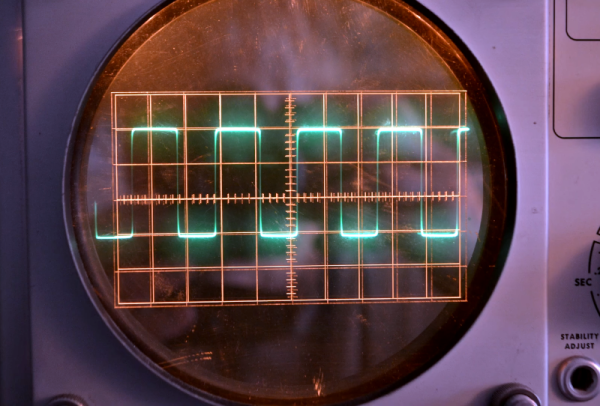
Oscilloscopes are great for measuring the time and voltage information of a signal. Some old scopes don’t have much in the way of markings on the CRT, although eventually, we started seeing scales that allowed you to count squares easily. Early scopes had marks on the glass or plastic over the CRT, but as [Vintage TEK Museum] points out, this meant for best accuracy, you had to look directly at the CRT. If you were at an angle horizontally or vertically, the position of the trace would appear to move concerning the lines on the screen. You can see the effect in the video below.

The simple solution was to mark directly into the phosphor, which minimized the effect. Before that was possible, [Bob Anderson] invented a clever solution, although Tektronix didn’t produce any scopes using it for some reason. The idea was the virtual oscilloscope graticule, and it was quite clever.

The idea was to put the graticule on a semi-reflective mirror. Looking through the assembly, you would actually see the trace and the reflection of the graticule in the mirror. The resulting image is perfectly aligned if the assembly is constructed properly. You can, at some angles, see both the front and reflected graticules.

According to the video, management was not impressed because someone other than [Anderson] showed a poor-quality prototype to them. By 1962, the graticule in the phosphor took over, and there was no need for [Anderson’s] clever invention.

These days, a graticule is just bits on the screen. Even if you roll your own.

Continue reading “Vintage Tektronix Virtual Graticule”

HP 3488A Teardown, Dismantled For Parts

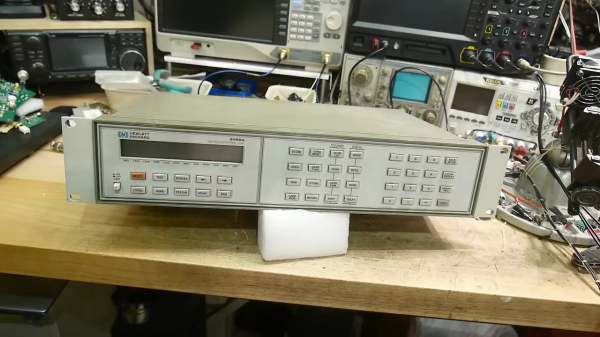
[IMSAI Guy] has an old HP 3488A Switch Control Unit that he wants to dismantle for parts ( see video below the break ). The 3488A is pretty simple as far as HP test equipment goes — a chassis that can hold various types of relay cards and is programmable over GPIB. He notes up front that these are plentiful and inexpensive in the used test equipment market. Continue reading “HP 3488A Teardown, Dismantled For Parts”

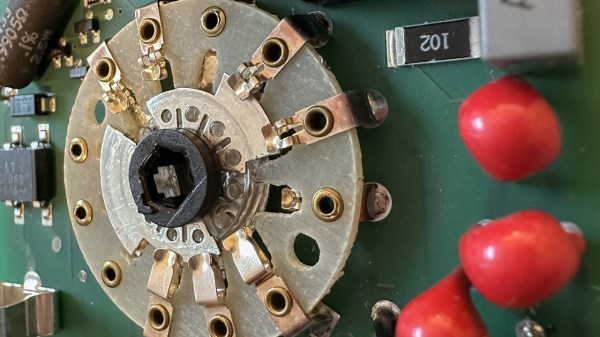
A closeup of the faulty section of the dial - you can spot the plastic rivets that broke off

The Tale Of Two Broken Flukes

Some repairs happen as if by pure luck, and [Sebastian] shows us one such repair on Hackaday.io. He found two Fluke 175 meters being sold on eBay, with one having a mere beeper issue, and another having a “strange error”. Now, theoretically, swapping beepers around would give you one working meter and a kit of spare parts – but this is Fluke we’re talking about, and [Sebastian] wasn’t satisfied leaving it there.

First, he deduced that the beeper issue could be fixed by repositioning the piezo disk – and indeed, that brought the meter number one to working order. This left the mysterious error – the meter would only power up in certain rotations of the dial, and would misbehave, at that. Disassembly cleared things up – the dial mechanics failed, in that a half of the metal contacts came detached after all the plastic rivets holding the metal piece in place mysteriously vanished. The mechanics were indeed a bit intricate, and our hacker hoped to buy a replacement, but seeing the replacement switch prices in three-digit range, out came the epoxy tube.

An epoxy fix left overnight netted him two perfectly working Fluke meters, and while we don’t know what the listing price was for these, such a story might make you feel like taking your chances with a broken Fluke, too. The tale does end with a word of caution from [Sebastian], though – apparently, cleaning the meters took longer than the repairs themselves. Nevertheless, this kind of repair is a hobbyist’s dream – sometimes, you have to design a whole new case for your meter if as much as a wire breaks, or painstakingly replace a COB with a TQFP chip.