Commercial Webcam Multi-touch Coming Soon

[youtube=http://www.youtube.com/watch?v=sBgg33J695I]

It looks like Toshiba has a webcam-based multi-touch display on the way. The video shows an iPod-esque photos album interface where the user stands in front of the display and manipulates it with both hands. The difference between this and some of the other multi-touch displays we’ve seen is that there is no touching necessary (goodbye fingerprints!). The user’s image is superimposed on the screen in a way that reminds us of the original Playstation Eye. Obviously this is much more refined, making us wonder if it’s the better camera, better processing, or both.

[Thanks Risingsun]
Augmented Reality Glasses

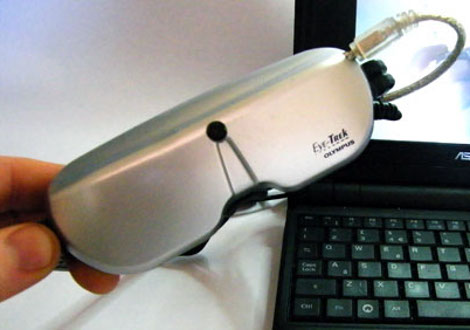
Augmented reality is a pretty neat thing but we don’t want to live our lives staring at a smartphone as we walk around. [F00] didn’t either so he built these augmented reality glasses. You can see a hole in the middle of the glasses where he added a webcam. The camera captures the image in front of you, processes it through augmented reality software, then sends the image to the wearable display that makes up the body of this hack. Integrate this into the head-mounted Linux hack and you’ll be able to ride your bike around the real world with your blast shield down instead of being tethered to your trainer in a virtual universe.

Monocle Fixes Webcam Farsightedness

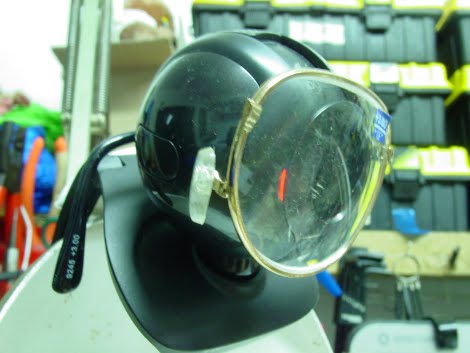
[Vik Oliver] came up with a webcam focus fix that is so quick and simple we never would have thought of it. He received the webcam as a gift and mounted on an articulated lamp so that it could easily be positioned around his projects. The problem is the camera lacks a focus adjustment so the close-up shots were blurry.

In what we consider a eureka moment, he sourced a pair of dollar store reading glasses to fix the optics. The glasses came with their own mounting bracket. He clipped them in half and wrapped the wire ear support around the camera body. Great hacks don’t have to be complicated, and we need to do a better job of looking at the dollar store for project parts!

Arduino Security With Frickin’ Laser

[over9k] used his Arduino to set up a laser trip wire. The laser is mounted along side the Arduino, reflects off of a mirror, and shines on a photoresistor that interfaces via a voltage divider. The signal from the voltage divider is monitored for a change when the laser beam is broken. [over9k] set things up so that a webcam snaps a picture of the intruder and Twitters the event for easy notification. Video after the break walks through each of these steps.

This build is a bit rough around the edges but unlike other laser trip wires this keeps all the electronics in one place. The laser interface could be a bit more eloquent, and we’re wondering just how much current it is pulling off of the Arduino pins. But if you’re bored and have this stuff on hand it will be fun to play around with it. Continue reading “Arduino Security With Frickin’ Laser”

Shadow Buttons

This art installation uses buttons made of light. A projector fills up the walls and ceiling of a room while a webcam monitors the pattern for changes. When the luminosity of a given area changes due to a shadow, a midi event is triggered. The software that controls the system is written in C# and uses the Emgu CV library to handle the image processing. In the video after the break you can see that creating shadows with your hands prompts changes in the image as well as the sound.

Continue reading “Shadow Buttons”

Open Source Artillery

[youtube=http://www.youtube.com/watch?v=zPm84nxa2dk]

Thanks to [Josh, Kyle, and Mike], it is now possible to wage (Nerf) war with an Arduino. The turret designed around it is capable of shooting 6 foam projectiles in close succession, between reloads. The faux weapon interfaces with a computer through the Arduino’s onboard serial link (via USB). Software on the PC sends commands to the Arduino, which then executes functions, such as panning, tilting, firing, and rotating the cylinder. The power for the firing itself comes from a 5 gal, 80 psi air compressor. The Java software on the host PC also does smarter things, like show streaming video from the turret’s webcam and even performs basic object tracking (with mixed success). All the code for building the brute is available on [Josh’s] website.

Pet-squirting Waterwall

waterwall

Sometimes, pets need to be trained to stay away from certain things. Over at sump.org, his cats needed to be kept out of his room. He used their natural fear of water by creating the waterwall, a motion-sensing device that sprays water. The project is incredibly simple and uses very few components. It is based around an IR intrusion detector and a windshield washer pump. Although that worked well enough, he also hooked it up to his computer via the parallel port so that he could take pictures as the cats (or people) are sprayed. Although the project is old, it shows how few components are really needed to achieve this kind of behavior.

Related: Motion detecting cat toy

[thanks todd]