Rise And Shine With This Japanese-Inspired Clock

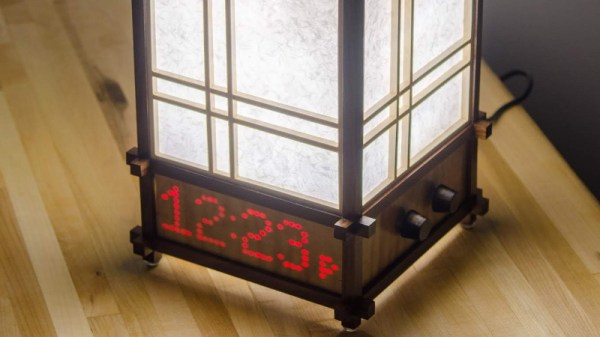
On the Hackaday.io page for his gorgeous “Sunrise Alarm Clock”, [The Big One] is quick to point out that his design is only inspired by Japanese lanterns, and does not use authentic materials or traditional woodworking techniques. Perhaps that’s an important fact to some, but we’ll just say that the materials used seem far less important when the end result looks this good.

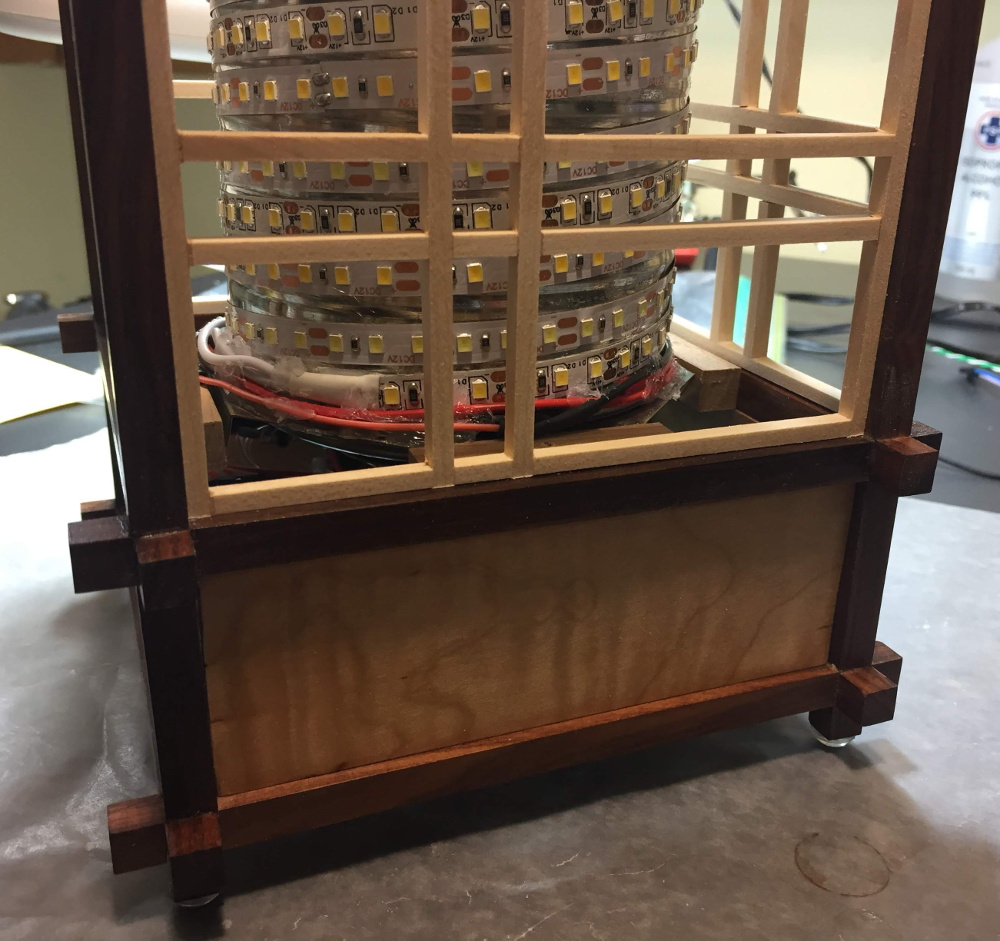
Unfortunately [The Big One] hasn’t provided any interior shots of his clock, as it sounds like the aesthetics of the internal wiring isn’t quite up to the standard set by the outside of it. But he has provided a concise parts list, a wiring diagram, and source code, so we’ve got a pretty good idea of what’s under the hood.

The clock is powered by the uBBB 32u4, an ATMega32u4 development board that [The Big One] developed in conjunction with [Warren Janssens]. It uses the popular MAX7219 LED matrix for the display, and a DS3231 RTC module to help keep the time. There’s also a DFPlayer Mini module onboard that allows him to play whatever sound effects or music he wants when the alarm goes off.

Of course the star of the show is the LED strips which illuminate the shōji-style column. These have apparently been wrapped around a coffee can of all things, which not only serves as a convenient way of holding the strips, but [The Big One] says actually makes the speaker sound a bit better. Hey, whatever works.

This isn’t the first “lantern” clock to grace these pages, but compared to the high-tech presentation of previous projects, we can’t help but be impressed by the grace and elegance of this wooden masterpiece.

Making A Bronze Cannon From Scratch

Casting metal at home is somewhat tricky, but there’s no denying the results can be quite rewarding. [FarmCraft101] put his incredible craftsmanship on display, and learned a few new things in the process, by scratch building a scale replica bronze cannon and carriage.

Starting with a sufficient quantity of scrap metal, he first produced bronze ingots. Getting the actual casting right took multiples attempts. First tried a lost foam cast, which failed miserably, but provided a sample metal which was put through tensile strength testing. The second attempt was done using a wood barrel form and a split mold, and was cast horizontally which resulted in shrinkage on top of the barrel. The third attempt, arranged vertically, almost resulted in a high risk game of “the floor is lava”, with molten bronze pouring out across his garage floor after the mold split open during casting.

Attempt number four was finally successful, again using a vertical mold but with more sturdy clamping. This roughcast barrel was then drilled out and finished to a beautiful mirror with the help of a lathe and a lot of elbow grease. He then turned his attention to the carriage, which itself is a real beauty featuring custom wagon wheels with a charred wood finish and linseed oil coating.

You can check out the build video after the break, but we’ll warn you now, [FarmCraft101] never actually fires this gorgeous creation. If you’d like to try your hand at DIY cannoneering and have a 3D printer, you might want to give lost PLA casting a try, or go into mass production with some DIY silicone molds.

Continue reading “Making A Bronze Cannon From Scratch”

Inventor And Detective Create Range Of Snack-Hiding Devices

Anyone who has had to deal with siblings, their friends, flatmates or parents who are overly fond of snacks may know this issue: you bought some snacks for your own consumption, but before you can get to them they have vanished. Naturally, nobody knows what happened to said snacks and obviously outraged that anyone would dare to do such a dastardly thing like eating someone else’s snacks.

This is the premise behind British inventor [Colin Furze]’s new series of YouTube videos (embedded after the break). Teaming up with former Scotland Yard detective [Peter Bleksley], their goal is to find ways to hide snacks around the house where curious and peckish individuals will not find them. Though a snack-company sponsored series (Walkers) and featuring snack names that will ring no bells for anyone outside of the UK, it nevertheless shows some innovative ways to hide snacks.

The first episode shows how one can hide snacks (or something else, naturally) inside a door. The second tweaks a standing lamp to add some hidden drawers, and the third episode creates a hidden compartment behind a television. Perhaps the most intriguing part of these episodes is the way it highlights how easy it is to not just hide snacks around the house, but also devices for automation and monitoring. Just think how one could use these tricks for IoT projects and the like.

Continue reading “Inventor And Detective Create Range Of Snack-Hiding Devices”

Quilting Desk Is An Absolute Unit

Most hobbies come with a lot of tools, and thread injecting is no different. Quilting itself may be Queen Hobby when it comes to the sheer volume of things you can buy: specialized templates, clips, thimbles, disappearing ink pens, and so on. And of course, you want it all within arm’s reach while sitting at the machine.

Ruler rack via Amazon.

Years ago, [KevsWoodworks] built an impressive custom quilting desk for his wife. He’d added on to it over the years, but it was time for a bigger one. This beautiful beast has 21 drawers and 6 large cubbyholes for plastic bins. At the wife’s request, one of the drawers is vertical. [Kev] doesn’t say what she put in there, but if it were our desk, that’s where we’d stash all our large plastic rulers that need to be kept flat (or vertical). There’s also a lift, so any sewing machine can be brought up flush with the enormous top.

Fortunately for us, [Kev] likes to teach. He documented the build in a series of videos that go nicely with his CAD drawings, which are available for download. Thread your way past the break to see those videos.

Want to do some thread injecting, but don’t want to spend hundreds on a machine? We got lucky with our entry-level injector. If yours is a piece of scrap or has limited stitch options, replace the motor, or add an Arduino.

Continue reading “Quilting Desk Is An Absolute Unit”

Project Egress: [Fran] Makes A Latch

[Fran Blanche] is on the team of elite hackers that has been offered a chance to contribute to [Adam Savage]’s Project Egress, a celebration of the engineering that got humanity to the Moon 50 years ago this month. By the luck of the draw, she landed a great assignment: building a replica of one of the fifteen latches that kept the Apollo Command Module hatch dogged down against the vacuum of space, and she’s doing a great job documenting her build with some interesting videos.

The first video below is mostly her talking through her design process, materials choices, and ideas about fabricating the somewhat intricate pieces of the latch. All 44 makers involved in the project get to choose what materials and methods they’ll use to make their parts, and [Fran] decided to use wood. Her first inclination was to use oak and brass, a nice combination with an 80s vibe, but in the second video, which covers more of the initial fabrication, she explains her switch to walnut. Unfortunately, the only CNC option she has is a Shaper Origin, which presents some difficulties; the handheld tool requires some complicated fixturing to safely machine the small parts needed, and its inability to read STL files means that [Fran] is stuck with a complicated software toolchain to drive the tool.

There are more videos to come as [Fran] gets further into the build, and we’re looking forward to seeing how her part and the rest of the makers’ builds come out.

Continue reading “Project Egress: [Fran] Makes A Latch”

Tiny Wooden Laptop Packs Raspberry Pi

Building a handheld Raspberry Pi rig is practically a hacker rite of passage these days. Off-the-shelf parts keep getting better, and we’re now starting to see affordable compact LCD screens with decent resolution become common. [MakeFailRepeat] got his hands on a HyperPixel screen, and decided to whip up a neat project with it.

The result is a charming little laptop, packing a 4″ screen with 800×480 resolution. Input is via multi-touch, as well as an integrated keyboard. The frame of the laptop is wooden, with a 3D printer supplying parts for the hinge mechanism. To round out the aesthetics, the top of the device was given a decorative copper inlay. Power management is via a UPS hat, which allows the device to switch seamlessly between battery and mains power.

A project like this is a great way to learn a wide range of valuable skills. It involves woodworking and 3D design, as well as the basic configuration of a single board computer. They come in all shapes and sizes, like this tiny RetroPie handheld, or this slick laptop build. Video after the break.

Continue reading “Tiny Wooden Laptop Packs Raspberry Pi”

JigFab Makes Woodworking Easier

Woodworking is an age-old craft that requires creativity and skill to get the best results. Experienced hands get the best results, while the new builder may struggle to confidently produce even basic pieces. JigFab is here to level the playing field somewhat.

Much of the skill in woodworking comes with mastering the various joints and techniques required to hold a piece together. Cutting these joints often requires specialized tools and equipment – ideally, some sort of jig. These jigs can be difficult to build in themselves, and that’s where JigFab shines.

The workflow is straightforward and quite modern. A piece is designed in Autodesk Fusion 360. Various joints can then be defined in the model between individual parts. JigFab then generates a series of laser cut constraints that can be used with power tools to easily and accurately cut the necessary parts to build the final piece.

It’s an impressive technology which could rapidly speed the workflow of anyone experimenting with woodwork and design. There’s even smart choices, like having a toolkit of standard predefined elements that reduce laser cutting time when producing new constraints. If you’re eager to get stuck in to woodwork, but don’t know where to start, don’t worry – we’ve got a primer for that. Video after the break.

Continue reading “JigFab Makes Woodworking Easier”