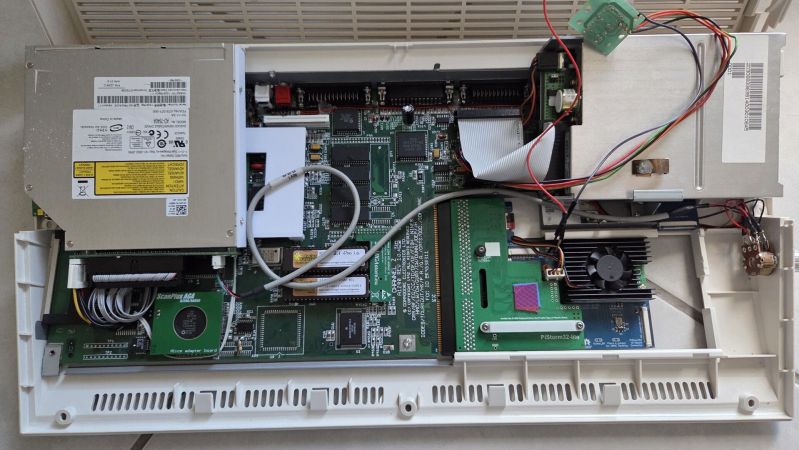
It's rare to see an A1200 case fuller than this.

Amiga 1232 Storm CD Packs Every Upgrade Into One Wedge

You know what they used to say– once you go Commodore, you’ll never leave by any door. Well, they might not have said that, but given the prevalence of projects still using Commodore-branded systems decades after the company’s demise, perhaps someone should have. A case in point is [Jit06] with this writeup on his Ultimate Amiga 1200 — or “Amiga 1232 Storm CD”– which crams just about every upgrade you might think of into the 1990s wedge computer.

Of course it has the PiStorm 32, with a CM4 providing supercomputer performance, at least by A1200 standards. That’s rather old hat, though, and it’s everything else crammed into the old Commodore that takes the score. For one thing, there’s a slot-loading, slim-form DVD drive from an old laptop that’s been incorporated so smoothly it almost looks factory. Ditto for the compact flash card slot, which is also on the IDE bus. The two share a custom IDE cable– yes, kids, we did used to roll our on 44-pin cables back in the day, but you’d better believe no one did it unless they really had to. With the space constraints inside the A1200 case, [Jit06] falls into that category.

The optical and CF cards trigger the drive LED on the Amiga case by default, but [Jit] wanted to see access on the PiStorm’s SD card as well, so he wired a couple of red LEDs to the default lightguide to get a colour-contrasting flash. That SD card is also broken out with an extender for easy access without opening the case– and once again, it looks almost as good as stock. So does the modded-on VGA port, which is stealing space that once belonged to the Amiga’s RF modulator and fed by a ScanPlus AGA board.

The only thing that really stands out as modded is the volume knob on the floppy-drive side of the case; that controls a mixer that sits between the CD audio and Paula, the Amiga’s custom sound chip. This lets him use the A1200 as a CD-32 system, and is very handy to have as CD-32 games used CD audio tracks that apparently were not well mixed with the digital audio in the games.

With all the cutting and soldering, this is not a reversible mod, something people are becoming much more concerned with as these machines slowly increase in rarity. Still, as a quality-of-life improvement, this sort of upgrade might be worth it if can keep the old A1200 relevant for another three decades. For anyone else who never got over the Amiga bug, he’s also published a linux-native SD-card creator called emu68 bootstrap on github to help with making images for the PiStorm.

Thanks to [Jit] for the tip! With the easy OS-swapping he’s enabled with the SD-breakout, there’s no reason not to try the rediscovered Amiga Unix. If you want the same without cutting into a vintage case, the PiStorm can be a sidecar.

Continue reading “Amiga 1232 Storm CD Packs Every Upgrade Into One Wedge”

Repairing A Pair Of Voodoo 2 GPUs For Some SLI Action

Well there's your problem. (Credit: Bits und Bolts, YouTube)
Well there’s your problem. (Credit: Bits und Bolts, YouTube)

Recently [Bits und Bolts] stumbled over a pair of Dragon 3000 branded 3dfx Voodoo 2 cards in his unfixed cards pile, and decided that the best course of action was to not only fix them, but also run them in SLI for some sweet Unreal Tournament action. Naturally, these cards being in the broken cards pile meant that he first had to figure out why they were broken and fix all issues.

The advantage of having two identical Voodoo 2 cards is of course that any missing components, like some resistors on one card, could be referenced on the other card. Beyond that it was mostly a matter of reflowing clearly corroded pins on the ICs and replacing damaged resistors and resistor arrays before the first tests could be run.

Using the mojo utility it was easy enough to spot that there were still some lingering issues, with clear issues visible in 3D games as well. These were tracked down to a dodgy pin on one of the texture mapping units (TMUs) that needed some more reflowing, and a very sneaky resistor array that was cracked but not obviously so until prodded with a multimeter.

With both cards now making happy noises when individually tested, it was time to go full SLI, fire up the Pentium 2 system and enjoy the glory of 24 MB of VRAM at high resolutions in Unreal Tournament. Considering that the bloke who had sent in these cards had found them while cleaning up a shed, it’s quite amazing how little rework was needed to once again party like it’s 1999.

Continue reading “Repairing A Pair Of Voodoo 2 GPUs For Some SLI Action”

DIY CO2 Scrubber In DIY Sub By A Hacker Braver Than Most

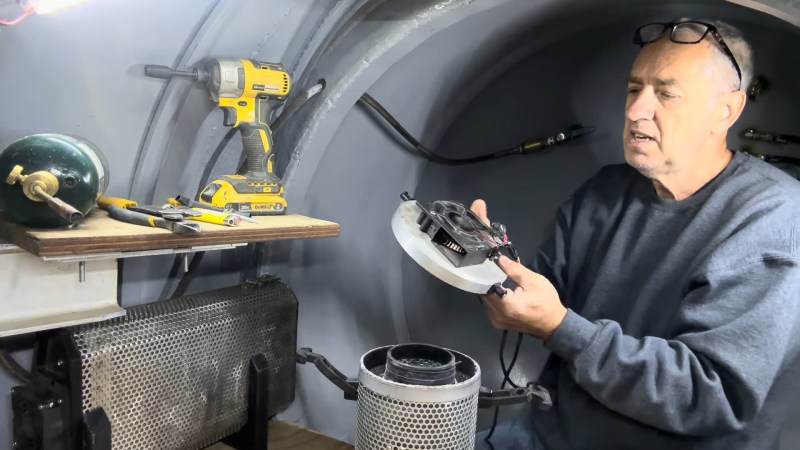
If you look around your environment, you can probably pick off quite a few things that you’ve made, at least if you’ve been at this a while. You probably aren’t reading this from the bottom of a body of water though, which means you lack the incredible confidence of submarine builder [Hank Pronk]. Not only is he building himself a capable-looking diesel-electric submarine over on YouTube, he’s even DIYing CO2 scrubbers for it! Yeah, that’s a man who believes in himself.

Luckily [Hank] is not anywhere near the Caribbean, so needn’t worry about being misidentified as a narco-sub, but he still has to be concerned about his oxygen supply when tooling around beneath the local lakes. Perhaps more important than the oxygen supply in a sub is the build up of CO2. It doesn’t matter how many oxygen tanks you bring down with you if you can’t scrub CO2 out of the air to make room for it. Just like the Apollo missions, he’s using a chemical adsorbent to take carbon dioxide out of the air — and just like Apollo 13, he’s switching from square to round.

Or, rather, from a rather rectangular commercial model to a DIY little round unit. That’s because he doesn’t need the big scrubber in this sub: being diesel-powered, he expects to spend a lot of time at snorkel depth, where both the pilot and the engines can get clean air through the tube. Dives are expected to be short, and in that use case, too big of a CO2 scrubber is really a waste. If for some reason he gets stuck on the bottom, well, the lake isn’t that deep. He can swim to surface, and has a detailed bailout plan. If he wants to stay under overnight to avoid bailing at night, he’s carrying enough extra adsorbent for that.

There’s a reason almost every submarine we’ve featured on this site over the years is an ROV. It’s not that a homemade submarine is automatically a death trap, but you sure do have to be confident in your design.

Continue reading “DIY CO2 Scrubber In DIY Sub By A Hacker Braver Than Most”

Re-Enable All Compute Units On The PS5-like BC-250 Cryptomining Card

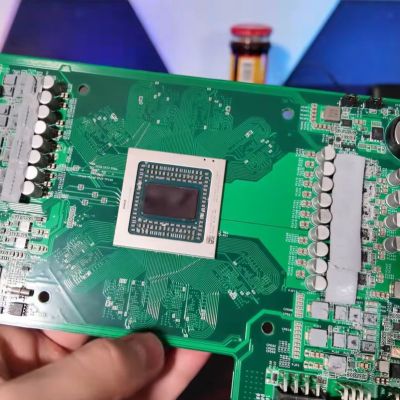
The custom APU at the core of Sony’s PlayStation 5 hasn’t just been quietly powering these game consoles, but also made their way onto cryptomining cards around 2023 which are called the BC-250. The APUs on these boards differ from the one found in the PS5 most notably by having two out of eight CPU cores disabled, along with many compute units (CUs) of the iGPU. Now apparently it seems that you can re-enable these CUs per instructions by [duggasco] if you’re feeling adventurous.

The BC-250's AMD APU in all its glory. (Credit: Lowest Logan, YouTube)
The BC-250’s AMD APU in all its glory. (Credit: Lowest Logan, YouTube)

As stated in the project’s README, BC-250 boards come with only 24 out of 40 CUs enabled, but this is not a permanent (e-fuse) thing. Instead you can write to two hardware registers during the GPU driver initialization, something which can be added to for example the Linux kernel module parameters.

Since many of these APUs likely had cores and CUs disabled due to them failing QA during PS5 APU manufacturing, there’s a good chance that some of the CUs truly are bad. Yet as we saw with the AMD Phenom II X3 with a supposedly bad fourth core back in the day, sometimes demand for the ‘defective’ part is high enough that good parts get mixed in as well.

Thus people like [Lowest Logan] decided to give it a shot, demonstrating the use of the patch with Bazzite Linux on a BC-250 system. After a reboot the system does indeed list 40 CUs as being enabled, and running Furmark shows a big boost in performance without any glitches or fire. There is of course thermal throttling, but that is due to the default cooling solution not being designed for running it at full blast.

Incidentally the real PS5 has only 36 active CUs, so this technically makes these unlocked APUs more powerful. With the water cooling solution demonstrated by [Lowest Logan] the thermal throttling is also resolved, showing that you can get a pretty nice gaming system out of these old cryptomining boards if you happen to win the silicon lottery.

Continue reading “Re-Enable All Compute Units On The PS5-like BC-250 Cryptomining Card”

How The 2020s Chip Crisis Led To A Buggy Saleae Analyzer In 2026

For those of us old enough to remember the harrowing days of the early 2020s, alongside another major kerfuffle there was a complete breakdown in global supply chains that led to the 2020-2023 global chip shortage. Unsurprisingly, this pushed many hardware manufacturers into less orthodox approaches, massive BOM changes, and hurried redesigns. One of the results of this era found its way into the hands of the bloke over at the [Playduino] YouTube channel, who was mystified to find two bodge wires in his fancy Saleae logic analyzer.

The reason for popping open the LA was crosstalk between two channels, which was bad enough that it made the unit quite unusable for the intended task. After seeing the cut traces and bodge wires he initially assumed that since he bought it used that the previous owner had modified it, but said person denied having opened it since purchasing it from an official retailer.

This was when he emailed Saleae support to see whether they knew anything. Initially they denied knowing anything about such a modification, but then the CTO emailed back with a long and very detailed confession. As explained in the video, during the aforementioned chip crisis Saleae was forced to rapidly redesign their LAs to use whatever FPGAs and other parts they could still get their hands on.

An initial prototype unit passed their internal tests, so they had a first batch manufactured using PCBs from a different supplier. Despite sending the same Gerber files, the resulting PCBs had ground fill issues that necessitated the observed rework, but due to insufficient testing for crosstalk a total of 406 units made it into the wild.

Sadly he had to return the defective unit for a replacement, making it somewhat hard to let go of such a piece of history. That said, if you want to know whether you’re also one of the lucky remaining 405 LA owners, the CTO provided the affected serial number range: 00200026245 to 00200026675 are affected.

Continue reading “How The 2020s Chip Crisis Led To A Buggy Saleae Analyzer In 2026”

The Winners Of The 2025 Obfuscated C Code Contest

One of the most exciting challenges available to any software developer is that of writing brilliantly working code that’s so obtuse, so indecipherable, and opaque, that even its own author would struggle to grasp its inner workings after returning to it a year later. While for some this is just how they naturally write code, for others it’s part of the International Obfuscated C Coding Challenge (IOCCC), with 2025’s entrants once again showing their mettle.

The IOCCC judges entries among a range of categories, as it can be hard to otherwise quantify what is the ‘best’ entry, with ground rules limiting what the entry can entail. Generally as long as your code adheres to the C11 standard with a source size of 4,993 bytes or less and final binary size of under 2,503, is accompanied by a GNU-style Makefile and doesn’t turn a judge’s computer into a raging inferno — it should qualify.

Among the winning entries we got fun ones like ‘Most likely to shock’ by [Yusuke Endoh] which generates a Lichtenberg figure in ASCII in the terminal. There are also quite practical ones, such as the ‘Best real emulator’ winner by [Nick Craig-Wood], whose entry is a functional Game Boy emulator. Although not full-featured, it can play a range of real GB ROMs, just do not expect to get any sounds or fancy terminal-based graphics.

Hackaday Links Column Banner

Hackaday Links: June 7, 2026

Christopher Nolan’s The Odyssey isn’t hitting theaters for another month or so, but if you’re already planning your trip to the cineplex, you may want to check out this page on the movie’s website which lets you view the trailer in the six (!) different formats it’s being released in.

We don’t really have an opinion on the big-screen adaptation of the epic tale as a piece of media, but from a technical standpoint, it’s interesting to see how the viewing experience changes between the 70mm IMAX version with an aspect ratio of 1.43:1 and the 35mm cut at 2.39:1. Unfortunately, the website offers no way to approximate what the movie will look like once compressed, streamed over the Internet, and displayed on a cheap TCL TV, to say nothing of how the viewing experience will be impacted should you watch the movie on your phone by way of a series of short YouTube clips while going to the bathroom. Maybe Nolan is saving that for his next film.

If you head over to the movies in one of Waymo’s vehicles, you can feel a little better about the long-term ecological impact of your trip thanks to a recently announced partnership between the autonomous car maker and B2U Storage Solutions. Under the agreement, old batteries pulled from Waymo’s fleet of self-driving electric cars will get a second life as localized grid storage.

The idea is that batteries which no longer hold enough charge to power a robo-taxi should still have enough capacity to store the energy produced by renewable sources so it can be doled out later when the demand goes up. By installing these batteries in the cities that Waymo actually operates their vehicles in, they don’t have to worry about shipping them around either — they can just yank them out of the car, and wire them right into the grid. Of course, eventually the batteries will be too cooked to adequately perform in this role as well, but this should give them a few more productive years before they get torn down and scrapped.

Continue reading “Hackaday Links: June 7, 2026”