PIC powered AVR programmer

posted Nov 18th 2009 9:03am by Mike Szczys
filed under: misc hacks

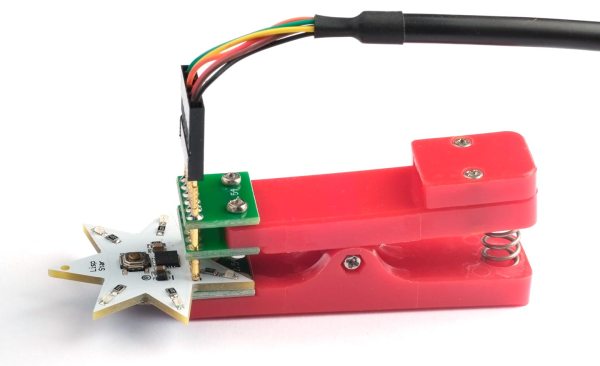
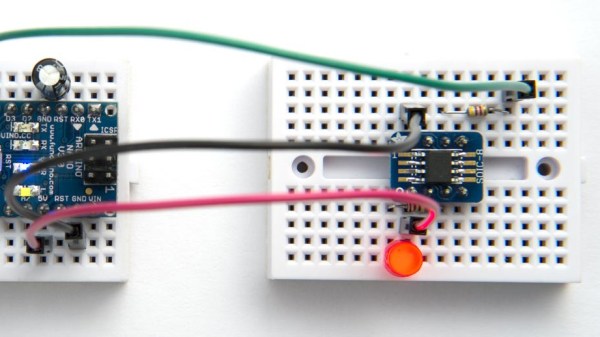
[Texane] wrote in to let us know he has implemented AVR ISP programming using a PIC microcontroller. He wrote some code for an 18F4550 that uses the STK500 standard for In System Programming. This means that his hardware is compatible with AVRdude, the open source AVR programming software. There has long been an argument over the virtues of PIC versus AVR but we say why not both? If you have already honed your programming chops with PIC, you can build your own programmer and give the Atmel family a try.

The current implementation uses a serial port to connect the programmer to a computer. Keep your eye on this one as [texane] plans to add USB connectivity and has told us he will post schematics for the device as soon as that is complete.

PCB light box in a scanner shell

posted Nov 10th 2009 9:00am by Mike Szczys
filed under: tool hacks

scanner-exposure-box

[Kizo] repurposed a flatbed scanner to use as an exposure box for making printed circuit boards. Exposure time is controlled by an AVR ATtiny2313 microcontroller. The device is connected to a separate display board to control four 7-segment displays using one shift register for each. Time is set in ten second increments and once started, switches on the lights with a relay. Once the right exposure time has been reached, the lights are switched off and a piezo speaker is buzzed. There’s no mention of they type of bulbs he’s using but they look like compact fluorescent with tin foil beneath as a reflector.

If these are just CFL bulbs, how will the performance compare to a light box based around a UV light source?

[Thanks Jake]


CNC hot wire cutter from scanners

posted Oct 19th 2009 1:00pm by Mike Szczys
filed under: cnc hacks

hot-wire-cutter-from-scanners

[Raul] built a CNC hot wire cutter that he uses for cutting shapes out of foam. His device uses two flat bed scanners to provide two planes of motion. One scanner arm has the foam mounted on it and provides the Y-axis movement. The other scanner has the hot wire mounted on it and provides the X-axis movement. The cutting wire is mounted on a flexed bow made from heavy gauge coat hanger wire.

He tapped into the logic board of one scanner to gain access to the motor movements. The other is connected through a couple of H-bridges. Both are controlled by an Atmel AVR ATmega128 which in turn takes its commands from a connection with a computer printer port. A python program uses vector graphic files in SVG format and traces the outline for cutting.

We’ve got a video of this in action after the break. At our request, [Raul] took some time to post a set of pictures and make comments on them. Thanks for the hard work and great job! Read the rest of this entry »

72 LED persistence of vision globe

posted Oct 15th 2009 12:00pm by Mike Szczys
filed under: classic hacks, led hacks

HaD-pov-globe

[Ben] told us about his POV globe yesterday. We took a look and saw just one photo and the code with no real explanation of his project. He certainly set to work over night and now we see all the goodies we look for in a great build log. He even threw the Hackaday logo up for our enjoyment. His build is well executed and he found some creative ways around the common problems in these projects. We take a closer look after the break. Read the rest of this entry »

Jamin’ to Bach, Commodore 64 style

posted Oct 13th 2009 3:00pm by Mike Szczys
filed under: classic hacks, digital audio hacks

[thrashbarg] missed the sounds of the Commodore 64 and longed to hear the great masters in 8-bit glory. To get his fix, he created a midi device using the original Sound Interface Device from those long-dead systems. He’s interfaced the MOS6581 SID with an Atmel AVR ATmega8 microcontroller. The receiving pin for the AVR’s UART is used as a MIDI-IN connection, with the microcontroller converting midi data into the proper sound generation specs for the SID. The result is the 10 minutes of [Bach]’s Brandenburg Concerto heard in the embedded video above.

We have no idea where he picked up this obsolete chip, but if you want to give this a try, perhaps you’ll have some luck emulating the MOS6581 by using another ATmega8.


AVR Dragon wiring alternative

posted Sep 26th 2009 9:41am by Mike Szczys
filed under: tool hacks

dragon_jumper_board

We love our AVR Dragon programmer. It is a small board with a lot of functionality: in-circuit serial programming, JTAG, debug wire, and high voltage serial programming. Unfortunately, out of the box it is not quite ready for action. The Dragon ships with an unpopulated prototyping area and missing a pin header for the HVSP. For most people this means soldering on pin headers and a ZIF socket then jumpering between the various programming headers and the header for the socket. Tired of working with jumper wires, [Jussi] designed a small PCB to make the connections (original link in Finnish). Read the rest of this entry »

Vintage Hack – Game Boy Camera

posted Sep 23rd 2009 6:06pm by James Munns
filed under: digital cameras hacks, gameboy hacks, handhelds hacks

Screenshot

Back in 2005, a member of a French robotics team named [Laurent] wrote a wonderful how-to that we somehow missed on using the Game Boy Camera as a vision device for a robot. The images above are actual shots from his project. The Game Boy Camera features a stunning 128×123 pixel resolution in a gorgeous 4 color gray-scale palette. Possibly the most attractive feature of this hack is that it is still possible to get a hold of these cameras for under ten dollars on ebay.

He connected the camera sensor to an Atmel AT90S4433 using a combination of digital and analog signals, and then used the microcontroller to echo the data back to his PC. His write up includes schematics for wiring up the sensor/microcontroller, the datasheet for the sensor, his C code for the whole project, and an easy to read pin out of the GBC connector. Although his project simply offloaded the image to a computer, it would be entirely possible to have the microcontroller respond to the image or simply just log and store it. It would also be just as easy to replace his Atmel chip with your own favorite microcontroller, as long as it has a couple Digital I/O ports and at least one Analog port (or an external analog to digital converter).

UPDATE: Good catch r4v5, it would require an ADC, not a DAC.

Arduino command interpreter shell

posted Sep 17th 2009 1:00pm by Matt Schultz
filed under: arduino hacks, linux hacks

F77LQEPFYTCLILR.MEDIUM

A lot of people like fancy GUIs and nice graphics, but some of us just feel more at home in a command prompt. [nevdull] is one of those people. Instead of just using the Arduino dev tools that are available for download, he wanted the ability to shell into his Arduino, so he created AVR Shell. AVR Shell is a UNIX-like shell that allows you to “log in” to your Arduino/AVR and see what’s really going on; letting you read registers, scale the CPU speed, create/edit/delete variables, and even set up timers. The shell is even user-customizable! Those of you interested in Arduino shells might also check out bitlash, another open source CLI. Someone ought to hook this up to the Internet enabled Furby and get Flite compiled on there, letting us shell into a Furby from miles away to make it talk.

[Thanks Leesam]


Life size animatronic wolf tail

posted Sep 9th 2009 8:00am by Jakob Griffith
filed under: misc hacks, wearable hacks

tail076

We’re not 100% sure the usefulness of this hack, but it is extremely interesting regardless and will probably make a lot of furries happy. WolfTronix presents their method for creating a realistic animatronic wolf tail. It uses an Atmel MCU controlling two servos alongside a mess of Klixx toys and paper clips to produce a nice wag motion. The guide is extremely detailed and looks to be fun, so long as you don’t mind the monotonous task of shaving off potentially hundreds of ‘nubs’ as they call them. Either way, you’ll definitely have the best (and only…) tail on the block.

Thanks [J. Peterson]

Humanoid Robot + Homebrew Waldo = Big Smiles

posted Aug 24th 2009 6:47am by Phil Burgess
filed under: robots hacks, wearable hacks

Robot enthusiast [Vitalijus Rodnovas] built this rig to allow a humanoid robot to mimic his own body movements in real time. [Rodonovas] refers to his man-machine interface as a “master-slave suit,” but elsewhere this is often called a waldo after a prescient 1942 [Robert Heinlein] novella. This project page is slight on details and is mostly written in his native Lithuanian, but the pictures speak volumes, and with a little help from Google Translate we can learn the essential facts: The robot itself is a commercially-available kit, the Kondo KHR-1HV from Japan. The custom-built harness uses a collection of surplus Soviet-era military potentiometers (acquired on eBay) to read the positions of his elbows and shoulders, then an ATmega8-based interface board translates these readings into motion commands sent to the robot’s onboard controller. Some additional notes and code can be found on the RoboSavvy Forum.

Does it work? Just watch. His grin as the video progresses is infectious!

Hack a Day has previously covered other Waldos, but this latest deserves style points for its lightweight simplicity.

Hack a Day serves up fresh hacks each day, every day from around the web and a special How-To hack each week.

Send us your hacks