Temperature sensing mug means never burning your mouth again

posted Apr 12th 2011 6:03am by
filed under: led hacks, misc hacks

temp_sensing_mug

Some people tend to get awfully attached to their favorite mug. Like an old friend, the mug holds a special place in their hearts, and there’s a weird sadness when it finally gives up the ghost. Through the winter months [Ben’s] girlfriend is never without hers, and when it broke, he decided to give her a new one with some added functionality.

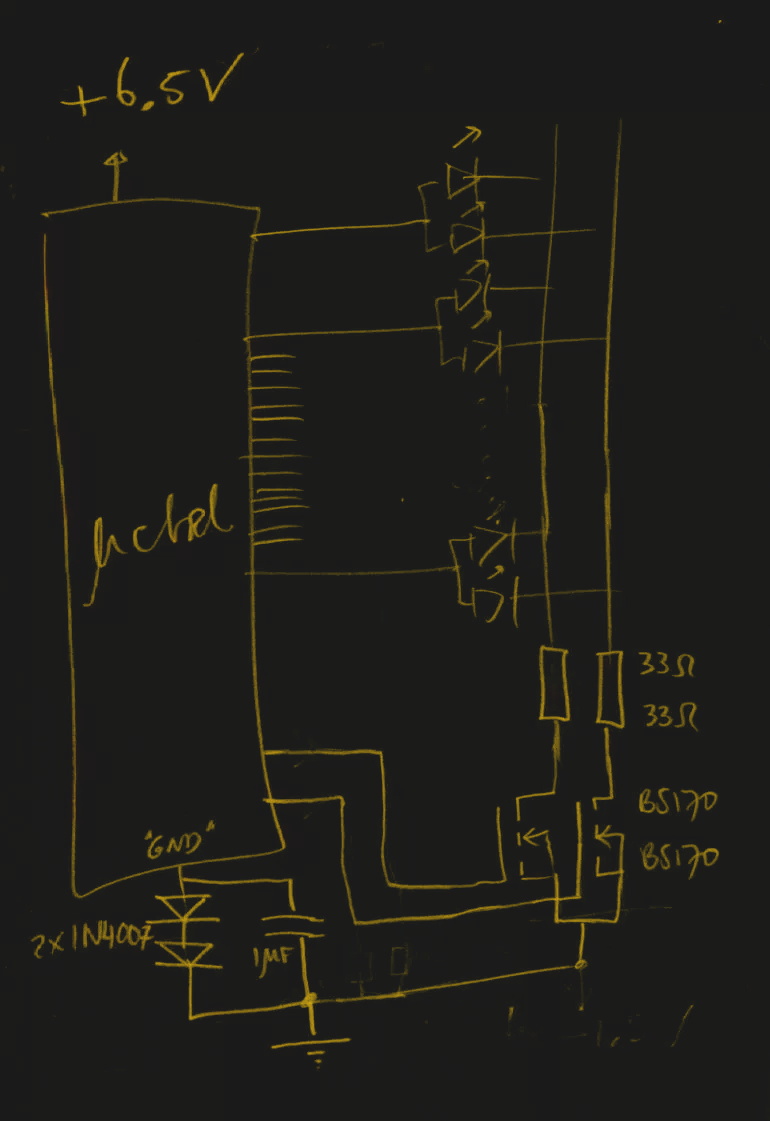
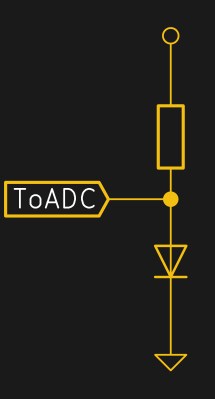
He built her a temperature sensing mug that uses a rather novel way of determining how hot or cold the contents are. Instead of using a thermistor to determine the drink’s temperature, he opted to use a simple diode since it is well known that a diode’s forward voltage varies with temperature. After determining the diode’s voltage range using hot and cold beverages, he hooked it up to the ADC of a PIC12F615 micro controller. The temperature is displayed via 10 LEDs, which are driven through a pair of 8-bit shift registers and buffers since his PIC did not have enough pins to control them on its own.

He had some PCBs made, and after a handful of setbacks got everything put together. He says the mug works pretty well, though the display changes a bit more slowly than he would like. He also mentions that if he builds a second version, he will be sure to select a different PIC that has enough I/O pins to do the job, as well as use a thermistor instead of a simple diode for sensing the temperature.

Continue reading to see a brief demo video [Ben] put together.

Read the rest of this entry »

Blu-ray laser plotter writes on glow-in-the-dark screen

posted Apr 6th 2011 9:30am by
filed under: laser hacks

This laser display is persistent thanks to a glow-in-the-dark screen. [Daniel] built it using a Blu-ray laser diode. As the laser dot traverses the screen, it charges the phosphors in the glow material, which stay charged long enough to show a full image.

The laser head is simple enough, two servo motors allow for X and Y axis control. A Micro Maestro 6-channel USB servo controller from Pololu drives the motors, and switches the diode on and off. This board offers .NET control, which [Daniel] uses to feed the graphics data to the unit. Check out the video demonstration below the fold to see a few different images being plotted. It’s shot using a night-vision camera so that you can really see where the laser dot is on the display. It takes time to charge the glow material so speeding up the plotting process could actually reduce the persistent image quality.

This is yet another project that makes you use those geometry and trigonometry skills.

Read the rest of this entry »


Fixing the Rovio battery charging circuit

posted Jan 7th 2011 9:21am by
filed under: repair hacks, robots hacks

[Chris] was unhappy with the battery performance of his Rovio. It seems that he’s not alone, so he set out to reverse engineer the battery charging circuit to see if there was a fix. Boy is there, what he found is the diode above, apparently installed backwards when compared to the silk screen diode symbol. Now it’s entirely possible that the silk screen is wrong and this was fixed during assembly. We think that’s unlikely because if the closer of the two diodes was supposed to have the same polarity as the one next to it there should have been room to install them both in exactly the same orientation. [Chris] pulled out a soldering iron and changed the diode to match the silk screen. That fixed his problem and he’s now getting better performance than he ever has.

[From our comments section]

Tiny USB business card

posted Oct 29th 2010 8:11am by
filed under: Microcontrollers

[Frank Zhao] put together a USB business card. It’s even got the instructions printed right on the silk screen of the PCB explaining how it should be used. He based the design around an AVR ATtiny85 microcontroller. It runs the V-USB package that handles USB identification and communication protocols. The rest of the hardware is pretty standard, the uC draws power from the 5V USB rail, with a couple of 3.6V Zener diodes to drop the two data lines down to the proper level.

Once plugged in it waits until it detects three caps lock keypresses in a row, then spews a string of its own keypresses that type out [Frank's] contact information in a text editor window (video after the break). It’s not as reusable as the mass storage business card because [Frank] didn’t breakout the pins on controller. But we still enjoy seeing business cards that make you stand out.

This is a great project to tackle with your newly acquired AVR programming skills.

Read the rest of this entry »

Build a cutting laser from an old PC

posted Sep 30th 2010 1:00pm by
filed under: laser hacks

[Drake Anthony] makes building a cutting laser from a PC look easy, and it seems like it actually is. Almost everything you need can be found in a dead desktop unit. The diode is pulled from a DVD writer (16x or faster), with the power supply unit, and heat sinks from the processor and GPU being used as well. You’ll also need a focusing lens (just a few dollars), some thermal glue, an LM317, a resistor, and a pair of protective goggles matching the laser diode’s wavelength.

He fits the diode into the lens, then glues the assembly into a hole drilled through the processor heat sink. A driver is built using the LM317 variable regulator, resistor, power supply, and the GPU heat sink to keep things cool. Check out the video after the break to see the laser cutting tape, burning plastic, and lighting matches. Read the rest of this entry »


Laser mic makes eavesdropping remarkably simple

posted Sep 25th 2010 12:00pm by
filed under: laser hacks

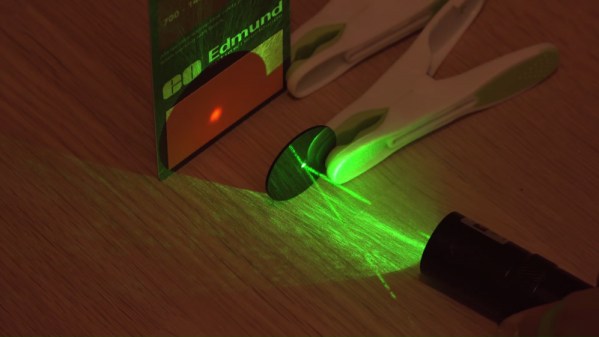
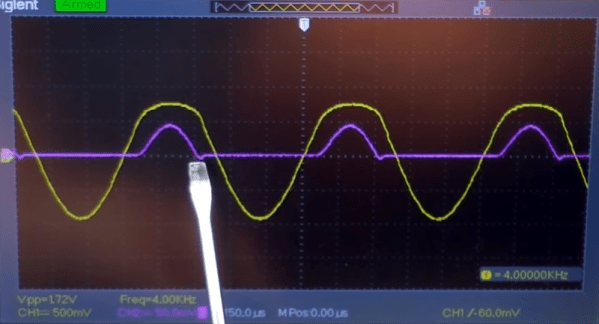
Here’s a surprisly simple way to build yourself a laser-based listening device. It consists of two modules, a transmitter and a receiver. The transmitter is a set of lasers, one is visible red for aiming, and the other is infrared for measuring the vibration of a surface. Point the transmitter at the window of the room you want to listen in on and the laser can be reflected back to the receiver. The receiver module has a phototransistor to pick up the infrared laser light, and an LM386 audio amplifier to generate the audio signal sent to a pair of headphone. The need to be well-aligned which is easy enough using a pair of tripods. Check out the demo after the break.

Looking for something to do with the leftover laser diodes from this project? Try making yourself a laser microscope.

Read the rest of this entry »

1 Watt laser engraver

posted Sep 13th 2010 9:54am by
filed under: cnc hacks, laser hacks

This laser engraver was built using printer parts, a CD-ROM carriage, and some homebrew electronic boards. The laser diode is a 1-Watt model similar to what we saw used as a weak laser cutter back in August. When the width of the material changes the focus of the laser is affected so the diode was mounted on a CD-ROM carriage (in the Z axis) for easy adjustment. The X and Y axes are made using parts from Epson Stylus 800 and Epson Stylus Color II printers. After the break we’ve embedded a video of the machine engraving some wood using EMC2 software on an Ubuntu box. It also boasts the ability to cut paper and some plastic but it can’t compare in power to a CO2-based unit.

Read the rest of this entry »

Building a laser cutter from a weak laser

posted Aug 26th 2010 11:00am by
filed under: laser hacks

We covet laser cutters and this diy model with a 1 Watt IR diode may be well within our price range. Most commercially available laser cutters, and some homemade ones, work in the 20-100 Watt ranges, using a CO2 laser. They have more than enough power to cut right through a lot of materials so how can a 1W diode compare? It seems that the weaker laser is still quite powerful right at its focal length, so moving that point along the Z axis will let you burn away a larger depth of material. The test rig seen above uses optical drive components for the three axes and managed to cut a rectangular piece out of the black plastic from a CD case.

This isn’t [Peter's] first try with CNC lasers. He’s the one that’s be working on an open source selective laser sintering platform.

[Thanks Osgeld and Vesanies]


Hack a Day serves up fresh hacks each day, every day from around the web as well as hacking related news.

Send us your hacks


Hacks

Resources