Half Keyboard, Half Guitar, Totally Radical, the Tabstrummer!

posted Dec 13th 2011 6:01am by
filed under: musical hacks

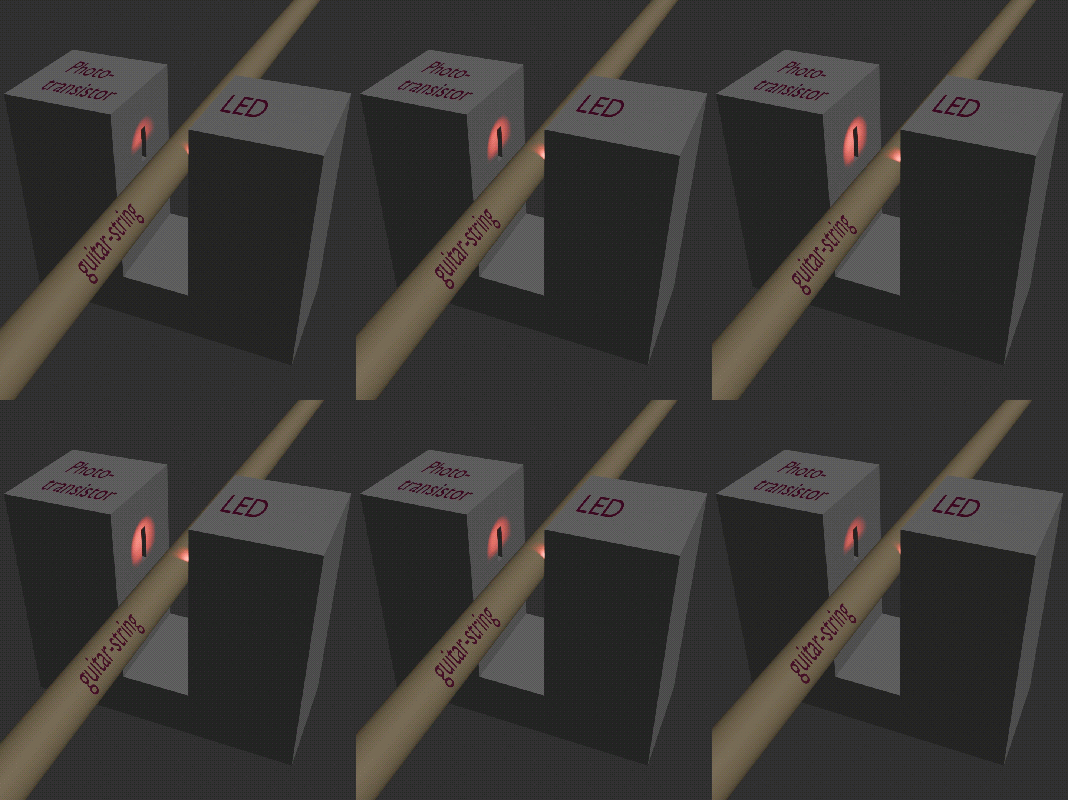
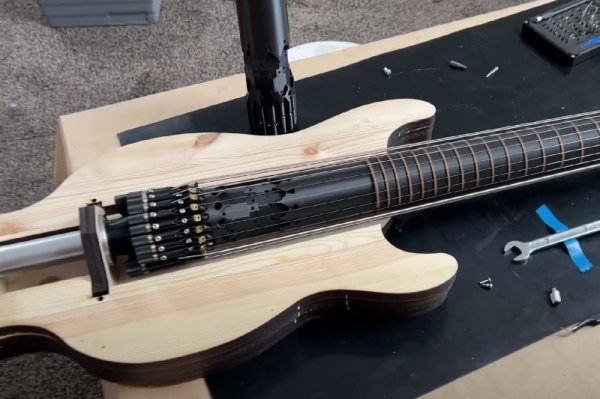
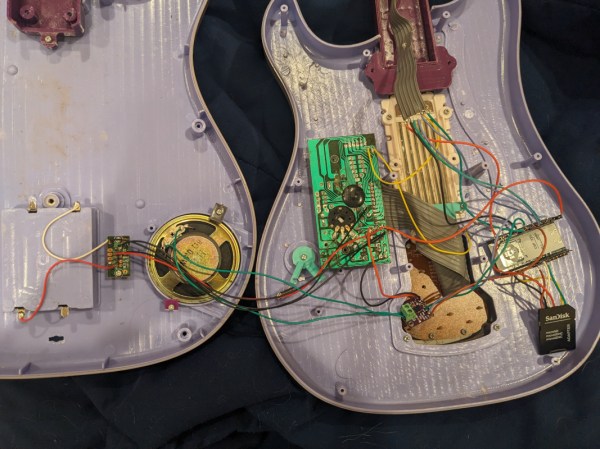
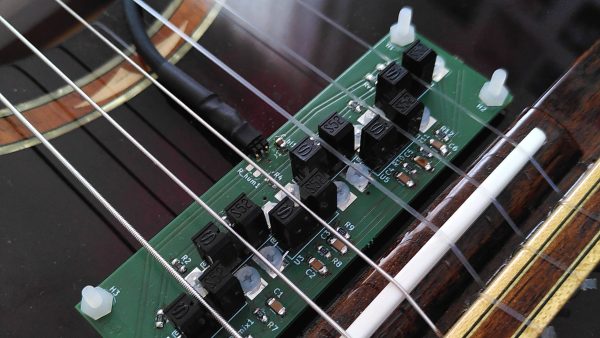
While tablature-based music probably annoys “properly” trained musicians to no end, it has given many musicians and musical-hobbyists their first introduction to the world of guitar. The [Tabstrummer] takes this to a whole new level, allowing chords to be programmed into this instrument and played back. Once pre-programmed chord is set, the “conductor-strings” are strummed to allow the chord to play.

This device is based around an Atmel microcontroller and features a MIDI output as well as an audio-out jack. Besides the interesting electrical hardware, the housing seems to be quite well-built featuring what appears to be an acrylic or polycarbonate body. Although not quite the same thing, possibly some influence was gained from the [Keytar]. It’s heyday may be past, but not forgotten.

Check out the video below for a Christmas-themed jam played on the [Tabstrummer] or check out their video page for several more songs. This “hack” is being considered as a commercial product, so the inventors would love to hear your feedback! Read the rest of this entry »

Fully fretted guitar MIDI controller

posted Sep 29th 2011 2:01pm by
filed under: musical hacks

[Andy] came across this guitar midi controller project from way back and decided to send us a tip about it. The English version, translated from the original Russian, is easy to follow and documents the build process from first prototypes to the version you see above. It can connect via a standard MIDI cable and then be used to control anything you want. The only thing missing is the ability to transmit velocity data, but that’s certainly not a deal breaker.

The device has two sensory parts. The first is a set of pickups that can be seen underneath the strings near the bridge. These work like standard magnetic pickups but instead of extrapolating fret data from the pitch picked up on the string, there is a second sensor mechanism for every fret of each string. Since the strings are made of metal, it’s possible to detect which fret is depressed based on continuity sensing. Of course this means you need a conductor between every fret, and that’s why the fingerboard has been replaced with one made of printed circuit boards. All of this data is gathered, then sent to the MIDI device via a PIC 16F74 microcontroller.

If this leaves you wanting for more guitar hacks, don’t miss this one that adds addressable LEDs in between each fret.


[Dino's] JFET guitar preamp with piezo pickup

posted Sep 12th 2011 12:01pm by
filed under: musical hacks

This week, with a little help from a Roomba, [Dino] built a guitar pickup and preamp that sounds marvelous. A pickup takes vibrations from the guitar and turns them into an electrical signal which can then be amplified and broadcast. He grabbed a long-dead Roomba which has slowly but surely been donating its organs for his weekly projects. After plucking out a piezo element he grabbed a bag of Junction gate Field-Effect Transistors (JFET) and built a preamp circuit around one of them.

JFETs operate in much the same way as MOSFETs (which we took a look at last week). [Dino's] design adds a few resistors and capacitors to tune the gain and decouple the circuit from the input and power rails. He epoxied the piezo element inside the guitar and connected leads between it and a jack mounted in the body. As always, he does an excellent job of explaining the concepts behind the design and outlining the build techniques that he used. We’ve embedded his video after the break.

Read the rest of this entry »

Guitar pickup winding workstation

posted Aug 30th 2011 8:07am by
filed under: musical hacks

After a bit of inspiration, [Pete] decided to build a solid body electric guitar for himself. Instead of assembling a conglomeration of off-the-shelf parts, he plans on building just about everything from scratch. This includes the guitar pickups, so he built himself a pickup winder that has measures RPM, ETA until done, and auto stop for when the pickup is complete.

Electric guitar pickups are simple devices – just a magnet for each string wrapped in thousands of turns of wire about as thin as a human hair. [Pete] began his build with a cheap sewing machine and added a tachometer and pickup mount. As an added bonus, [Pete] threw in an ohmmeter to measure the coil resistance and a Gauss meter to measure the magnetic flux and polarity of the pole pieces. It’s a very nice build that’s designed to be as functional as commercial pickup winders.

[Pete] was originally inspired to build a pickup winder by the Les Paul Google doodle, and he plans on continuing Les Paul’s tradition of guitar innovation by building his own solid body guitar. The wood has been cut already, and we can’t wait to see the final product.

Check out a video of [Pete]‘s coil winder in action after the break.

Read the rest of this entry »

Hackaday Links: July 24, 2011

posted Jul 24th 2011 12:30pm by
filed under: Hackaday links

Plasma speakers

Apparently if you run AC and DC currents through a welding torch flame you can use the resulting plasma as a loudspeaker. [Thanks Cody]

Power metering

The Google Power Meter API is no longer in development but that didn’t stop [Pyrofer] from finishing his metering hardware. It uses a reflectance sensor to read the meter instead of using clamp-based current sensing.

Music videos from inside the instrument

Filming from inside of a guitar creates the camera effect seen above which looks like the waveform you’d see on an oscilloscope. [Thanks Philleb]

Hidden messages in audio files

GhostCoder lets you encrypt and hide audio files within other audio files. The thought is, you can piggyback your own data into Torrents that are circling the interwebs.

2×4 Chair

If you’re skilled with a Skill saw you can make a chair out of one 2 by 4. You can see the pattern you’ll have to cut out from the board in the image above, wow!


Guitar becomes an improved color organ

posted Jul 24th 2011 10:22am by
filed under: digital audio hacks, musical hacks

[Charles] wanted to put some LEDs in his guitar. He also wanted individual notes to output certain colors, but he couldn’t find any projects with tone-based algorithms to convert sound into colors. After about a year of work, his ColorChord guitar was born.

Unlike every other color organ build we’ve seen, the color of a note does not relate to the absolute pitch of the note. Instead, the colors are mapped within a musical key. A I chord will always be Yellow, a IV chord will always be purple, and a V chord will always be blue. Playing in the key of C will have the LEDs output yellow, purple, and blue for a C, F and G chord, respectively.

Read the rest of this entry »

Creating music from GPU noise

posted Jul 24th 2011 7:21am by
filed under: digital audio hacks

Yep, that’s a picture of a Laptop rocking out on an electric guitar. In what can only be described as a truly bizarre hack [CNLohr] discovered that the RF noise from the computer can be used to play music through the guitar’s pickup.

Check out the clip after the break to hear an annoying, but very discernible rendition of Jingle Bells. Once [CNLohr] stumbled onto the fact that changes in what the graphic processing unit is doing was affecting the pitch detected by the pickup he started writing some code. Now he’s got a program that automatically calculates the size of the window, and produces a white square on a black background to dial in the GPU at the right frequencies.

He mentions in the notes accompanying his video that he had to turn off Vsync to get this to work right. We don’t understand why but we’d love to hear what you think in the comments.

Read the rest of this entry »

Million volt guitar rocks the house…for science!

posted Jun 6th 2011 9:01am by
filed under: arduino hacks, musical hacks

science_brothers_tesla_hero

[Bill Porter] and his friend [Dan Flisek] work together to put on a science-related educational stage show called “Science Brothers”, in which the pair try to convince school children that their field of expertise is the cooler science. While the two are competitive on stage, the main goal of the program is to get kids interested in science, no matter what the specialty.

The pair currently finance the project out of pocket, so they are always looking for ways to make things interesting while also keeping costs in check. With that in mind [Bill] came up with an awesome way to show off the Tesla coil he built a while back. His most recent educational creation is a little something he calls “Tesla Hero”.

Since he already had a solid state Tesla coil hanging around, he dug up a PS2 Guitar Hero controller and got busy getting the two acquainted. The guitar connects to the coil via a fiber optic isolator board, playing one of five notes as he strums along. A series of Arduino-driven LED strips adorn the guitar, flashing various colors while he plays, as you can see in the video below.

It’s quite a cool project, and we’re sure that his audience will be impressed!

Stick around to see a video of  Tesla Hero in action, and if you’re interested in learning more about the Science Brothers, be sure to check them out here.

Read the rest of this entry »


Hack a Day serves up fresh hacks each day, every day from around the web as well as hacking related news.

Send us your hacks


Hacks

Resources