posted Feb 10th 2012 11:01am by
Mike Szczys
filed under:
misc hacks

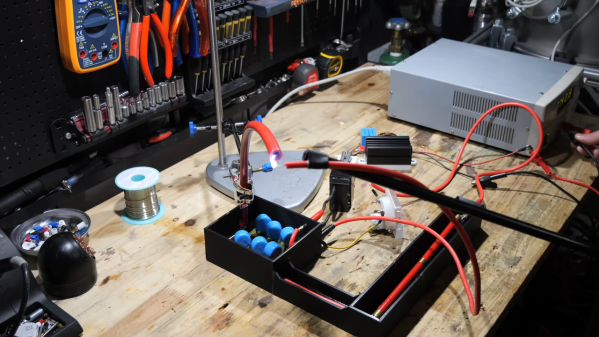
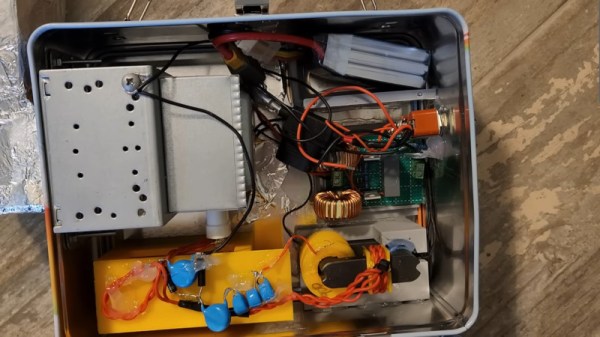
If you’ve already dipped your toes into high-voltage power supply pool you may be thirsty for a bit more knowledge. Here’s a neat illustration of how to build a voltage multiplier that can output a positive or negative supply. It is based on a design known as the Cockroft-Walton Multiplier. It’s the add-on housed in the plastic box seen in the image above. It uses diodes and capacitors in an orientation very common for generating high voltages. In fact, the same thing can be found in that high-voltage bulletin board. The place this differs is when it comes to connecting the multiplier to the PSU.
If you look closely you can see one red and one black banana plug jack poking out the end of the plastic container. There is also a pair of these on the other end. The multiplier has been designed so that reconfiguring the inputs and outputs changes how it works. Each jack has been labeled with one possible input and one output. Choose the desired output (DC+ or DC-) and then follow the labels for the rest of the connections.
What can you do with this setup? Check out the clip after the break that shows it powering a lifter.
Read the rest of this entry »
posted Jan 1st 2012 4:43pm by
Brian Benchoff
filed under:
hardware,
Medical hacks

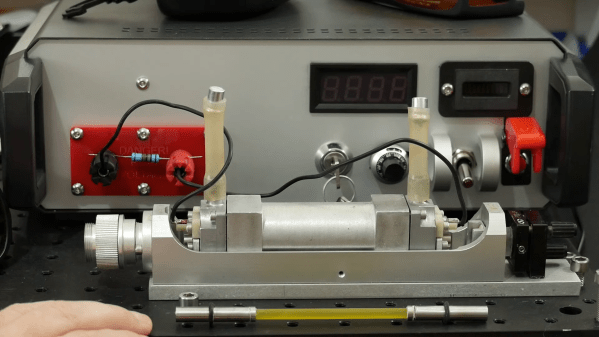
[Grenadier] built his very own x-ray machine. He’s no stranger to high voltage – we’ve seen his Jacob’s Ladders and Marx generators. Surely he can handle himself with high voltage and dangerous equipment. With this portable x-ray machine, [Grenadier] has begun overloading Geiger counters. We’re just happy he knows what he’s doing.
The key component of [Grenadier]‘s portable x-ray machine is the Coolidge tube, a simple vacuum tube that produces x-rays with the help of 75 kilovolts of power. The finished build looks awesome. Two meters display the milliamps and kilovolts going to the x-ray tube, and a trio of nixies display the exposure time.
Even though [Grenadier] doesn’t have x-ray film, he can see through things with a scintillation screen that fluoresces when exposed to ionizing radiation. There are two pictures of the x-ray in action – one showing the inside of a pen and the guts of a hard drive (as shown in the title pic).
The output of the x-ray was measured with a Geiger counter. [Grenadier] was able to get a hit every second or so at 50 yards, and very loud white noise at 1 foot. Check out the video of [Grenadier]‘s Buildlounge laser cutter contest submission after the break.
via Buildlounge
Read the rest of this entry »
posted Dec 10th 2011 10:12am by
Mike Szczys
filed under:
misc hacks,
musical hacks

We love a good Tesla coil music performance, but have never really considered building our own. After reading [TheHomebrewGuru's] guide to musical Tesla coils we’re still not considering it. Whether or not you’re going to undertake the project, his massive writeup is worth a look.
The tutorial begins at the beginning, with a bit of background on these devices, including what they are, where they came from, and the electrical theory behind them. From there it’s on to the build. This isn’t a go-out-and-buy it type of project. You’re going to need some ingenuity to hunt down parts that will work, and will work with each other.
The image above shows a partially built device, using sheet metal ductwork covered in foil tape as the torroid at the top. The column is wrapped in wire, forming the secondary coil, and the wooden base is ready for the installation of the primary coil. Electronics will be housed between the two wood discs of the base, with a TI Launchpad board driving the music part of the hack.
There isn’t a good demo video of this playing music. But you can get the idea if you look back at the head-mounted tesla coil which did a great job of pumping out the tunes.
posted Nov 18th 2011 7:01am by
Mike Nathan
filed under:
misc hacks

We can hear the commercial now…
“Reeeeeeal men of geniuuuuuuus! Here’s to you Mr. no-fear, singing Tesla coil on your hat wearing guy…”
Call him a genius or call him crazy – all we know is that [Tyler’s] Tesla coil hat is awesome! Even though it’s the middle of November, we couldn’t pass up this Halloween costume.
[Tyler’s] creation essentially boiled down to taking a standard dual resonant solid state Tesla coil and shrinking it down to a reasonable size for mounting on his skull. The mini Tesla features a pretty compact boost core which worked reasonably well, at least for a little while. He says that the boost never truly worked properly and needs a redesign, which is something he’ll tackle when he gets some free time.
Boost issues or not, we think that the video below speaks for itself. The hat is certainly an attention getter, and we think it’s great – even if wearing a Tesla coil on your head is not necessarily the safest thing to do.
Read the rest of this entry »
posted Nov 10th 2011 1:01pm by
Mike Szczys
filed under:
misc hacks

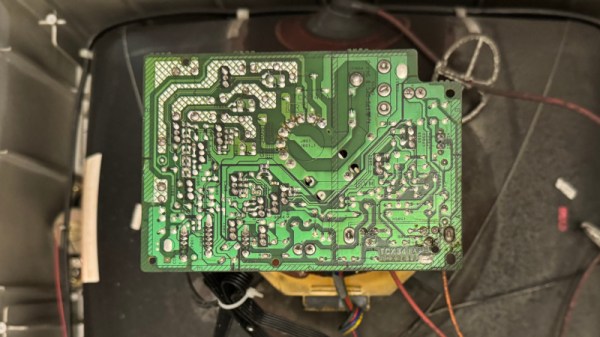
Electrical Engineers don’t need push pins. That’s because they know how to control electrons! [Sven] put his knowledge of these subatomic particles to use when building his high voltage bulletin board. It uses a set of vertically strung wires to keep paper pinned against the board. The wires have high voltage at low current travelling through them. They’re in front of the board, but not touching it, and the board is serving as a ground plane. In this way an electrostatic charge pushes (or should that be pulls?) against the paper to keep each sheet right where he places it.
In the video after the break [Sven] gives us a tour of the hardware at work here. It starts with a 12V psu which feeds a buck converter. The regulated feed is patched into a high voltage supply which was designed as a CCFL driver. Finally, a voltage doubler is used to reach the final voltage, measuring about 20 kV per wire.
Don’t worry, [Sven] says the bare wire is “almost completely safe” because of the low current being conducted.
Read the rest of this entry »
posted Nov 3rd 2011 8:01am by
Mike Nathan
filed under:
classic hacks,
Holiday Hacks


[Matt] entered himself in a pumpkin carving contest this year, even despite the fact that his artistic skills were a bit…lacking. He knew that he had very little chance of winning the contest unless he had a great gimmick to make his creation stand out, so he started brainstorming.
[Matt] figured that since his design would have to be somewhat simple, he needed something eye catching that he could add to the pumpkin after it went under the knife. Like a bolt of lightning, inspiration struck, and he set off to fetch an ignition transformer along with some wire coat hanger.
He built a makeshift Jacob’s ladder that would fit perfectly inside his hollowed out pumpkin, and proceeded to carve the pumpkin with the “Caution, risk of electric shock” logo, familiar to most anyone that works with electronics. You can see the final result in the video below, which we think looks pretty neat. If he didn’t end up winning the contest, we’d be shocked!
Read the rest of this entry »
posted Aug 30th 2011 12:08pm by
Kevin Dady
filed under:
HackIt,
misc hacks

Reader [Xellers] sent in his newest instructable: DIY Electron Accelerator: A Cathode Ray Tube in a Wine Bottle. While not exactly what you might think of a cathode ray tube, the basics are in place. A wine bottle is used as a vacuum chamber and a 9kv neon transformer is attached to a stopped in the top. A cathode is placed mid way, the air is sucked out with a pump, and high voltage is applied.
Naturally as more air gets pumped out the electric arc intensifies into a pretty solid plasma filling the space between the two contacts. While mixing drilled glass with a vacuum and high voltage sounds like an awesome hospital story [Xellers] does cover some safety points including the possibility of this thing putting out some nasty waves.
One thing that is not mentioned (that I saw) is this is very similar to how florescent light tubes work and without florescent material lining the chamber it will spit out quite a bit of UV light (notice germicidal UV lights are clear). So you will want to watch your eyes!
Join us after the break for a quick video.
Read the rest of this entry »
posted Aug 28th 2011 5:00am by
Brian Benchoff
filed under:
hardware


Over the last two weeks, we’ve seen some pretty crazy and potentially dangerous stuff, like a stun glove and modern day alchemy. For our high voltage theme finale, we couldn’t pass up [Photonicinduction]‘s YouTube channel.
Best known for his self-destructing washing machine (the source of this animated .gif), [Photonicinduction] is also the brainchild behind the hair dryer flame thrower and his homemade fifty thousand amp transformer.
While we do like his Not Safe For Work ammeter (yes, it really is NSFW), some of [Photonicinduction]‘s videos – charging a car battery in 4 minutes, making a kettle boil without a heater element, pressurizing coconuts to over 200 psi, and exploding rabbits – are hilariously dangerous and should not be attempted by anyone.
We need to say you should not attempt to emulate [Photonicinduction]‘s hijinks under any circumstances. Cleaning up a puddle of burning gasoline with a vacuum cleaner may sound like fun, but copying [Photonicinduction] will eventually get you killed. This man must know his stuff, because we’re honestly shocked he hasn’t exploded yet. The best way to enjoy three hundred thousand volts is probably grabbing a coffee and watching [Photonicinduction]‘s YouTube channel.