posted Feb 9th 2012 8:58am by
Mike Szczys
filed under:
security hacks

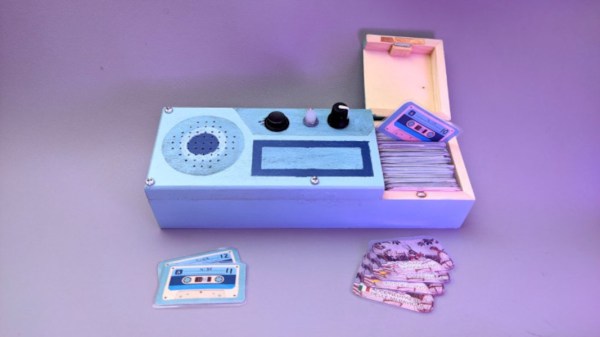
[Navic] added a slew of abilities to his RFID reader. It’s now a full-featured RFID reader and smart card writer with extras. When we looked at it last time the unit was just an RFID and smart card reader in a project enclosure. You could see the RFID code of a tag displayed on the LCD screen, but there wasn’t a lot more to it than that.
The upgrade uses the same project enclosure but he’s added four buttons below the display. These allow him to access the different features that he’s implemented. The first one, which is shown in the video after the break, allows him to store up to six tags in the EEPROM of the Basic Stamp which drives the unit. He can dump these tag codes to a smart card (pictured above), but also has the option of interfacing with a PC to read from and write to that card.
We don’t think you can directly write RFID tags with the device, but we could be wrong.
Read the rest of this entry »
posted Jan 4th 2012 7:20am by
Mike Nathan
filed under:
arduino hacks,
cooking hacks

[Andrew Robinson] and his co-workers are lucky enough to have a Keurig coffee maker in their office, though they have a hard time keeping track of who owes what to the community coffee fund. Since K-Cups are more expensive than bulk coffee, [Andrew] decided that they needed a better way to log everyone’s drinking habits in order to know who needs to cough up the most cash at the end of the month.
He started by tearing down the Keurig B40, making note of the various PCBs inside while identifying the best way to go about hacking the device. The coffee maker is controlled by a PIC, and rather than try to re-engineer things from the bottom up, he left the core of the machine intact and focused on the control panel instead.
He disconnected all of the unit’s buttons from the control board, routing them through an Arduino before reconnecting them to the machine. This essentially rendered the machine inoperable unless triggered by the Arduino, giving [Andrew] control over the brewing process. He wired in an RFID reader from SparkFun, then got busy coding his security/inventory system. Now, when someone wants coffee, they merely need to swipe their office access card over the machine, which enables the use of its control panel.
As you can see in the video below the system seems to work well. If we were to offer some constructive criticism, we would suggest ditching the laptop and rolling the RFID reading/verification into the Arduino instead – other than that, we think it’s great.
Read the rest of this entry »
posted Dec 14th 2011 4:01pm by
Mike Szczys
filed under:
home hacks

[Flowolf] added an auto-locking RFID entry system to his front door. He used our favorite fabrication system, acrylic and threaded rod (we also like to throw in aluminum angle bracket from time to time). The support structure mounts underneath the escutcheon plate for the lockset, keeping the main acrylic sheet flat against the door.
An RFID reader and Arduino run the system, with a button inside to unlock the door. But if power were to fail, you will still be able to get in or out manually. When you are using the electronic system, a stepper motor connected to the geared lock knob by a chain is what grants access, then revokes it again five seconds later. The wire going up out of the this image is for a switch that lets the unit sense when the door is closed.
As shown in the video after the break, you can turn the auto-lock feature off. But we’d like to see an emergency entry feature, like a knock-based lock, because eventually you will leave without your keys!
Read the rest of this entry »
posted Nov 19th 2011 1:27pm by
Mike Nathan
filed under:
misc hacks

[Aaron] was looking for a cheap RFID reader that had some easy to follow documentation and a standardized interface. Most everything he saw was pretty expensive, so he decided to buy a cheap $10 reader from eBay to see how easy it would be to work with.
The reader came with very little documentation, but [Aaron] did know that the device identifies itself as a USB keyboard, outputting scan tag data into a text editor. That functionality wasn’t incredibly useful, so he took it apart to see if he could interface with it in some other manner. Exposing the PCB revealed an unknown IC for which he could find no documentation, but the board did include some breakout pins, so [Aaron] started by probing those for data.
He tried reading the data in both a terminal program and with a logic analyzer, but nothing seemed to make a whole lot of sense. He turned the sampling rate of the sniffer down, and things started looking a little better. After comparing the data from the sniffer with known tag codes, he noticed that each digit had an offset of 39 applied, so he whipped up a bit of code to correct the numbers.
[Aaron] did a good amount of legwork to get usable data from the reader, but at a cost of $10 it can’t be beat. We certainly know what we’re going to be hunting for on eBay this afternoon…
posted Nov 10th 2011 10:01am by
Mike Szczys
filed under:
Hackerspaces,
security hacks

It seems like every Hackerspace should have some type of kludged together access system on their entry door. [Vasilis] wrote in to share the system called Jarvis that controls access to P-Space, a Hackerspace in Patras, Greece. It’s an RFID-based system that offers a few nice features.
They already have a server running the webpage, so basing their entry system off of a computer was an easy option. You can get in one of two ways; by presenting your valid RFID tag to a reader at the front door, or by ringing the bell and having a member inside press the Big Button of Doom (BBoD) which is a wireless controller.
The BBoD has an Xbee module inside which lets it send an unlock command back to the computer. The remote is powered by two AA batteries, and since it’s never on unless the button is pressed the team estimates these batteries should last around one year.
There’s even a feedback system. The computer posts the last few events to the webpage. So you can go online and see when the BBoD was used, or who’s tag has recently unlocked the entrance to tell if your friends are there.
posted Nov 10th 2011 8:14am by
Brian Benchoff
filed under:
security hacks

Locks are always temporary hindrances. After deciding to open the RFID-secured lock in his department, [Tixlegeek] built a device to read and spoof RFID tags (French, Google translate here).
The system is built around an ATMega32 microcontroller with a 16×2 LCD display. A commercial RFID reader module takes care of all the sniffing/cloning duties, and a small modulation circuit handles pumping those bits over to a lock. Right now, the spoofer can only handle reading and spoofing 125kHz RFID tags with no encryption or authorization. A tag that’s more complex than the duct tape RFID tag doesn’t work.
[Tixlegeek]‘s little project does open up a few interesting avenues of exploring stuff that’s most certainly illegal. A smaller version of the project could be emplaced near a door or other RFID reader and left to crack a lock with a 32+62 bit password at 125 kilohertz. It wouldn’t be the fastest safecracker in the business, but it would work automatically as long as there is power.
If you’ve got any other ideas on what [Tixlegeek]‘s RFID spoofer could do, leave a note in the comments.
posted Nov 3rd 2011 3:01pm by
Mike Nathan
filed under:
arduino hacks,
beer hacks,
Hackerspaces

The crew at the Milwaukee Hackerspace are pretty serious about their beer. They used to have a fridge filled with cans, available to all at the hackerspace, but they decided to beef things up and create a secured beer dispensing system.
Like many others we have seen, their kegerator is built into an old refrigerator, complete with a tap built into the door. To ensure that interlopers are kept from their precious brew, they have secured the refrigerator using an Arduino and RFID tags to grant access. They use the same RFID key fobs members carry to gain access to the space for tracking beer consumption, unlocking the tap whenever a valid tag is swiped past the sensor.
They are still in the midst of tweaking and revising the system, but it looks good so far. It’s a great way to keep uninvited guests from their beer stash, while giving them a way to track consumption at the same time. We’re looking forward to seeing more details and code once things are completely wrapped up.
[via BuildLounge]
posted Oct 17th 2011 11:01am by
Mike Szczys
filed under:
arduino hacks,
home hacks

[Alex] wrote in to let us know he just completed a pretty major upgrade to his PopCARD RFID vending machine system. You may remember that earlier this year he added an Arduino based RFID reader to a soda machine so that thirsty patrons could pay with plastic instead of cold hard cash. That system worked, but at the beginning of the video after the break [Alex] goes over some of its flaws. There was a button to add cash from the card to the machine in $1 increments, rather than the system just knowing how much to charge you. Also, if you accidentally selected something that was out of stock you were out of luck and were charged anyway.
The new system does away with the button, and knows what product is sold out. The control hardware was upgraded to an Arduino mega to gain extra I/O pins. The device now sits in between the machine’s buttons and its own controller. When cash is used, the Arduino sits passively and lets the machine do its thing. But when a card is scanned, it takes over control of the buttons, sensing your selection, then simulating coin and button presses to vend accordingly. The new setup also uses an Ethernet shield which allows [Alex] to tell what items are running low without being at the machine itself.
Read the rest of this entry »