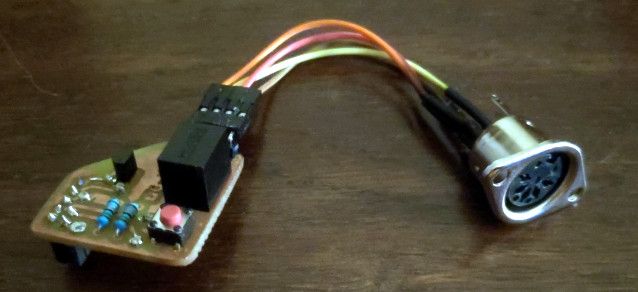
[Spikenzie] is at it again. This time he’s posted a nice USB to serial converter. He points out that you can buy a USB to serial adapter pretty cheaply, but sometimes you want this functionality built into your project enough to justify the greater cost. In those cases where you want to integrate it, this is an elegant solution. This design was made to be fairly compact and still usable on a breadboard. As usual, you can download the files from his website. If his work looks familiar, it’s because we’ve covered his work severaltimes before.
Did you forget your hardware-based password and now you’re locked out? If it’s an IBM ThinkPad you may be in luck but it involves a bit more than just removing the backup battery. SoDoItYourself has an article detailing the retrieval of password data from an EEPROM.
The process is a fun one. Disassemble your laptop. Build a serial interface and solder it to the EEPROM chip where the password is stored. Connect this interface to a second computer and use it to dump the data into a file. Download a special program to decipher the dump file and dig through the hex code looking for something that resembles the password. Reassemble your laptop and hope that it worked.
We know that most people won’t be in a position to need a ThinkPad administrator password, but there must be other situations in which reading data off of an EEPROM comes in handy. What have you used this method for?
Back in 2005, a member of a French robotics team named [Laurent] wrote a wonderful how-to that we somehow missed on using the Game Boy Camera as a vision device for a robot. The images above are actual shots from his project. The Game Boy Camera features a stunning 128×123 pixel resolution in a gorgeous 4 color gray-scale palette. Possibly the most attractive feature of this hack is that it is still possible to get a hold of these cameras for under ten dollars on ebay.
He connected the camera sensor to an Atmel AT90S4433 using a combination of digital and analog signals, and then used the microcontroller to echo the data back to his PC. His write up includes schematics for wiring up the sensor/microcontroller, the datasheet for the sensor, his C code for the whole project, and an easy to read pin out of the GBC connector. Although his project simply offloaded the image to a computer, it would be entirely possible to have the microcontroller respond to the image or simply just log and store it. It would also be just as easy to replace his Atmel chip with yourownfavorite microcontroller, as long as it has a couple Digital I/O ports and at least one Analog port (or an external analog to digital converter).
UPDATE: Good catch r4v5, it would require an ADC, not a DAC.
The folks at Openschemes.com have written up an article on how to convert a USB serial port adapter to a low voltage serial interface for interfacing with microcontrollers. Though you can always just buy one, this is a fairly quick and cheap solution, especially if you are in a pinch or don’t have access to a retailer. The specific models you should watch for, are the ones with two chips, a microcontroller and a line translater.They go through the process of finding exactly where to patch in to add an extra interface. It only takes a couple wires and you are ready to go.
Not only can you use this as your serial connection to another microcontroller, but you can actually take control of the one on the board itself. If you load it with the drivers from TI, you gain access to the flash memory and can do whatever you want. They don’t go into much detail here though, stating that they’ll write another article on that.
We thought this little bugger looked familiar so we went digging through our archives. Sure enough, we found this system in action back in January of 2008.
Today the parallel printer port is on the brink of extinction (and good riddance, some would say). Largely rendered obsolete by USB, few (if any) new peripherals even include a parallel connector, and today’s shrinking computers — nettops, netbooks, media center PCs — wouldn’t have space for it anyway. That’s great for tidy desks, but not so good if you enjoyed the dirt-cheap hacks that the legacy parallel port made possible.
Fear not, for there’s a viable USB alternative that can resurrect many of these classic hacks! And if you’ve done much work with Arduino, there’s a good chance it’s already lurking in your parts drawer.
We’ve had a lot of requests in the comments for more Arduino centered posts so we were happy when [Njay] told us about his EDuino board. This is a minimal Arduino clone that has a crystal and its capacitors, a pull-up resistor and button on the reset pin, and a detachable serial programming connection. He also has a breadboard-friendly version seen above with all the interface pins on one side of the board. This is certainly a useful project and we’re glad to see the board files available for download. This does get us thinking… is this an Arduino, or is it an AVR ATmega168 breakoutboard that happens to use the Arduino boot loader and programming language?
This is the Illuminato X Machina, a “cellular” style computing system. Each unit is a fully functioning computer with its own processor, storage and communications. You can watch above as a change in the operating software is propagated across the grid. You can see the LEDs in the video going nuts, there are actually LEDs on the sides too. [Justin] described it to us as a personal fireworks show on your desk. This system is fully open with the schematics and source code available on their site. You might recognize these guys too, we covered their Open Source GameBoy.
[Vince Briel] has created an embedded device based on the Parallax Propeller chip that acts as a serial terminal. It takes input from a standard PS/2 keyboard and outputs color VGA. It also has a second serial port to connect to a PC for debugging or programming. He is selling kits and has the schematics available. The board has a lot of hacking potential and it could easily be made into a video game or a Wikipedia browser.
Update, Saturday July 4th, 2009: All preorders are closed.
We’re excited to announce our partnership with the folks at Seeed Studio (home of the excellent Seeeduino) to put the Bus Pirate v2go into production! The preorder period ends July 3rd. The price is $30 including worldwide shipping. The board pictured above is a hand soldered prototype, but the ones sold by Seeed are completely factory assembled.
This is the first officially produced piece of Hack a Day hardware. Depending on its success, we’ll be able to put many future designs into production. Read more about the Bus Pirate in our latest How-to. Thank you for your support!
***Update, Monday June 29, 2009: Wow, your support has been overwhelming! Thank you! There have been more orders for the Bus Pirate than we ever imagined. As of this update, there’s a few (12) Bus Pirates left in the Seeed preorder. After that, we’ve exhausted the supply of PIC24FJ64GA002s available in Shenzhen. If you’ve already placed your order nothing changes, the manufacturing process has already begun and your Bus Pirate will ship ASAP.
After the first preorder is filled, Seeed will start a new preorder. The second preorder will be delayed until more PIC24FJ64GA002s are delivered, about 4 to 6 weeks. This order should ship about 6 to 8 weeks after July 3, 2009, but we’ll try our best to get it out sooner. Thank you again for your support!
[Synoptic Labs] stumbled upon an RGB light strip with individually-controllable LEDs. The strip uses 5 volts and is controlled by an HL1606. Because the strips are hard to find, this chip is mostly undocumented and he had trouble driving the strip. He was unable to get it working until he met with [John Cohn], who had previously reverse-engineered the serial protocol. Working together, they released a library for the Arduino to drive the strip. So far, the library only supports fading each LED, the only known functionality. If more strips like these were available, constructing LED matrices would be much easier. Embedded below is a video of the strip fading through the rainbow.