
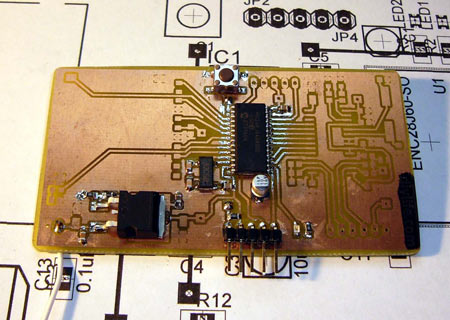
How-To: Web Server On A Business Card (Part 1)

For years, Microchip PIC microcontrollers dominated; PIC16F84 hacks and projects are everywhere. The 8-bit 16F and 18F lines are supported by several coding environments and easy-to-build serial port programmers. Microchip’s 16-bit PIC24F is cheaper, faster, and easier to work with, but largely absent from hacks and projects.

We recently used a Microchip PIC24F microcontroller in a mini web server project, but didn’t find many introductory references to link to. In this article we’ll cover some PIC 24F basics: support circuitry and programming options. We’ll also talk about our favorite features, and how we figured them out. Our next article will outline a web server on a business card based on the PIC 24F.

Continue reading “How-To: Web Server On A Business Card (Part 1)”

Crabfu Challenge Winners Announced

The Trossen Robotics Blog has announced the winners of the “Crabfu challenge”. The challenge, issued by [Crabfu] was to make a robot that was full of character. It didn’t have to have a purpose or be autonomous, it just had to be full of character.

The first place winner, pictured above, won us over when he “blinked” a few moments into his video. Strange how something so simple can add so much life. Continue reading “Crabfu Challenge Winners Announced”

Archos 5th Generation Hacked, Bigger Drive Possible

Over at the ArchosFans.com forums, [grond] has posted some screenshots of his cracked archos 5th generation. Using a custom bootloader, they’ve unlocked the ability to swap hard disks as well as some hidden plugins. The plugins seem to be used mainly for dev tools, like core dumps and screenshots, but this opens the door to possible future homebrewed plugins.

[via Engadget]

OCZ Neural Impulse Actuator Teardown

m8ta fun did an extensive teardown of OCZ’s Neural Impulse Actuator (NIA). OCZ’s computer/mind interface is actually a fairly straight forward design. An analog front-end cleans and amplifies the ‘neural’ signal with a few op-amps before feeding it to a 24 bit analog to digital converter (ADC). A USB enabled PIC microcontroller reads the 24bit parallel ADC output through a common 7400 series parallel to serial adapter IC. The device has an ICSP programing header (top right), though it’s not yet clear if the PIC can be read or written.

[Thanks, joeyo]

Backup DVD Burning Robot

[Aaron Shephard] at mini-itx.com just finished a backup DVD burning robot based on an EPIA M10000 Mini-ITX motherboard and scavenged parts. A Perl script interacts with stepper motors, LEDs, and sensors through the parallel port on the motherboard. The robot inserts DVDs for burning, flips them for labeling, and stacks completed discs in a pile. Coasters are rejected to a ‘penalty box’ for easy disposal.

We’ve also covered some other optical disc duplicators in the past.

[thanks maxthereal]

Control Your Camera Remotely With A DS

Using a custom built cable connected to the lower GBA slot and a copy of Canon’s SDK, [Steve Chapman] has come up with a very clever way of taking pictures remotely with a Nintendo DS Lite.

Currently the software supports bracket shooting as well as bulb mode. [Steve] points out that he is currently testing an audio based trigger system using the mic built into the DS and the software is still a work in progress.

While the weight saving benefits of using a DS instead of a notebook are obvious, there are things you do give up going this route. Traditionally, when you tether a camera to a computer the photos are saved directly to the computer where you can view the image on a much larger monitor. With the DS, it seems all you can do is remotely trigger the camera. Given the size and resolution of the screens maybe that’s all it can do.

[via Boing Boing Gadgets]

Old School High Voltage Capacitance


What would MacGyver do if he needed a high voltage capacitor but only had some foil, tape, water, salt, a nail and a plastic jug?  He would build a salt water Leyden jar, that’s what.  The Leyden jar is a very simple capacitor. Invented in 1745, it has been integral to many scientific experiments. Check the wikipedia entry to learn more about the history.

This specific type is quite easy to make. It uses a salt water interior instead of foil on the inside and outside. That means you could slap one of these together in a few minutes to impress your friends and/or electrocute yourself accidentally.  Please be careful as this is high voltage.









