Trick Mouse Keeps The Screen Saver At Bay

mouse_wiggler

[Jerry] wrote in to share a little device he built to solve a problem he was having at work. You see, every computer in his office has a policy-enforced idle timeout, requiring the user to enter a password in order to regain access to their desktop.

This is a huge pain, since he sporadically uses an old computer for the sole purpose of monitoring some applications running in his data center. With the computer timing out every 10 minutes, he is constantly required to enter his password in order to take a 10 second glance at the screen to ensure everything is OK.

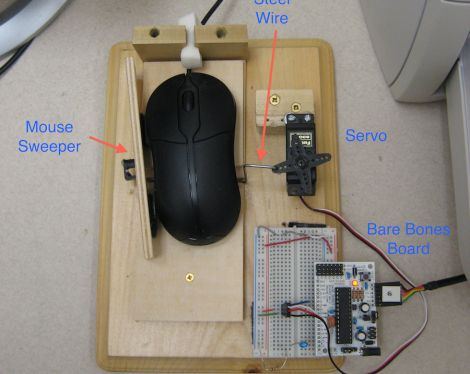
Rather than circumvent the screen saver using a local security policy or by implementing a microcontroller-based signal generator, he opted to create a mechanical solution instead. His computer’s optical mouse resides inside a wooden frame, and is periodically swept from side to side by an ATmega-controlled servo, keeping the screensaver permanently at bay.

Call it a hack, call it a kludge, call it what you will. All we know is that while we might have done it a little differently, it works just fine for [Jerry], and it generates all sorts of interesting conversation to boot.

Stick around for a quick video demonstration of his mouse wiggler box.

Continue reading “Trick Mouse Keeps The Screen Saver At Bay”
Cheap And Cheerful Arduino Breadboard Basics

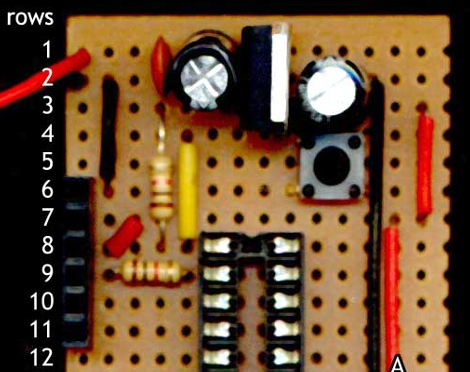
For those less experienced folks looking to move their Arduino projects to more permanent installations, this is just for you! [Martyn] Posted a three part series, VeroBoardUino, over at his blog about moving your Arduino project to a soldered breadboard.

Part one kicks off with the appropriate breadboard requirements, modifications, and a simple 7805 power supply. In the guide [Martyn]  is using strip board, so copper connections will have to be broken using a drill or just by scraping with a hobby knife. Strip board also saves a bit of wire routing in the end. Part two handles the reset button, serial connection and chip socket  (Part 2.5 has also been added to include schematics of the breadboard). Finally, part three installs the crystal and connects your Atmega chip to power and ground.

Next post he will be covering more on the software end of things, burning the bootloader and uploading programs to your new board so stay tuned for updates!

Archaeopteryx: A Large, Colorful MIDI Controller

This is [Robert Jarvis’] new MIDI controller which he has christened the Archaeopteryx. It makes its home (quite nicely might we add) in a discarded wooden cutlery case. This provides a strong and stable base for the controls while keeping the electrical connections close at hand for any rewiring or repair work.

The interface is made up of several different input devices. The guts from two Korg Nanokontrols donated the sliders and pots. These are both USB devices and they join with a USB keyboard which has been rewired to work with the colorful push buttons. All three devices connect to a hub inside which makes the device work using just one cable connection to the computer.

There’s a lot of wiring shoved into that shallow case. But if he keeps the keyboard mapping straight we think it won’t be too hard to configure the device. We like it that [Robert] included a snapshot of the back-of-the-envelope prototyping plans he made. This kind of ‘how I got there’ information is what we’re looking for when choosing projects to feature.

Kickstarter Roundup: Wednesday, June 1st

We have been getting tons of emails lately recommending we take a look at various Kickstarter projects. We used to ignore them since they all boil down to a request for project funding, but since there are so many cool projects out there, we figured we might as well share a couple. Some of these projects have already met their funding goals, but we thought they were worth a mention anyhow.


Solar Powered Coffee Roasting

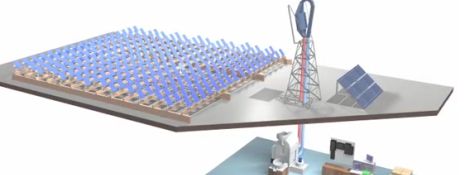
solar_coffee_roaster

We’re all about both coffee and alternative energy, so this one caught our eye right away. While this coffee roaster won’t exactly fit on your back porch, it would be perfect for a coffee shop located in a sunny locale. Based off “power tower” solar concentrator systems, this rooftop-mounted solar harvester has big potential. Pair this with sopme sustainably-grown coffee, and you’ve got quite the tasty combo.


HexBright – an open source flashlight

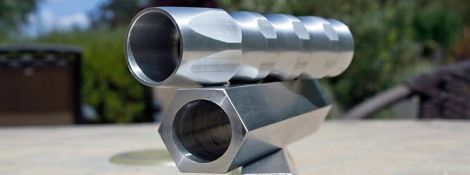
hexbright

What do you get when you combine milled aluminum hex bar and a Cree XM-L LED? A lightweight, extremely bright flashlight that won’t roll away on you. The HexBright puts out 500 lumens and sports a built-in rechargeable battery that can be topped off via your computer’s USB port. Not only that, the high-end version can be programmed to support any pattern or brightness that you choose.  We’ll take two, thanks.


Arduino Project Board

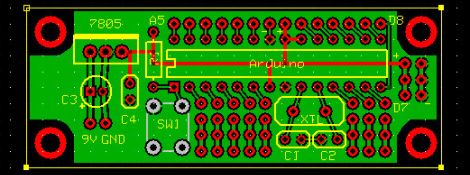
arduino_project_board

[Randy Sarafan] of Clap-off bra fame is working on a slimmed-down Arduino board for use in the final stages of project development. He really doesn’t see the need to put an entire Arduino development board into his finished projects and often makes a quick perfboard circuit for his builds once he is finished prototyping. He’s grown tired of the process and developed a small circuit board that has all the connectivity he needs, without all the extra bits found on Arduino development boards.

Sinister Tone Generator Brings The Bass

sinster_tone_generator

[RichDecibels] wrote in to share a new device he built called the “Sinster Tone Generator”. It’s basically a bass drone synthesizer that uses two pairs of heterodyning oscillators to generate the output. If you swing by his site, he has a long audio demo of the device in action with a bit of reverb and filtering applied to enhance the sound. After listening, we agree that it sounds pretty sinister!

The device is relatively small and handsomely packaged in a plastic project box he had custom cut by Ponoko. [Rich] says that this particular unit is a one-off that he has produced for a charity auction, and that bidding is open through Sunday if you really want to get your hands on it. If you happen to have the time to build one yourself, he has uploaded schematics and layout files to his site (as usual), so feel free to stop by and grab a copy.

GPU Password Cracking Made Easy

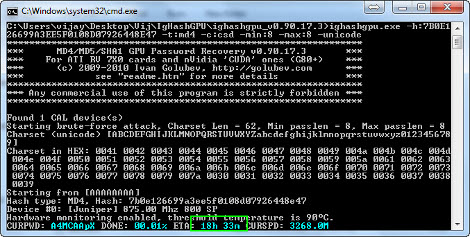
The power that a Graphics Processing Unit presents can be harnessed to do some dirty work when trying to crack passwords. [Vijay] took a look at some of the options out there for cracking passwords and found that utilizing the GPU produces the correct password in a fraction of the time. On a Windows machine he pitted the Cain password recovery tool which uses the CPU for its calculations against ighashgpu which uses ATI or Nvidia graphics cards to do the deed. Hands down ighashgpu is the fastest; with Cain taking about one year to crack an eight character password while ighashgpu can do it in under nineteen hours.

We were very interested to see how easy it is to use this package. We looked in on GPU cracking in September but didn’t focus on the software packages that are out there. Now that you know how easily your password can be unearthed perhaps you will get some use out of this article discussing the usability and security of longer passwords which we ran across over on Reddit.

[Jeri’s] Dress Lights Up When Someone Invades Her Personal Space — Step Back Nerds!

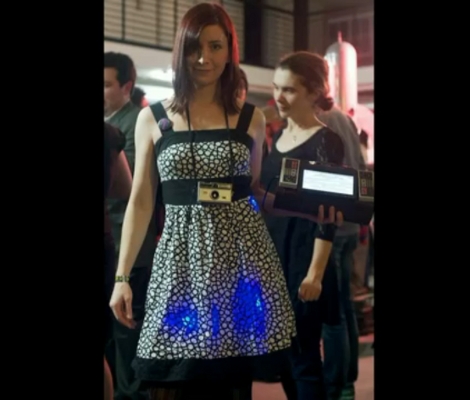
[Jeri] threw down the geeky fashion gauntlet by building this LED enhanced dress. She chose to assemble the project for her trip to BarBot 2011, and we can’t think of a more appropriate setting for such a garment. It uses a motion sensor to set off a delayed pattern of blue lights hidden underneath the fabric.The best part of the hack is the instamatic camera. It looks like a fashion accessory, but it’s really hiding all of the circuitry for the lights.

Inside the camera a PIR sensor waits until it detects motion, sending a signal through an op-amp to the trigger circuitry. A 74LS14 Schmitt Trigger chip teams up with some resistor-capacitor timer circuits to build a delay chain for the LEDs. This way, after motion is detected the LEDs come on and off in a staggered pattern that doesn’t require a microcontroller and is very pleasing to the eye. See the Analog win for yourself after the break.

Continue reading “[Jeri’s] Dress Lights Up When Someone Invades Her Personal Space — Step Back Nerds!”