Hacking The Green Goose For Fun And Profit

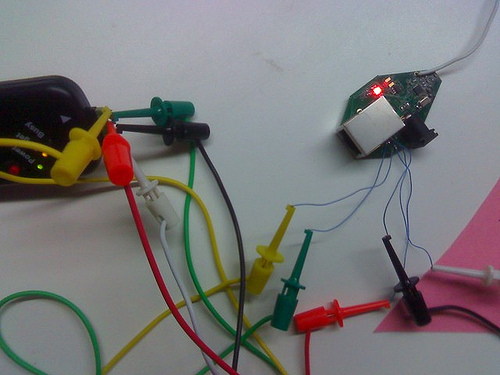
[Troy] recently got his hands on a greengoose starter kit and like any HAD reader would do, proceeded to probe it mercilessly.

The greengoose appears to be some sort of location-tracking device which reports back to a server on the position and location of radio transmitters relative to it. [Troy] managed to not only get the base-station’s firmware, but to also hack it and greengoose’s data to his own server. As if that wasn’t good enough he broke down the packet structure for us. Good job [Troy].

Looks like the greengoose could be a fun tool for anyone interested tweeting the whereabouts of their cat, or checking if the toilet seat lid is down. Let’s see what people come up with.

Another Homebrew Segway Clone Comes In At Under $300

[Matt Turner] tipped us off back in January about his homemade Segway project. Unfortunately that message slipped through the cracks but we’re glad he sent in a reminder after reading Friday’s feature an a different 2-wheeled balancer.

We like it that he refers to this project as being on the budget of a graduate student with a young family. We certainly understand where he’s coming from, and we hope he can ride this to job interviews to show them he truly lives engineering. The control circuitry is a bit higher-end than we’re used to seeing. He chose a Cypress CY8C29466 SoC to control the device. But the sensors are a common choice, using the Wii Motion Plus and Wii Nunchuk for the gyroscope and accelerometer they contain. This is a no-brainer since the sensors are high-quality, cheap and available locally, and communicate of the standard I2C protocol.

When looking for motors [Matt] was happy to find an old electric wheelchair on Craig’s List. This also gave him a gear box, wheels, and tires. He added a pair of motor drivers, with his own alterations to suppress feedback. Sounds like they run a little hot because he plans to add cooling fans to them in the future. But this first iteration is up and running quite well as you can see in the clip after the break.

Continue reading “Another Homebrew Segway Clone Comes In At Under $300”

EL Wire Piping On A Party Couch

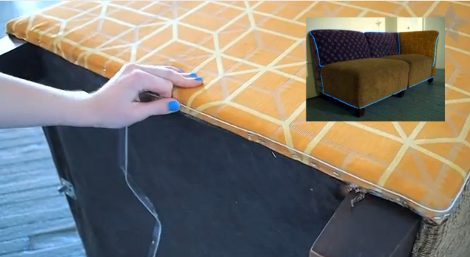
If you’ve been putting off that reupholstering project here’s a little incentive to get started. Adafruit now has some electroluminescent wire which is perfect for use as piping. They’ve outfitted a small sofa with the glowing material and we think it looks great whether switched on or not.

The installation process is really quite easy. The EL wire is covered with clear material that provides a continuous tab running the length of the wire. This can be stapled on like you see in the image above, or sewn into a fabric seam. So you could take an existing sofa cover, remove all the stitching, and sew it back together with the EL wire replacing the original piping. The video after the break shows how simple the process is.

This will be a nice complement to that Daft Punk table we’ve been meaning to build. Continue reading “EL Wire Piping On A Party Couch”

[Ian] Shops Seoul, South Korea

We don’t get a chance to shop some of the cooler electronic component shops here in the States, much less hop on a plane and experience the Hacker’s Disneyland that are the Asian markets. So we’re glad to live vicariously through Hackaday alum [Ian Lesnet’s] adventures. This time around he’s combed through Seoul, South Korea’s electronics markets. That link will take you to the roundup of about a dozen posts he published during his recent trip.

The image above is a screenshot from one of the videos he made of the experience. After the break you can watch him put on the tour-guide hat. We think he did a great job of explaining the experience and showing off what the market is like without letting the video drag on. The shops mostly offer a window display with all of the components they sell. To make a purchase you just window shop, then go inside and they will pull out an order for you from bulk bags stored on floor-to-ceiling shelves. [Ian] also makes a stop at the local Hackerspace where they show off some of their 3D printer builds.

This is not the first time he’s given us a tour like this, go check out his Akihabara trip if you missed it before. He’s also planning to meet up with the Seeed Studio folks to tour the shops in Shenzhen next month. Continue reading “[Ian] Shops Seoul, South Korea”

Isomorphic Piano Keyboard Is Button Madness

[nikescar] sent in a link to a huge isomorphic MIDI keyboard. We might have missed it the first time around, but that doesn’t diminish such a great looking project.

According to the project page, this humongous keyboard is the work people at Louisville Soundbuilders’ efforts to clone the AXiS-64 MIDI controller. Instead of looking like a ‘normal’ piano keyboard, this isomorphic keyboard puts notes in a hexagonal pattern. This keyboard layout is very useful – fingerings for chords are the same across all keys – but these keyboard layouts are fairly rare and MIDI controllers are expensive as a result.

To make the keyboard in the video velocity sensitive, there are two layers of PCBs. The top layer uses Cherry key switches, while the bottom PCB is an array of tact switches. Measuring the time between the top and bottom key presses gives the on board microcontroller velocity information that is converted to MIDI notes. This setup has a few downsides, namely the huge amount of switches, components, and pins needed for two keyboard matrices.

The project page hasn’t been updated for a few months, so we’re pretty curious about the current status of this build. If any of the Louisville Soundbuilders have an update on this project, send it on in.

Getting A Home Built Scanner From ’92 Up And Running Again

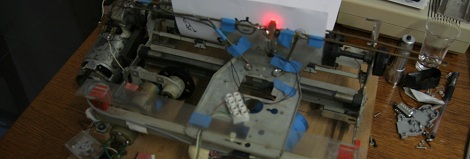
In 1992, [Arpi] didn’t have much time for Ninja Turtles, Nintendos, and other wonderful wastes of time his fellow geeks were raised on. He was busy building a scanner for his Commodore 64. Although this very impressive build could have been lost to the sands of time, he pulled his project out of the attic for a “Try to use it again” party. Although this party is not a formal competition, we’re going to say that [Arpi] walked home that night with the most geek cred.

While there are no build details, there is a bunch of info to be gleaned from the gallery about how this machine was built. We’re pretty sure a good majority of the build was a typewriter at one point, and it looks like there’s a windshield wiper motor in there somewhere. Like this completely unrelated but similar build, [Arpi]’s scanner uses a photoresistor and a few LEDs to transfer image data to the custom software. In case you were wondering, yes, the ancient 5 1/4 floppy disk was still readable – one of the few advantages of the huge sectors on these disks.

Check out the videos of this scanner in action after the break, and if you’ve got a decades-old hack sitting in your attic (remember that acoustic modem you built?), send it in on the tip line.

Continue reading “Getting A Home Built Scanner From ’92 Up And Running Again”

Motor Controller Also Does Nyan Cat

As a freshman at UC Berkeley, [Keegan] has been helping out with his school’s Pioneers in Engineering program that gives high school students some hands on experience with engineering principles, usually by building robots. This year, [Keegan]’s project is a motor controller that just so happens to play the nyan cat song over the motor PWM output.

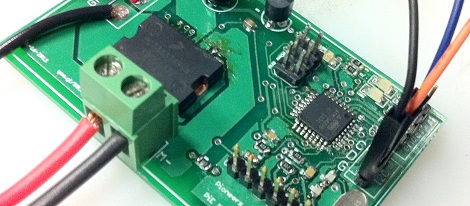
The motor controller is meant to replace the Pololu simple motor controller the PiE team is currently using. Onboard is an H-bridge chip and an ATmega328 that takes commands from an I2C bus. The ‘328 is loaded up with the Arduino bootloader making the firmware very accessible – a good thing for the high school students that will be building and programming these robots.

[Keegan] put up the Eagle files for the board up on the PiE Wiki. For now, just enjoy the dulcet tones of the pop tart cat theme song after the break.

Continue reading “Motor Controller Also Does Nyan Cat”