Having Fun With Dumb Terminals

terminal

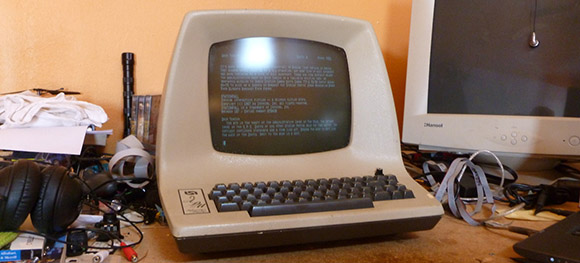
For a long time now, [Morgan] has been wanting an old serial terminal. In a stroke of luck, one of his pals at the Quelab hackerspace scored an awesome ADM-3A terminal from a collector. It’s a historically significant piece of computing and UNIX history, so obviously [Morgan] needed to get it working.

The ADM-3A terminal pre-dates the famous DEC VT-100 terminal, but since [Morgan]’s new acquisition speaks RS-232, he had a good shot at getting it to work with one of his more modern boxes. He’s using a Windows laptop loaded up with FreeBSD in a VM to talk to the terminal. Surprisingly, the only additional hardware required was a USB to serial cable and a DE9-DB25 serial adapter.

It may not be as cool (or as loud) as Quelab’s Teletype ASR-35 they have set up for Zork sessions, but it’s great to see ancient hardware have some
use. Right now, [Morgan] is editing files with vi and of course playing Zork. Seems like there’s plenty of life left in this old dumb terminal. After looking for an old VT-100 for a while now, I’ve got to say I’m pretty jealous.

Giving A CNC Knitting Machine A New Brain

We’re all about big machines that build things for us – laser cutters, CNC mills, and 3D printers are the machines de rigueur for Hackaday.  Too often we overlook the softer sides of fabrication that include textiles and knitting. [varvara] and [mar] are doing their best to bring us the softer side of things with their modification of a Brother knitting machine. They call their build Knitic, and it’s a great way to knit with computer control.

Instead of previous Brother knitting machine hacks we’ve seen, Knitic doesn’t bother with emulating the keypad or controlling the microprocessor already there; this build dispenses with the Brother brain and controls the solenoids and switches of the knitting machine directly with the help of an Arduino and a home-etched shield.

It’s not quite an automated knitting machine – someone still has to run the shuttle across the machine – but the patterns are controlled via a Processing app available on the Knitic github. You can check out [Varvara]’s demo of Kinitic after the break.

Continue reading “Giving A CNC Knitting Machine A New Brain”

Rate Gyroscope Circuitry Explained

rate-gyroscope-driver

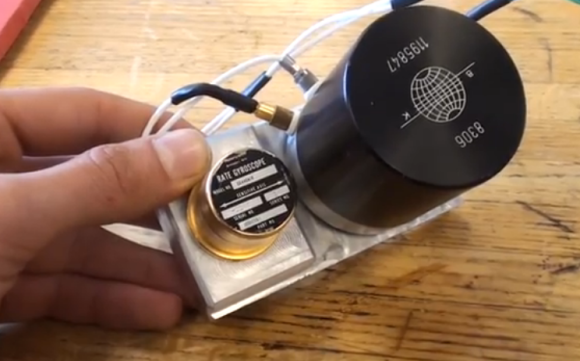
Hackaday alum [Adam Munich] shot a tutorial video on using a rate gyroscope.

Here he’s showing off the really fancy piece of ancient (technologically speaking) hardware. It would have set you back about fifteen grand in the 1960’s (inflation adjusted) but can be had these days for around $30. What a deal! These are not small, or power efficient when compared to the components that go into smart phones or gaming controllers, but they’re a heck of a lot more accurate than the ubiquitous modern parts. That’s because a rate gyroscope — which is the gold cylinder on the left — actually incorporates a spinning motor and a way to monitor how it is affected by changes in gravity. The driver/interface circuitry for this gets hairy relatively fast, but [Adam] does a solid job of breaking down the concept into smaller parts that are easy to manage.

Wondering what is different about this compared to a MEMS accelerometer? We know they’re really not the same thing at all, but wanted a chance to mention [The Engineer Guy’s] video on how those parts are made.

Continue reading “Rate Gyroscope Circuitry Explained”

Playing Meat Boy On An FPGA

We usually look at these FPGA University projects and think how much fun it must have been to get credit for the work. But in this case we can’t image the grind it must have been to implement the game mechanics of Meat Boy in an FPGA. See how well it came out in the clip after the break.

Remember that with an FPGA you’re basically building hardware devices by using code. The Reddit discussion of the project sheds some light on where to start (and even shares the source code). The Altera DE2 is pushing the game to a monitor using SXGA at 60Hz. The map is laid out as a collection of 32×32 tiles, each represented by 2 bits in memory. [SkipToThe3nd] does go into detail about how the physics work but we can’t even begin to paraphrase that part of the discussion.

The game being cloned here is Meat Boy, the Flash game predecessor to Super Meat Boy. If you’ve never heard of the title we’d suggest watching Indie Game: The Moviea documentary which follows several independent game developers as they try to get their titles to market.

Continue reading “Playing Meat Boy On An FPGA”

Rigol WFM Viewer Ported For Non-Windows Users

rigol-wfm-parser-for-linux

[Matthias Blaicher] may think this isn’t a big deal when it comes to the amount of work he put into the hack. But for us, anything that extends the functionality of the versatile yet affordable Rigol DS1052E is a win. In this case he’s taken a previous hack and made it work for more people by extending the functionality of the WFM file format viewer.

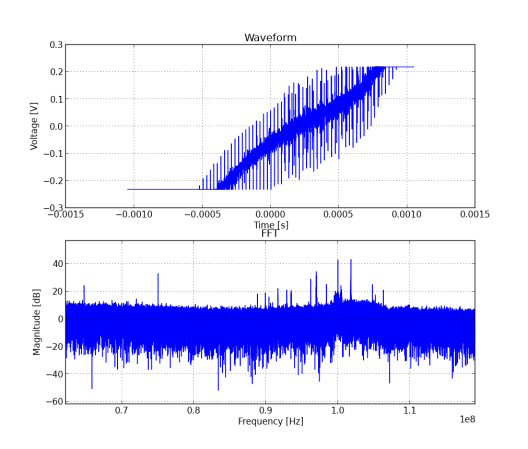
[Dexter2048] pulled off the original hack which allows this oscilloscope to be used as a spectrum analyzer. [Matthias] didn’t want the tool to be limited to running only on Windows systems so he got to work. This isn’t quite as easy as sounds because the only part of the original code that was released is the parser itself. [Matthias] had to build everything up from that starting point. His software uses standard Python to parse the WFM file and reformat the data. The features included in the current version allow you to export data as a CSV file and even plot the waveform and FFT as seen above.

Robot Bartender Mixes A Mean Drink

Back in 2002, [Dave] came across a discarded PUMA robotic arm and quickly set his sights on turning it into a bartender to serve drinks at his parties. Unfortunately, the arm was far from operational and being an engineer at his day job meant that working on this project was the last thing he wanted to do when he came home. So, progress trickled along slowly for years. He eventually announced a public deadline to spur him to action, and this years Pi(e) party saw the official debut of  ‘Sir-Mix-a-Bot’ – the robot bartender.

With the exception of having to build a new hand for it, mechanically, the arm was still in good condition when [Dave] found it. The electronics were another story however. Using some off the shelf components and his own know-how, [Dave] had to custom build all the controls. The software was written from scratch as well. (He lucked out and had help from his brother who was taking a Ph.D. program in robotics at the time).

As if the robotics aspect of the project wasn’t enough, [Dave] even created a beautiful custom table that both houses and displays his masterpiece. The quality of craftsmanship on his table alone is worth the time to check this out – there’s a short video after the break.

[Thanks Dave]

Continue reading “Robot Bartender Mixes A Mean Drink”

Hackaday Links: March 25, 2013

Illegal, yet impressive

cans

Want a soda? Just grab a robot, shove it in a vending machine, and grab yourself one. This video is incredibly French, but it looks like we’ve got a custom-built robot made out of old printers and other miscellaneous motors and gears here. It’s actually pretty impressive when you consider 16 ounce cans weigh a pound.

UNOBTANIUM

chip

Okay, we got a lot of emails on our tip line for this one. It’s a group buy for a programmable oscillator over on Tindie. Why is this cool? Well, this chip (an SI570) is used in a lot of software defined radio designs. Also, it’s incredibly hard to come by if you’re not ordering thousands of these at a time. Here’s a datasheet, now show us some builds with this oscillator.

Chiptune/keygen music anywhere

keygen

[Huan] has a co-loco’d Raspi and wanted a media server that is available anywhere, on any device. What he came up with is a service that streams chiptune music from your favorite keygens. You can access it with Chrome (no, we’re not linking directly to a Raspberry Pi), and it’s extremely efficient – his RAM usage didn’t increase a bit.

Take it on an airplane. Or mail it.

bomb

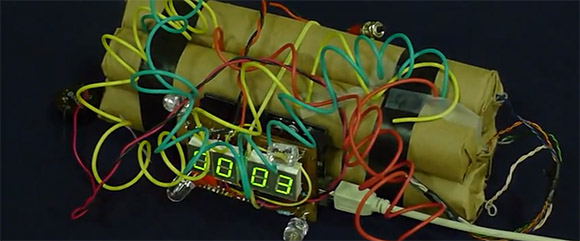
[Alex]’s hackerspace just had a series of lightning talks, where people with 45-minute long presentations try to condense their talk into 10 minutes. Of course the hackerspace needed some way to keep everything on schedule. A simple countdown timer was too boring, so they went with a fake, Hollywood-style bomb. No, it doesn’t explode, but it still looks really, really fake. That’s a good thing.

Printers have speakers now?

nokia

[ddrboxman] thought his reprap needed a nice ‘print finished’ notification. After adding a piezo to his electronics board, he whipped up a firmware hack that plays those old Nokia ringtones. The ringtones play over Gcode, so it’s possible to have audible warnings and notifications. Now if it could only play Snake.