Ask Hackaday: What Can Save RadioShack?

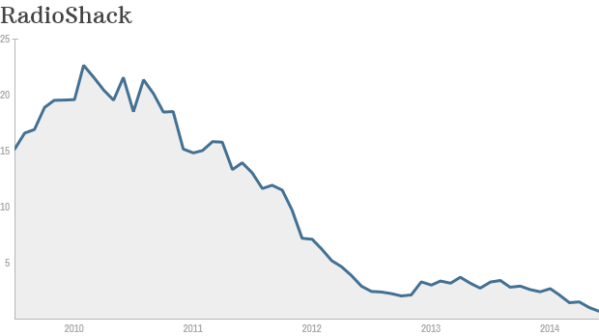
The news for RadioShack is not good. The retail chain that we hackers hold near and dear to our hearts is in financial trouble, and could go under next year.  With just 64 million in cash on hand, it literally does not have enough capital to close the 1,100 stores it planned to in March of this year.

On May 27th, 2011, we asked you what RadioShack could do to cater to our community. They listened. Most of their retail stores now carry an assortment of Arduino shields, the under appreciated Parallax (why?), and even El Wire. Thanks to you. You made this happen.

Today, we are asking you again. But not for what RadioShack can do better. We’re asking what they can do to survive. To live. It makes no sense for RadioShack to compete in the brutal cell phone/tablet market, and makes every bit of sense for them take advantage of the rapidly growing hacker/builder/maker what-ever-you-want-to-call-us community. Let’s face it. We’re everywhere and our numbers are growing. From 3D printers to drones, the evidence is undeniable.

With 5,000 retail stores across the USA, they are in a perfect position to change their business model to a hacker friendly one. Imagine a RadioShack down the road  that stocked PICs, ARMs, Atmels, stepper motors, drivers, sensors, filament….like a Sparkfun retail store. Imagine the ability to just drive a few miles and buy whatever you needed. Would you pay a premium? Would you pay a little extra to have it now? I bet you would.

Now it’s time to speak up. Let your voices be heard. Let’s get the attention of the RadioShack board. You’ve done it before. It’s time to do it again. Hackers unite!
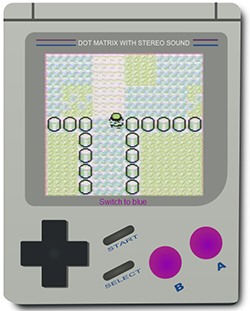
 

Pokáde: Twitch Plays Pokemon, Reborn On Vintage Hardware

poke Early this year, Twitch Plays Pokemon, a webstream of tens of thousands of people playing the same game of Pokemon via web chat. It was certainly an interesting sociological phenomenon, but as in any system where thousands of people try to do a single thing, progress was exceedingly slow at points. This was compounded by the fact the Twitch stream delayed the chat by about 30 seconds.

At the time, there was some talk about setting up an alternative to the emulator-based Twitch stream. Ideas were floated, but until now, no one has yet come up with a workable solution. Now we have Pokáde: real Pokemon games (Red and Blue) running on real hardware (two Super Game Boys, two super Nintendos, and two Game Genies), streamed live to the Internet with an IRC-like chat function.

Simply for the ease of capturing the video of the stream, [Johannes], the guy behind all of this, is using a pair of Super Nintendos and Super Game Boys connected to USB video capture dongles. The Super Game Boys are modded to enable trading between the Red and Blue versions of the game, and controls are handled with a USB connection to the PC running the server.

Anyone can play the game, simply by going to the Pokáde Chat, entering the chat, and clicking on random buttons on the brick Game Boy GUI. The game ROMs have been slightly modified to disable the option of starting a new game, but this is still the classic Twitch Plays Pokemon experience: people all around the globe mashing buttons and creating a religion around a fossil pokemon.

Creepy Cat Eyes With A Microsoft Kinect

F8X0VISHV3Q1HLI.LARGE

Ever feel like someone is watching you? Like, somewhere in the back of your mind, you can feel the peering eyes of something glancing at you? Tapping into that paranoia, is this Computer Science graduate project that was created during a “Tangible Interactive Computing” class at the University of Maryland by two bright young students named [Josh] and [Richard], with the help of HCIL hackerspace.

Their Professor [Dr. Jon Froehlich] wanted the students to ‘seamlessly couple the dual worlds of bits and atoms’ and create something that would ‘explore the materiality of interactive computing.’ And this relatively simple idea does just that, guaranteeing some good reactions. 

As you’ve probably gathered from the title, this project uses a Microsoft Kinect to track the movement of nearby people. The output is then translated into actionable controls of the mounted eyeballs producing a creepy vibe radiating out from the feline, robot poster.

Continue reading “Creepy Cat Eyes With A Microsoft Kinect”

The Fridge Hacking Guide By BrewPi

brewpi-fridge-conversion-51

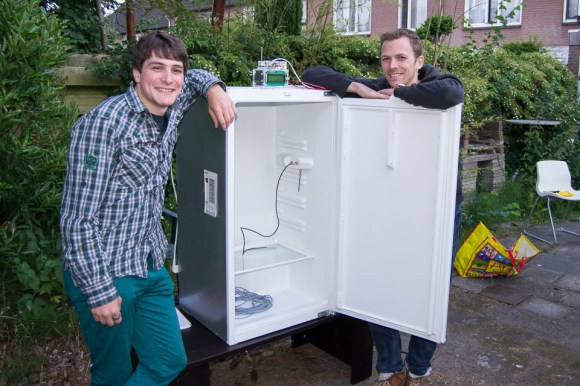
The team behind BrewPi are at it again! This time they have created an online guide showing how to convert a min-fridge into a Raspberry Pi & Arduino controlled fermentation chamber. In it, they describe 3 possible options:

  • Option 1: Make a simple switched power cord, without hacking into the fridge electronics.
  • Option 2: Make a switched power cord, but also override or remove the thermostat.
  • Option 3: Rip out the thermostat and fully integrate the SSRs into your fridge (which is what [Koen] and [Elco] did).

First things first though. They had to clean the fridge. And depending on where they got it or how long it has been unplugged for, the inside might have been pretty rank and disgusting from mold growing out of every corner. This took a good hour or so to clean properly lest the brewing process get infected with external grossness. This is all worth it because a well-controlled fermentation chamber results in a superior batch of beer.

They put their laser cut case on top of the fridge, holding an LCD, Raspberry Pi, Arduino and the BrewPi Arduino shield. The Arduino reads the temperature sensors inside the fridge, the beer and the ambient temperature. Then it controls the SSRs they added to switch the compressor and a heater. Then, the cables were routed through the fridge and take control of the compressor.

Continue reading “The Fridge Hacking Guide By BrewPi”

Supersonic NERF Dart Speedometer

ATtiny Chronograph

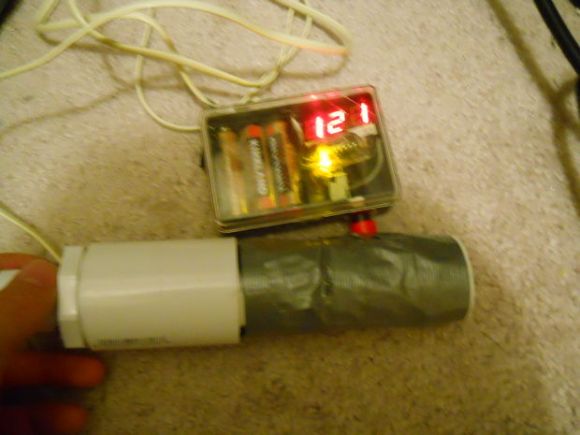
[John] was faced with an interesting problem: after he built his own air cannon, how could he tell exactly how fast his NERF darts were moving? Luckily he had some spare parts on hand and hacked together a fully functional projectile speedometer for less than the cost of an Arduino.

A device is essentially two detectors spaced a precise distance apart from one another. When something passes the first detector, a timer is activated which measures how long it takes the object to reach the second detector. From this, the device calculates the speed. [John] used infrared emitter/detector pairs spaced exactly three inches apart and wired them to an ATtiny2313. After a little bit of coding, he now knows just how fast he can fire those squishy ballistic missiles.

The infrared emitter/detector pairs are mounted to a PVC pipe through which the projectile travels. [John] notes that in theory this could be used to measure almost anything that could fit through the pipe, although this particular device might be damaged by muzzle flash or a pressure wave from an actual gun.

We’ve seen other NERF dart air cannons before, and we wonder if maybe there should be some sort of competition to see who can shoot a NERF dart the fastest now that there’s an easy way to measure speed?


Hackaday Links: August 3, 2014

hackaday-links-chain

A ton of people sent in this video of crazy Russians who have taken a microwave, removed the magnetron, taped it to a broom, and turned it on. Don’t try this at home. Or near us.

You know the Google Cardboard kit that’s a real VR headset made of cardboard (and a smart phone)? Google may have gotten their inspiration from Oculus, because every Oculus Rift DK2 ships with a Samsung Galaxy Note 3 inside.

paul allen

Ever design a PCB and be disappointed by the quality of the silkscreen? [Paul Allen] has been defining the edges of his PCB labels with the copper layer, and the examples are dramatic. Etching copper is what you actually pay for when you fab a board, so it should come as no surprise that the quality is a little higher.

Dunk tanks are fun, but how about competitive dunk tanks? [Chad] built a dunk tank (really more of a ‘dunk shower’) out of a 2×4 tripod, a garbage can, and a few parts from a the toilet aisle of Home Depot’s plumbing department. Then he built a second. Set up both dunk showers across from each other, give two people a few balls, and see who gets soaked last. Looks fun.

Want a MAME cabinet, but don’t want it taking up room in your house? Build a MAME coffee table! Here’s the reddit thread. Maybe we’re old-fashioned, but we’d rather have a giant NES controller coffee table.

Last week we saw a 16-bobbin rope braiding machine, but odd braiding machines like this aren’t limited to fibers. Here’s a wire twisting machine for making RS422 cables. It only produces a single twisted pair, but that’s really all you need to create a cable. Somebody get some paracord and make some Cat5.

Brushless DC Motor Used For High Speed CNC Spindle

Brushless DC Motor CNC Spindle

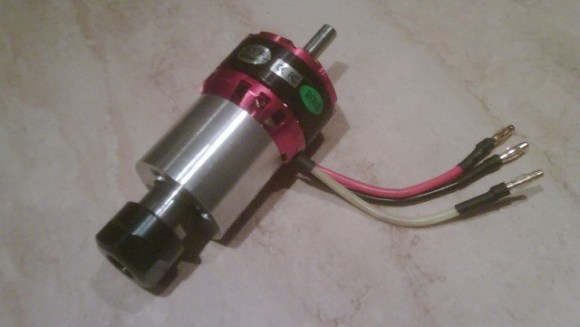
Brushless DC motors are common place in RC Vehicles. They are small, light, fast and can be inexpensive. [Raynerd] wanted a new spindle for his CNC machine and thought that a brushless DC motor would be a great platform to build from.

[Raynerd] started with an off the shelf motor that had an 8mm shaft. This shaft size was important because the motor shaft was to be replaced with an ER16 collet arbor of the same size. A collet is a device used to hold cutting tools by collapsing a segmented ring around the tool. Collets allows for quick tool changes while providing a strong clamping force. ER16 is a designation of one of many collet standards.

The main housing was machined out of aluminum specifically for this project. This housing holds two radial load ball bearings that support the new rotating collet arbor. There’s another bearing in this assembly, a thrust washer this time, that keeps the arbor from moving axially in the housing.

The 12 volt output of a standard ATX power supply was used to power the system for testing purposes. A general RC Vehicle electronic speed control and a servo tester work in conjunction to manually regulate the spindle speed. Check out the bench test video and an exploded photo after the break.

Continue reading “Brushless DC Motor Used For High Speed CNC Spindle”