IKEA LED Table Mod Doesn’t LACK Awesome

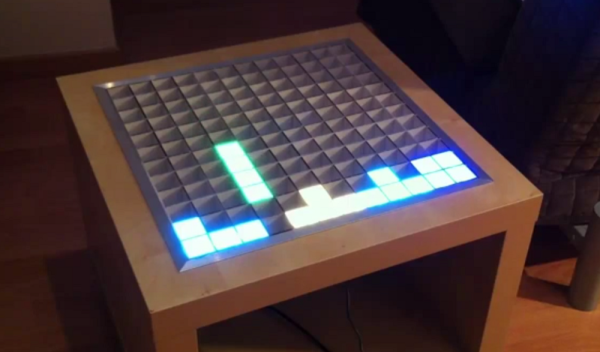
Some people look at IKEA LACK tables as cheap furniture. Our readers look at them as a blank canvas. [Klaas] has turned a LACK Side table into an interactive LED table featuring 144 RGB LEDs. After attending a class on WS2801 pixel strings at his student IEEE chapter, [Klaas] was inspired to design something of his own. He settled on an IKEA LACK table and started sketching. He didn’t actually have a table on hand, so he had to deduce the size from the website images and dimensions. He calculated a usable size of around 45cm, which was pretty close to the mark. After running a few tests, [Klaas] determined that a 12×12 grid of squares 35mm on a side would provide that enough resolution to play simple games. The 35mm x 35mm grid would also be small enough for the LEDS to illuminate. He used a laser cutter to cut the an interlocking grid from 3mm MDF. A base plate with 144 12mm LED holes was also cut out, and the entire assembly was glued together.

For illumination, [Klaas] settled on WS2812B LEDs, as they were cheaper than their WS2801 couterparts. The WS2812B’s also snapped easily into his 12mm holes. At this point [Klaas] actually purchased his IKEA table and proceeded to cut a huge hole in it. The grid glued right in, and some aluminum L-profile cleaned up the top edge. Driving all those LEDs would need a bit of processing power, [Klaas] chose a Teensy 3, and the well-known OctoWS2811 library. He also added a USB host shield, which allowed him to use an Xbox 360 USB game pad as his controller. For software, he created a simple Tetris clone, and ported snake from the Arduino game shield. A menu and some scrolling text ties everything together. The only thing left to add is a glass top. [Klaas] hasn’t settled on clear or diffuse glass yet. We a suggest clear to avoid hiding any details of this great build.

Continue reading “IKEA LED Table Mod Doesn’t LACK Awesome”

Decoding News Helicopter Signals On YouTube

A serendipitous YouTube video recommendation led [Oona] to a raw copy of a news helicopter car chase video. While watching the video she noticed an odd sound playing from her left speaker. That was all it took to put [Oona] on the hunt. Decoding mystery signals is a bit of an obsession for her. We last saw [Oona] decoding radio signals for bus stop displays. She isolated the left audio channel and sent it through baudline software, which helped her determine it was a binary frequency shift keyed (BFSK) signal. A bit more work with SoX, and she had a 1200 baud bit stream.

Opening up the decoded file in a hex editor revealed the data. Packets were 47 bytes each. Most of the data packets was static. However, thee groups of bytes continuously changed. [Oona] decoded these numbers as latitude and longitude, and plotted the resulting data on Google Earth. Plotting her data against the position of the car in the video revealed a match. [Oona] had a complete track of the news helicopter as it followed the car. The telemetry data is in 7-bit Bell 202 ASCII, and is most likely part of an Interruptible Foldback (IFB) system used by the helicopter news crew and the studio producers. Click past the break for the YouTube video that started this all.

Continue reading “Decoding News Helicopter Signals On YouTube”

Paintball Picasso Purposely Misses Its Prey

waterlooPB

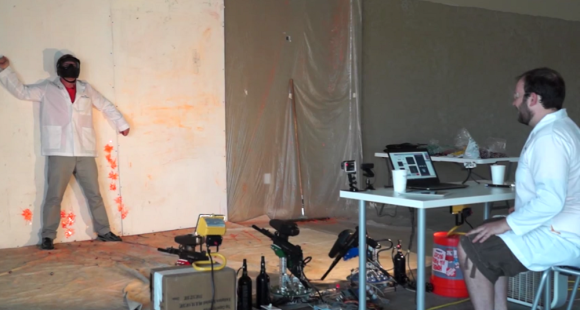
We’ve seen quite a few automated paintball marker systems over the years. Generally it’s the same story – a motion detection system used to target and fire upon the opposing team, prowlers, spouses, etc. [Waterloo Labs] decided to take a slightly different approach, and create a system that intentionally misses its target. Paintball Picasso uses a pair of Tippmann A-5 paintball markers to draw an outline around the person in its sights. This is a rather safe project for [Waterloo Labs], considering their previous adventures in car surfing.

The Paintball Picasso system uses a webcam to capture an image of a willing test subject. Picasso then processes the image. The human outline is plotted on a 50×50 grid of paintball pixels. Then the real fun begins. Paintball Picasso uses a National Instruments myRIO to command two paintball markers to simultaneously fire. The markers are fitted with high torque R/C style servos for pan and tilt. At 10 rounds per second the markers quickly draw the human outline. The test subject walks away slightly splattered, but otherwise unscathed. With a matrix of 2500 points, [Waterloo Labs] has enough resolution to draw some basic logos.

We liked the mounting system [Waterloo Labs] created for the markers. Using a mix of 3D printed parts, Lego Tetrix, 80/20 aluminum extrusion, and ball bearings, they fashioned a mount that moved smoothly enough for R/C servos to actuate, yet was strong enough to withstand the kick of firing. We’d love to see the servos swapped for stepper motors and belt drives. While open loop, stepper motors would afford more accuracy and a longer life than PWM driven R/C servos.

Continue reading “Paintball Picasso Purposely Misses Its Prey”

Help Ithaca Generator Get A Laser Cutter

laser-cutter

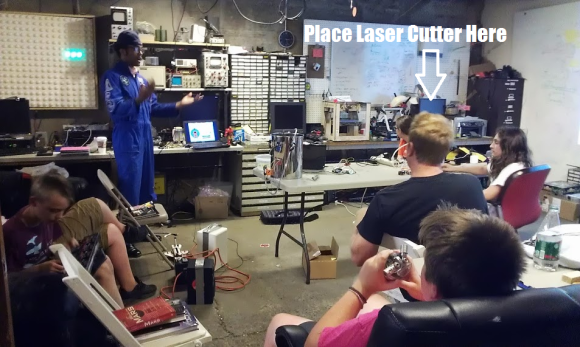
Ithaca Generator, a hackerspace in upstate New York, is running an indiegogo campaign for a laser cutter. With the recent stories of fires, and landlord problems hitting hackerspaces lately, we thought it would be good be to mention a space that is doing well and working to expand their tools. The Generator is looking to purchase a 60 Watt laser cutter. The flexible funding campaign is set for $3000 US, and they are within striking distance of just passed their goal! As any laser veteran will tell you, $3000 isn’t nearly enough for a 60 Watt model from a reputable company. The group already has a donor who will match the campaign final funding amount up to $4000. If the campaign exceeds Now that the campaign has exceeded their goal, the extra funds will go toward a fume extraction systems for the new laser, as well as spare lenses and parts. The group has also added stretch goals for an extended warranty and an upgrade to 90 Watts of laser power.

Many of the donation perks include free membership to the hackerspace. [Vic Aprea], a member of The Generator board told us that out-of-town donors can gift these memberships to anyone local to the hackerspace. A membership would be a great gift for a Cornell or Ithaca college student. For more information on the generator and the campaign check out their website and the video after the break.

Continue reading “Help Ithaca Generator Get A Laser Cutter”

Ball Bearing Motor Rolls For Reasons Unknown

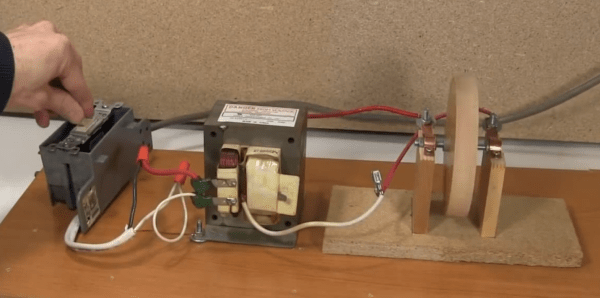
[RimstarOrg] has brought us an oldie but goodie this week. He’s built a ball bearing motor, a design which has been causing engineers and scientists to squabble for decades. [RimstarOrg] used a microwave oven transformer with a 70 turn primary coil and a single turn secondary coil to create a low voltage, high current AC power supply. Needless to say, there’s a real risk of fire or electrocution with a setup like this, so be careful if you try this one at home. [RimstarOrg] then built the motor itself. He de-greased two ball bearings then installed them on a metal shaft along with a wooden flywheel. The entire assembly was then mounted on a board so the wheel could spin freely. Two copper straps hold the bearings to the board. Finally, the transformer is wired into the copper straps. In this configuration, the current will flow through the outer race of one bearing, through the balls, and into the inner race. The current then passes down the axle and passes through the other bearing. There is very little resistance in this circuit, so it can only be powered on for a few seconds at a time before things start to melt down.

Continue reading “Ball Bearing Motor Rolls For Reasons Unknown”

The 8 Bit Harmonica Blows In From Japan

8bit-harmonica

From [Basami Sentaku] in Japan comes this 8bit harmonica. [Basami] must remember those golden days of playing Famicom (or Nintendo Entertainment System for non-Japanese players). As the systems aged, the contacts would spread. In the case of the NES, this would often mean the infamous blinking red power light. The solution for millions of players was simple. Take the cartridge out, blow on it, say a few incantations, and try again. In retrospect, blowing on the cartridges probably did more harm than good, but it seemed like a good idea at the time. We’d always assumed that the Famicom, being a top loading design, was immune from the issues that plagued the horizontal slot on the NES. Either [Basami] spent some time overseas, or he too took to tooting his own cartridge.

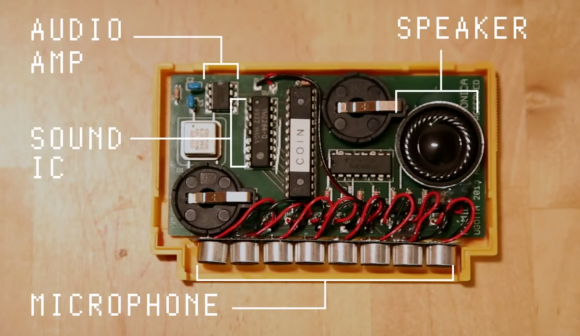
Blowing into cartridges has inspired a few crafty souls to stuff real harmonicas into cartridge cases. [Basami] took a more electronic route. A row of 8 microphones picks up the players breath sound. Each microphone is used to trigger a specific note. The katakana in the video shows the traditional Solfège musical scale: do, re, mi, fa, so, la ti, do. A microcontroller monitors the signal from each microphone and determines which one is being triggered. The actual sound is created by a Yamaha YMZ294. The ‘294 is an 18 pin variant of the venerable General Instrument AY-3-8910, a chip long associated with video game music and sound effects. While we’re not convinced that the rendition of Super Mario Bros’ water theme played in the video wasn’t pre-recorded, we are reasonably sure that the hardware is capable of doing everything the video shows.

Continue reading “The 8 Bit Harmonica Blows In From Japan”

Adventures In Hackerspacing: An Interview With Chris Boden Of The Geek Group

advInHSLayout00

There are some big hackerspaces out there.
And then there’s The Geek Group.
It takes a certain chutzpah to convert a 43,000 foot former YMCA into a hackerspace. And an epic hackerspace it is, complete with 5 axis CNC machines, 3d printers, and of course, giant robots romping through a forest of Tesla coils.  The Geek Group has performed live demos in front of thousands of people over the years, and inspired tens of thousands more via the internet. You don’t work this big without having some big adventures, and The Geek Group is no exception. They’ve been through roof leaks, gas pipe breaks, surprise tax bills and angry neighbors. They’ve also been dealing with their current adventure, fire.

Unless you’ve been under a rock the last few weeks, you’ve probably read about the recent fire, and ensuing cleanup at The Geek Group labs. We’ve covered the fire and its cause here on Hackaday, with no small amount of drama in our comments section. There is a small but vocal minority who don’t have many good things to say. Accusations of cults, safety violations, and tax evasion often fly. While some groups would take this lying down, the geek group put on their flame proof suits and wade through the comments. None more vocally than [Chris Boden], the president, CEO and founder.

DISCLAIMER: The interview contains questionable content and some profanity (which we’ve altered as grawlix). We have posted the transcript as it was captured, which includes some spelling and grammar issues. Please consider these things before clicking through to the interview itself.

Continue reading “Adventures In Hackerspacing: An Interview With Chris Boden Of The Geek Group”