Get Tangled Up In EL Wire With Freaklabs

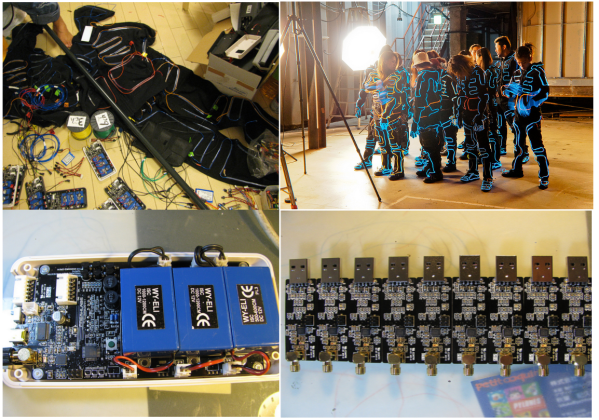
[Akiba] over at Freaklabs has been working with electroluminescent (EL) wire.  An entire dance company worth! We know [Akiba] from his post tsunami radiation monitoring work with the Tokyo Hackerspace. Today he’s one of the engineers for Wrecking Crew Orchestra, the dance company that put on the viral “Tron Dance” last year. Wrecking Crew Orchestra just recently put on a new production called Cosmic Beat. Cosmic Beat takes Wrecking Crew’s performances to a whole new level by adding stage projection mapping and powerful lasers, along with Iron Man repulsor style hand mounted LEDs.

As one might expect, the EL wire costumes are controlled by a computer, which keeps all the performers lighting effects in perfect time. That’s where [Akiba] came in. The modern theater is awash in a sea of RF noise. Kilowatts of lighting are controlled by triacs which throw out tremendous amounts of noise. Strobes and camera flashes, along with an entire audience carrying cell phones and WiFi devices only add to this. RF noise or not, the show must go on, and The EL costumes and LEDs have to work. To that end, [Akiba] He also created new transmitters for the group. He also changed  the lighting booth mounted transmitter antenna from an omnidirectional whip to a directional Yagi.

The EL wire itself turned out to be a bit of a problem. The wire wasn’t quite bright enough. Doubling up on the wire would be difficult, as the dancers are already wearing 25 meters of wire in addition to the control electronics. Sometimes best engineering practices have to give way to art, so [Akiba] had to overdrive the strings. This means that wires burn out often. The dance troupe has gotten very good at changing out strands of wire during and between shows. If you want a closer look, there are plenty of pictures available on [Akiba’s] flickr stream.

Continue reading “Get Tangled Up In EL Wire With Freaklabs”

Boil Off Some White Gas In The Back Yard

Gas-still

[S Heath] is a Coleman lantern collector. Coleman lanterns can run from a variety of fuels, however they seem to run best with white gas, or Coleman fuel. Store bought Coleman fuel can cost upwards of $10USD/gallon. To keep the prices down, [S Heath] has created a still in his back yard to purify pump gas. We just want to take a second to say that this is not only one of those hacks that we wouldn’t want you to try at home, it’s also one that we wouldn’t try at home ourselves. Heating gasoline up past 120 degrees Celsius in a (mostly) closed container sounds like a recipe for disaster. [S Heath] has pulled it off though.

The still is a relatively standard setup. An electric hot plate is used to heat a metal tank. A column filled with broken glass (increased surface area for reflux) rises out of the tank. The vaporized liquid that does make it to the top of the column travels through a condenser – a pipe cooled with a water jacket. The purified gas then drips out for collection. The heart the system is a PID controller. A K-type thermocouple enters the still at the top of the reflux column. This thermocouple gives feedback to a PID controller at the Still’s control panel. The controller keeps the system at a set temperature, ensuring consistent operation. From 4000 mL of ethanol free pump gas, [S Heath] was able to generate 3100 mL of purified gas, and 500 mL of useless “dregs”. The missing 400 mL is mostly butane dissolved in the pump gas, which is expelled as fumes during the distillation process.

Continue reading “Boil Off Some White Gas In The Back Yard”

Oculus Rift Goes From Virtual To Augmented Reality

[William Steptoe] is a post-doctoral research associate at University College London. This means he gets to play with some really cool hardware. His most recent project is an augmented reality update to the Oculus Rift. This is much more than hacking a pair of cameras on the Rift though. [William] has created an entire AR/VR user interface, complete with dockable web browser screens. He started with a stock Rift, and a room decked out with a professional motion capture system. The Rift was made wireless with the addition of an ASUS Wavi and a laptop battery system. [William] found that the wireless link added no appreciable latency to the Rift. To move into the realm of augmented reality, [William] added a pair of Logitech C310 cameras. The C310 lens’ field of view was a bit narrow for what he needed, so lenses from a Genius WideCam F100 were swapped in. The Logitech cameras were stripped down to the board level, and mounted on 3D printed brackets that clip onto the Rift’s display. Shapelock was added to the mounts to allow the convergence of the cameras to be easily set.

Stereo camera calibration is a difficult and processor intensive process. Add to that multiple tracking systems (both the 6DOF head tracking on the Rift, and the video tracker built-in to the room) and you’ve got quite a difficult computational process. [William] found that he needed to use a Unity shader running on his PC’s graphics card to get the system to operate in real-time.  The results are quite stunning. We didn’t have a Rift handy to view the 3D portions of [William’s] video. However,  the sense of presence in the room still showed through. Videos like this make us excited for the future of augmented reality applications, with the Rift, the upcoming castAR, and with other systems.

Continue reading “Oculus Rift Goes From Virtual To Augmented Reality”

Four Cable Drawing Machine Pulls Our Strings

sandplotter

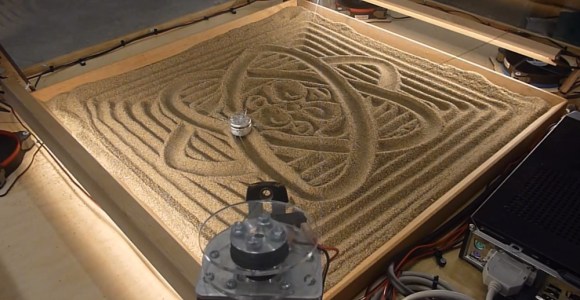
[David] has created a four cable drawing machine for the Telus Spark Science Centre in Canada. Hackaday has featured [David’s] unconventional drawing contraptions before, specifically his center pivot pen plotter. The drawing machine is a new take on a drawbot, and could be considered to be close cousins with [Dan’s] SkyCam. The premise is simple: A stepper motor with a reel of string is placed at each corner of a square. The strings for all four motors come together at a center weight. When all four strings are taut, the weight is lifted off the drawing surface. When a bit of slack is added into the strings, gravity pulls the weight down to touch the sand.

It’s at this point that a simple premise becomes a complex implementation. Moving the weight in one direction is a matter of reeling out string on one motor, and reeling in string on the other. But what about the two “un driven” strings? They have to be slack enough to allow movement in the driven direction, but not so slack that the weight can dig in and tumble on the sand, causing a tangle. To handle some of these questions, [David] called on [Kevin] to write some software. [Kevin] created a custom kinematics module for LinuxCNC to control the drawing machine. The drawing machine runs on Gerber Code, similar to a CNC. Simply feed the machine Cartesian coordinates, and [Kevin’s] module converts to steps.

Continue reading “Four Cable Drawing Machine Pulls Our Strings”

Fubarino Contest Example: A Sneaky IRC Bot

adam-fubar

You may have heard about Hackaday’s contest to win one of 20 Fubarino boards. We included an example entry from [Mike]. Here’s my example entry for the contest: An IRC search Bot powered by a Wicked Device WildFire board. We’ve all seen IRC bot’s before, but how many have you seen that can turn on an LED while running off a cell phone battery?

The IRC bot’s operation is fairly straightforward. It enters a channel and can be commanded to search.  The first two searches will return links to Google searches for the strings given.  Every third search however, will return a link to Hackaday’s search page. In the example below, “SedAwk” is an unsuspecting user, and “SearchRobot” is our bot.

SedAwk: SearchRobot: SEARCH Unicorns
SearchRobot: Search Complete! https://www.google.com/#q=Unicorns
SedAwk: SearchRobot: SEARCH Rainbows
SearchRobot: Search Complete! https://www.google.com/#q=Rainbows
SedAwk: SearchRobot: SEARCH Quadcopters
SearchRobot: Search Complete! http://hackaday.com/?s=Quadcopters
SedAwk: What the heck?

Follow along after the break to see what other tricks the bot has up its sleeve…

Continue reading “Fubarino Contest Example: A Sneaky IRC Bot”

Compliant Robot Gripper Won’t Scramble Your Eggs

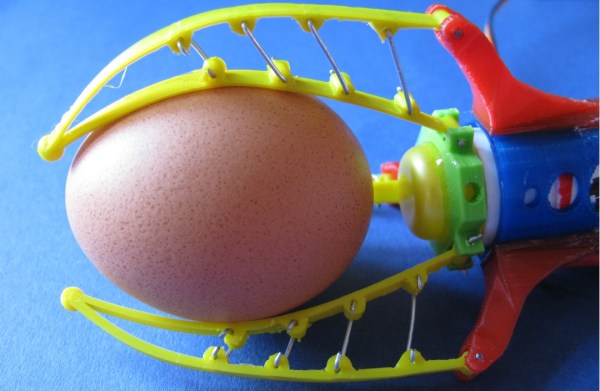
[Chiprobot] has created an amazing compliant gripper.  Designing robot hands (or end effectors) can be a perilous task. It is easy to give robots big, good, strong hands. Strong grippers have to be controlled by sensors. However, sensors can’t always be relied upon to ensure those hands don’t crush anything they touch. Hardware fails, software has bugs. Sometimes the best solution is a clever mechanical design, one which ensures a gripper will conform to the object it is gripping. We’ve seen “jamming” grippers before. (so named for their use of a granular substance which jams around the object being gripped).

[Chiprobot’s] gripper is something entirely different. He designed his gripper in blender, and printed it out with his Ultimaker 3D printer. The material is flexible PLA. Three plastic “fingers” wrap around the object being gripped. The fingers are made up of two strips of printed plastic connected by wire linkages. The flexible plastic of the fingers create a leaf spring design. The fingers are attached to a linear actuator at the center point of the gripper. The linear actuator itself is another great hack. [Chiprobot] created it from a servo and an empty glue stick.  As the linear actuator is pulled in, the fingers pull around  any object in their grip. The end result is a grip strong enough to hold an egg while shaking it, but not strong enough to break the egg.

We would like to see the gripper gripping other objects, as eggs can be surprisingly strong. We’ve all seen the physics trick where squeezing an egg with bare hands doesn’t break it, yet squeezing an egg while wearing a ring causes it to crack much… like an egg.

Continue reading “Compliant Robot Gripper Won’t Scramble Your Eggs”

Build And Control Your Own Robot Army

deltas

[Sarah Petkus] has a simple dream. She wants to build and command her own delta robot army. It all began with an illustration she drew of a woman hovering over a field of flowers. The flowers in this case had incandescent light bulbs as blooms. [Sarah] decided to create her image in the real world as an interactive art installation. Her first attempts at moving light flowers were based on a pulley system, which was unreliable and not exactly the graceful movement she imagined. Eventually [Sarah] discovered inverted delta robots. She changed her flower design to a delta, and began building her own delta robots out of parts she had around the house.

A chance meeting with the folks at SYN Shop hackerspace in Las Vegas, NV kicked the project into high gear. [Sarah] switched from using R/C ball links as joints to a simple ball bearing joint. She created her entire design in CAD software and printed it on the hackerspace’s 3d printer. She now has six working prototypes. The robots are all controlled via I2C by an Arduino compatible Nymph board. Six robots doesn’t exactly constitute an army, so [Sarah] had to find a new way to fund her project. She’s currently setting up a project for Kickstarter. [Sarah] will be selling kits for her robots, with the proceeds going toward the realization of her dream of a field of robotic light bulb flowers – Assuming the deltas don’t become sentient and try to take over the world first. [Sarah] posts progress updates to her blog, and has a dedicated site (which we featured on Sunday as part of a Links post) for information about her upcoming Kickstarter campaign.

Continue reading “Build And Control Your Own Robot Army”