Hack Chat: The Incredible Sprite_tm And The ESP32

This Friday at 5pm PST, [Sprite_tm] will be leading a Hack Chat talking about the ESP32.

[Sprite_tm] should require no introduction, but we’re going to do it anyway. He’s can install Linux on a hard drive. He can play video games on his keyboard. He built the world’s tiniest Game Boy, and gave the greatest talk I’ve ever seen. Right now, [Sprite] is in China working on the guts of the ESP32, the next great WiFi and Bluetooth uberchip.

[Sprite] recently packed his bags and headed over to Espressif, creators of the ESP32. He’s one of the main devs over there, and he’s up to his neck in the varied and weird peripherals contained in this chip. His job includes porting NES emulators to a WiFi-enabled microcontroller. If you want to learn about the latest and greatest microcontroller, this is the guy you want to talk to, and he’s taking all questions.

Note that we usually do these things earlier in the day but this week we start rolling at 5 PM Pacific Friday to help match up with [Sprite’s] timezone. You can figure out when this event will happen with this handy time and date converter.

Here’s How To Take Part:

Buttons to join the project and enter the Hack Chat

Our Hack Chats are live community events on the Hackaday.io Hack Chat group messaging. Log into hackaday.io, visit that page, and look for the ‘Join this Project’ Button. Once you’re part of the project, the button will change to ‘Team Messaging’, which takes you directly to the Hack Chat.

You don’t have to wait until Friday; join whenever you want and you can see what the community is talking about.

And Tindie Too

In addition to [Sprite]’s Hack Chat on Friday, we’re going to have a Tindie Chat in the Tindie Dog Park on Friday at noon, Pacific time. You can figure out when that’ll be in your local time by following this link.

In the Tindie Chat, we’re going to be talking about all the aspects of selling hardware on Tindie. This is a phenomenal community that keeps on growing, and right now there’s some really, really cool hardware being offered up from makers and creators around the world.

Upcoming Hack Chats

We have a few more Hack Chats on the books. On February 10th, we’ll be talking RF with [Jenny List]. Sparkfun will be around for a Hack Chat on February 17th. If stats are your thing, we’ll have a chat on the ins and outs of R in a few weeks.


Increase The Range Of An ESP8266 With Duct Tape

For the longest time now, I’ve wanted to build a real, proper radio telescope. To me, this means a large parabolic reflector, a feed horn made of brass sheet, coat hanger wire, and at least for the initial experiments, an RTL-SDR dongle. I’ve done the calculations, looked at old C-band antennas on Craigslist, and even designed a mount or two that would make pointing the dish possible. I’ve done enough planning to know the results wouldn’t be great. After months of work, the best I could ever hope for is a very low-resolution image of the galactic plane. If I get lucky, there might be a bright spot corresponding to Sagittarius A.

There are better ways to build a radio telescope in your back yard, but the thought of having a gigantic parabolic dish out back, peering into the heavens, has stuck with me. I’ve even designed a dish that can be taken apart easily and transported because building your own dish is far cooler than buying a West Virginia state flower from a guy on Craigslist.

Recently, I was asked to come up with a futuristic, space-ey prop for an upcoming video. My custom-built, easily transportable parabolic antenna immediately sprang to mind. The idea of a three-meter diameter parabolic dish was rejected for something a little more practical and a little less expensive, but I did go so far as to do a few more calculations, open up a CAD program, and start work on the actual design. As a test, I decided to 3D print a small model of this dish. In creating this model, I inadvertently created the perfect WiFi antenna for an ESP8266 module using nothing but 3D printed parts, a bit of epoxy, and duct tape.

Continue reading “Increase The Range Of An ESP8266 With Duct Tape”

Hackaday Links Column Banner

Hackaday Links: January 29, 2017

A 3D printer and laser cutter were cited as cause in two deaths. A couple (and two cats) were found dead in their apartment this week. The cause of death was carbon monoxide poisoning. Police and the gas company investigated the residence and found no other source of carbon monoxide besides a 3D printer and a laser cutter. Be sure to check out the people who know more about these deaths than the people who actually investigated these deaths in the comments below. In the mean time, get a CO detector. It’s nasty stuff.

At CES last this month, Lulzbot unleashed the MOARstruder. It’s an extruder with a massive, massive, 1.2mm nozzle. [James] from xrobots dot co dot uk just got his hands on the MOARstruder and the initial results are pretty cool. With a 1.2mm nozzle, you can print big parts fast (helpful for [James]’ massive builds), and the parts are stronger. Check out the video for a great hammer vs. printed part test.

We knew this would happen eventually. Pi Blades. Element14 is now offering ‘breakout boards but not quite’ for the full-size Raspberry Pis and Pi HATs. The idea of this product is to package clusters of Pis into an easy-to-use form factor. The Bitscope Blade Quattro, for example, provides power to four Pis. In other news, I own 20% of the world’s supply of vertical SODIMM sockets.

Arbitrary Code Execution On The Nintendo 64. A bit of background is required before going into this. Pokemon Stadium is a game for the N64. It used a Transfer Pak to read the save game data on Pokemon Game Boy cartridges to battle, trade, and organize Pokemon. Additionally, the Pokemon Tower in Pokemon Stadium allows players to play first-gen Game Boy Pokemon games from within an N64 – sort of like the SNES Super Game Boy. By using two Game Boy Pokemon games and two Transfer Paks, arbitrary code can be executed on the N64. Video demo right here. This is really cool, and the next obvious step is a ‘bootloader’ of sorts to allow arbitrary code downloading from controller button presses.

The Travelling Hacker Box is on the move! The original plan for the Travelling Hacker Box was to visit home base for the 2016 Hackaday SuperConference, then depart to foreign lands beginning with Canada, Greenland, Europe, Africa, Asia, Oceana, and the other America. After the SuperCon, the box was shipped out to its first recipient in Canada. The box came back. Something with customs. Now, the Travelling Hacker Box is on the move again. The plan is still the same, it’s just delayed a month or two. If you want to check out the future travels of the Travelling Hacker Box, here you go.

The DIY Luggable PC

If you haven’t gone laptop shopping recently, you’re in for a big shock when you do. Recent consumer laptops are thin, powerful, surprisingly inexpensive, and Apple’s latest MacBook Pros even have a fantastic ‘Touch Bar’ – a touch-sensitive OLED display where the function keys should be. The greatest laptops ever made are available right now, and they don’t cost much, either.

Unfortunately, the laptop as a platform is inherently a compromise. If you want a discrete CPU, or if you simply want to choose your own parts, you’re relegated to a desktop build. The middle ground between extensibility and portability isn’t really covered by case manufacturers, and even the rare ‘LAN party’ cases rarely have a handle.

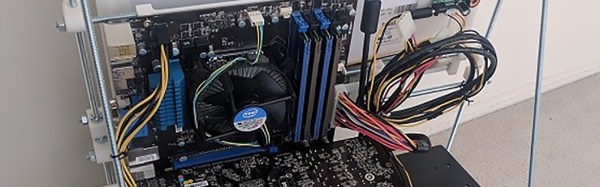
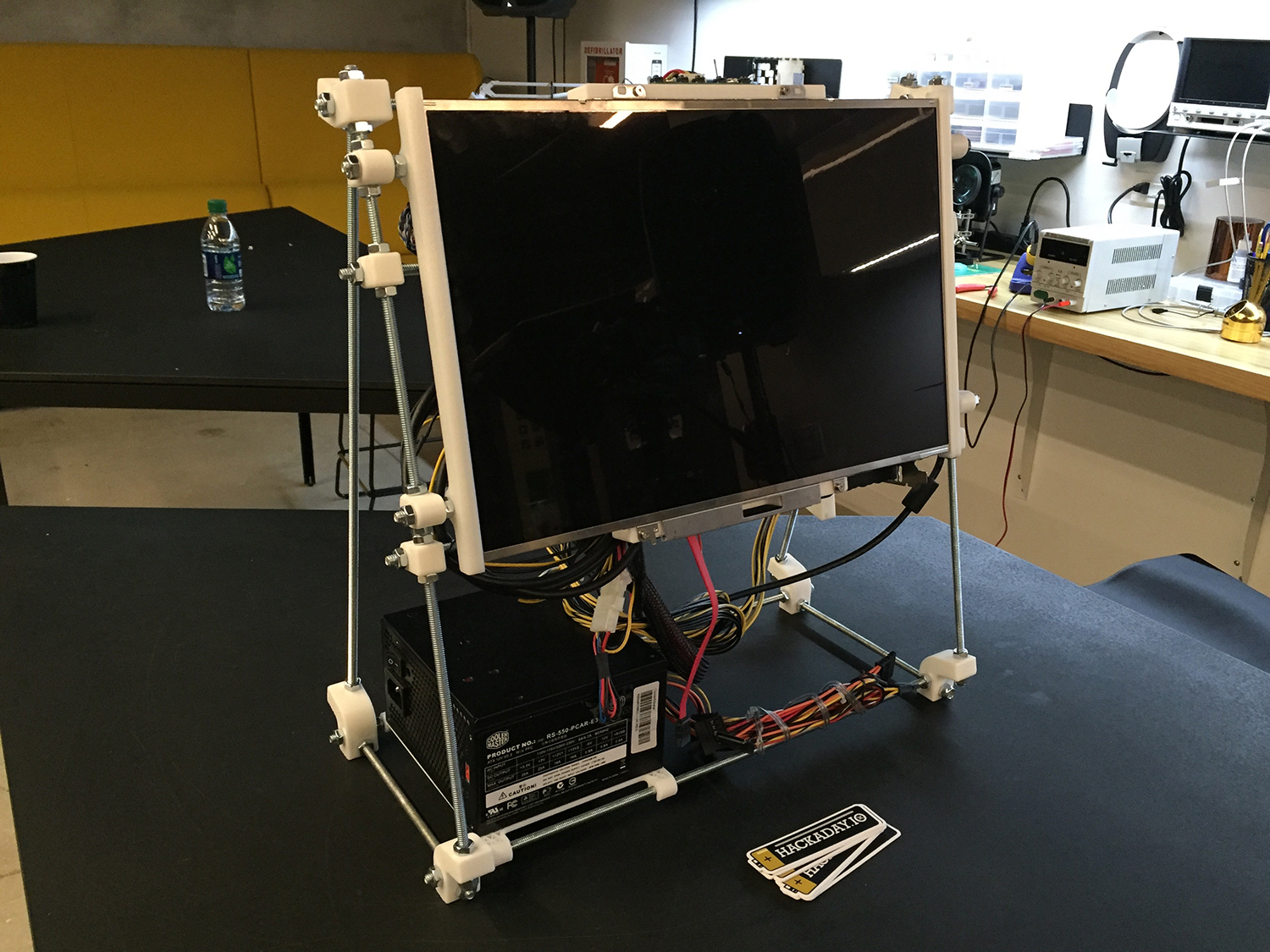
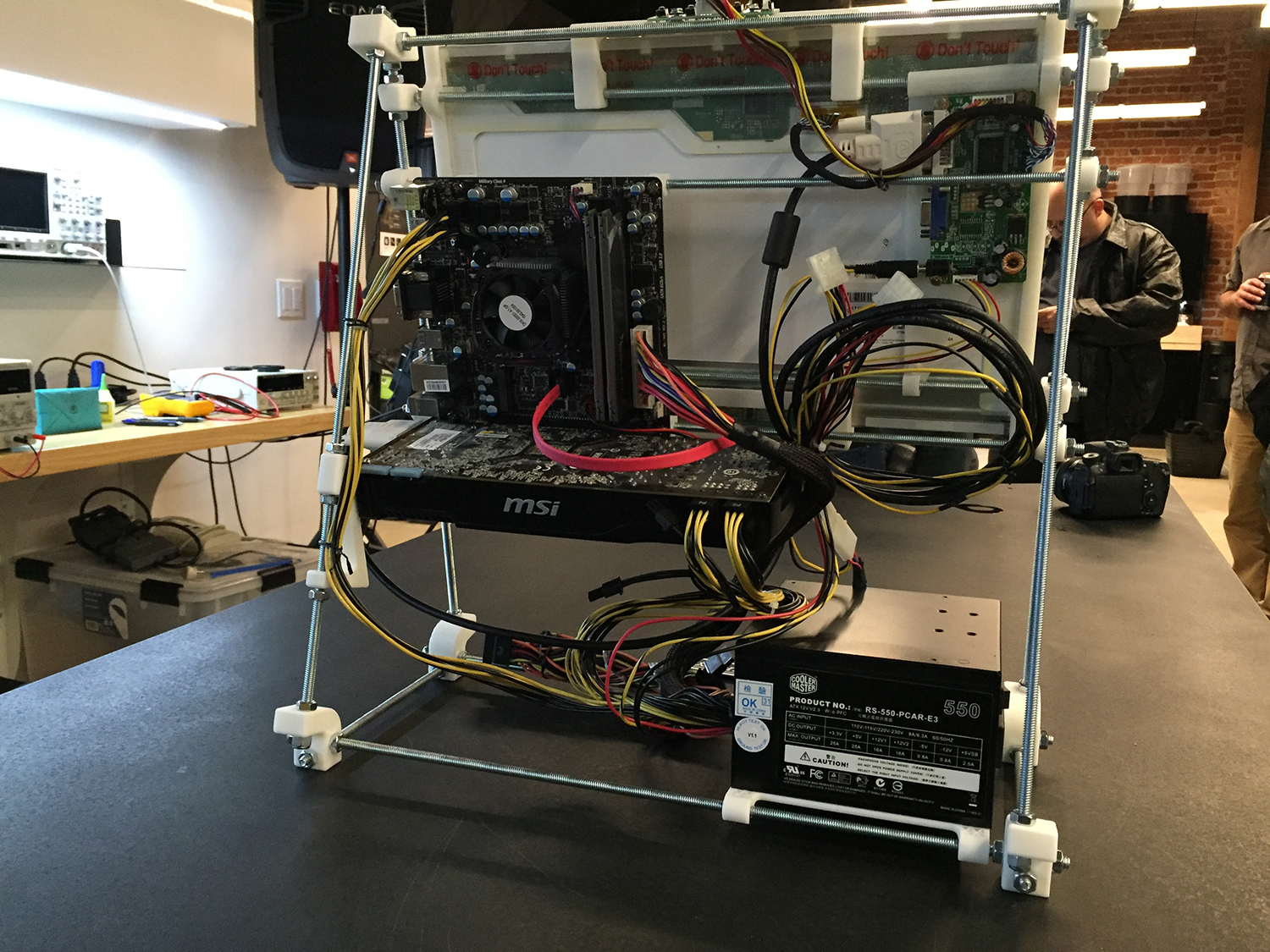
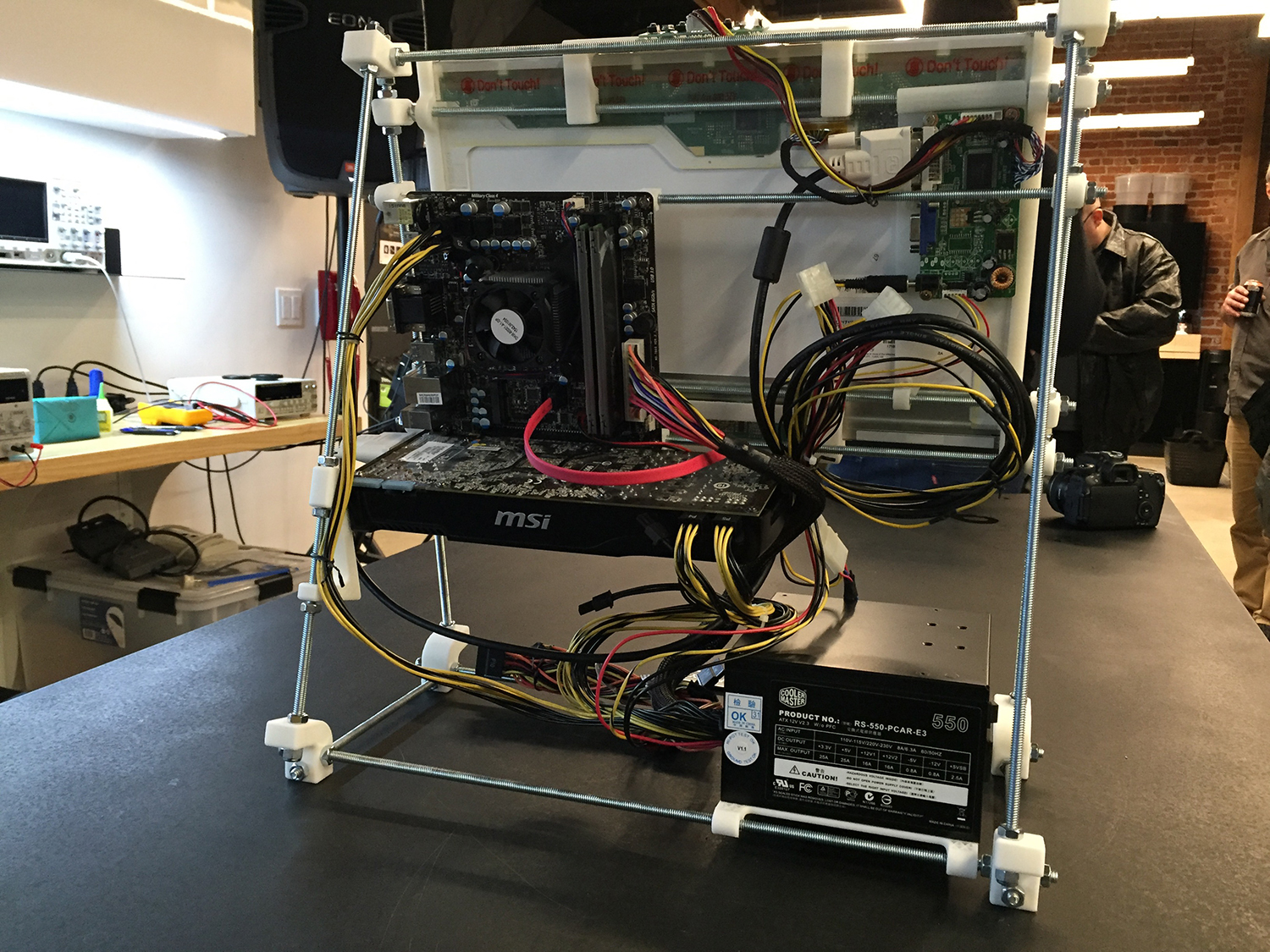
[Roger] is taking steps to solve this problem. He’s designed a 3D printable luggable PC. Yes, now you can have a GTX 1080 and a 22-core Xeon in a form factor you can carry around. It’ll fit in the overhead bin on your next flight, and yes, the monitor is included.

The construction of this DIY luggable PC should be familiar to anyone who built a 3D printer in 2011. It’s made out of threaded rods, with brackets for an LCD panel, ATX power supply, motherboard, and SSDs. Since this is effectively a modular system, you can load this case up with hardware. The included monitor in [Roger]’s build is taken from an old laptop and driven through an eBay “LCD Controller Board”.

While a luggable PC might be a very niche use case, it is still one that’s vastly underserved. I recently built a new battlestation, and after searching for a case like this for a few months, I eventually gave up, caved in, and bought whatever Linus told me to buy. You simply cannot buy an ATX case that has a monitor bolted to the side, and [Roger]’s build is the first DIY solution we’ve seen.

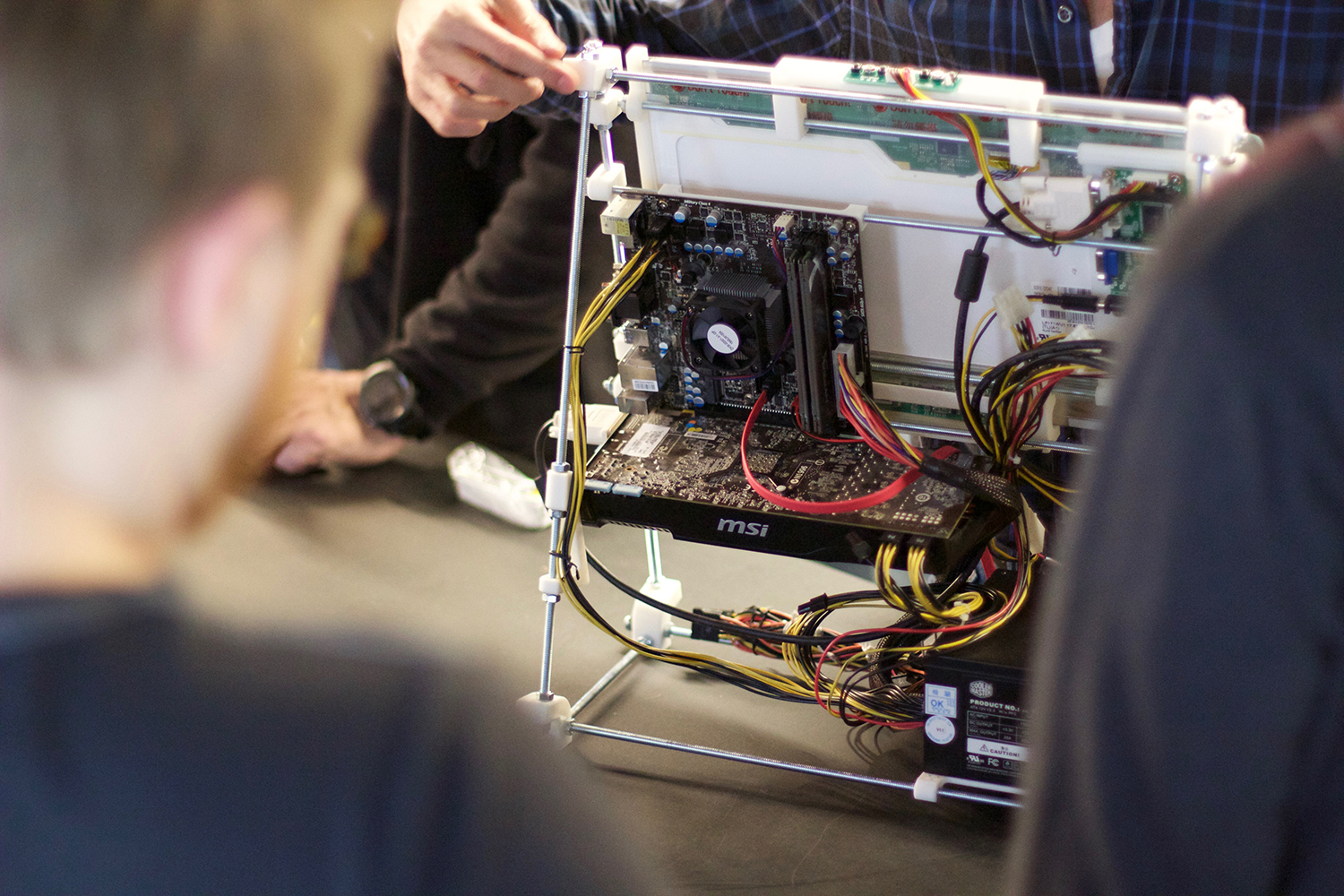
All the files to replicate this project are linked to on the [Roger]’s Hackaday.io project, and this would be an excellent basis for a community-based project to build an Open Hardware luggable PC enclosure. A few days ago, [Roger] brought this PC out to the Hackaday LA January meetup. He brought to the meetup on the train, providing more than enough evidence this is a truly portable PC. Check out the pics from the meetup below.

These Five Hackaday.io Members Just Won Fancy New CircuitPython Boards

Just a few hours ago, we had a HackChat over on Hackaday.io with Adafruit discussing CircuitPython, their new extension to the MicroPython codebase. During the chat, the folks at Adafruit took questions and asked participants in the chat what they’d like to build with some cool new hardware. These CircuitPlayground M0 Express boards are brand new, unreleased hardware. Really cool stuff.

The winners of these unreleased boards, and the projects they’ll be using them for are: [RaidDude8] for a light painting system, [gelatinousslime] for a ‘magic wand’ for his daughter that reacts to gestures, [Neon22] for a multiuser game using Neopixels, [turbinenreiter] for a gravity demonstrator using Neopixels and the accelerometer, and [todbot] for a Powermate knob USB HID clone.

During the chat, The folks at Adafruit talked about their additions to MicroPython. It’s a rework of the API, provides better support for more platforms, and extends the entire thing to microcontrollers.  If you like Python and want to get into microcontrollers, this one is for you.

If you missed the chat, you can still check out Adafruit’s live stream right here, or the transcript right here. Below, you can check out Lady Ada awarding the new boards after the break.

We have a few more HackChats coming up in the next few weeks, one with [Sprite_TM], inevitably discussing why he won’t do a crowdfunding campaign for his tiny, tiny Game Boy, an RF talk with [Jenny List], and a chat with Sparkfun. You can check out the upcoming HackChats here. Want to get in on the action? Request to join the HackChat and you’re in.

Continue reading “These Five Hackaday.io Members Just Won Fancy New CircuitPython Boards”

A Personal Fight Against The Modern Laptop

If you haven’t gone laptop shopping recently, you’re in for a big shock when you do. While the current generation of MacBook Pros is rightly torn to shreds for being an overpriced machine with a stupid gimmick of a Touch Bar, there are issues with laptops across the industry. No one has figured out how to take a high-res iPad screen and add a keyboard, most laptops with a display smaller than 13 inches are capped at 720 resolution, new features are introduced at the expense of old ones, binary blobs are cast into a web of BIOS whitelists and missing drivers, No, the Microsoft Surface doesn’t count, because while it’s a nice machine it’s a tablet with a keyboard, not a laptop.

After months of searching, [Hamish Coleman] found the closest thing to a perfect laptop. It’s a Thinkpad X230 from the ancient days of yore, or 2012 depending on how you’re counting. It’s close to perfect, though: aside from an old CPU and GPU, the only real show stopper is the keyboard. Replacing that keyboard was [Hamish]’s personal fight against the modern laptop (YouTube, embedded below), and he’s making it easier for us to fight against the current crop of craptops, too.

Continue reading “A Personal Fight Against The Modern Laptop”

Hackaday Links: January 22, 2017

What is a 1971 Ford Torino worth? It depends, but even a 2-door in terrible condition should fetch about $7 or $8k. What is a 1971 Ford Torino covered in 3D printed crap worth? $5500. This is the first ‘3D printed car’ on an auction block. It looks terrible and saying ‘Klaatu Varada Nikto’ unlocks the doors.

Old Apple IIs had a DB19 connector for external floppy drives. Some old macs, pre-PowerPC at least, also had a DB19 connector for external floppy drives. These drives are incompatible with each other for reasons. [Dandu] has a few old macs and one old Apple II 3.5″ external floppy drive. This drive can be hacked so it works with a Mac Classic. The hack is simply disconnecting one of the boards in the drive, and it only reads 400 and 800kB disks, but it does work.

The US Army is working on a hoverbike. Actually, it’s not a hoverbike, because it doesn’t have a saddle or a seat, but it could carry 300 pounds at 60 mph. That’s 136,000 grams at 135 meters per second for the rest of the world out there. This ‘hoverbike’ will be used for very quick resupply, and hopefully a futuristic form of jousting.

Over the past few months, we’ve seen a few new microcontrollers built around the RISC-V core. The first is the HiFive1, a RISC-V on an Arduino-shaped board. The Open-V is another RISC-V based microcontroller, and now it too supports the Arduino IDE. That may not seem like much, but trust me: setting up the HiFive1 toolchain takes at least half an hour.

The NAMM show has been going on for the last few days, which means new electronic musical gear, effects pedals, and drum machines. This is cool, but somewhat outside our editorial prerogative. This isn’t. It’s a recording studio using a Rasberry Pi. Tracktion is working on a high-quality digital audio input and output add-on for the Pi 3. This is really cool, and you only need to look back at MPCs and gigantic Akai samplers from 15 years ago to see why.

Hey LA peeps. Sparklecon is next weekend. What’s Sparklecon? The 23B hackerspace pulls out the grill, someone brings a gigantic Tesla coil, we play hammer Jenga, and a bunch of dorks dork around. Go to Sparklecon! Superliminal advertising! Anyone up for a trip to the Northrop ham meetup next Saturday?