Pwning With Sewing Needles

If you don’t have root, you don’t own a device, despite what hundreds of Internet of Things manufacturers would tell you. Being able to access and write to that embedded Linux system in your new flashy gadget is what you need to truly own a device, and unfortunately this is a relatively uncommon feature. At this year’s DEF CON, [Brad Dixon] unveiled a technique that pwns a device using only a sewing needle, multimeter probe, or a paperclip. No, it won’t work on every device, and the devices this technique will work with are poorly designed. That doesn’t mean it doesn’t work, and that doesn’t mean the Pin2Pwn technique isn’t useful, though.

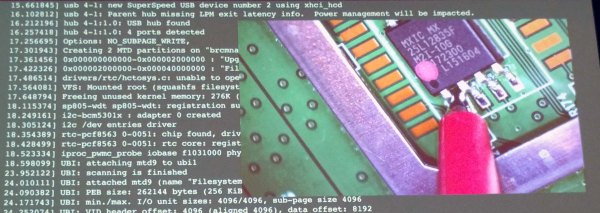
The attack relies on how an embedded Linux device boots. All the software needed to load Linux and the rest of the peripheral magic is usually stored on a bit of Flash somewhere on the board. By using a pin, probe, or paperclip to short two data pins, or two of the latch pins on this memory chip, the bootloader will fail, and when that happens, it may fall back to a uboot prompt. This pwns the device.

There are a few qualifications for this Pwn using a pin. If the device has JTAG, it doesn’t matter – you can already own the device. If, however, a device has a locked-down JTAG, unresponsive serial ports, or even their own secure boot solution, this technique might work.
Two data pins on a TSSOP Flash shorted by a multimeter probe

This exploit works on the property of the bootloader. This bit of code first looks at a piece of Flash or other memory separate from the CPU and loads whatever is there. [Brad] found a few devices (mostly LTE routers) that would try to load Linux from the Flash, fail, try to load Linux again, fail, and finally drop to a uboot prompt.

As with any successful exploit, an equally effective mitigation strategy must be devised. There are two ways to go about this, and in this case, the software side is much better at getting rid of this attack than the hardware side.

Since this attack relies on the software falling back to uboot after an unsuccessful attempt at whatever it should be booting, the simplest and most effective mitigation technique is simply rebooting the device if the proper firmware can’t be found. Having a silent serial console is great, but if the attack relies on falling back to uboot, simply not doing that will effectively prevent this attack.

The hardware side is a little simpler than writing good firmware. Instead of using TSSOP and SOIC packages for storing the device firmware, use BGAs. Hide the pins and traces on an inner layer of the board. While this isn’t a foolproof way of preventing the attack – there will always be someone with a hot air gun, magnet wire, and a steadier hand than you – it’s hard to glitch a data line with a sewing needle if you can’t see the data line.
The Terrible Security Of Bluetooth Locks

Bluetooth devices are everywhere these days, and nothing compromises your opsec more than a bevy of smartphones, smart watches, fitbits, strange electronic conference badges, and other electronic ephemera we adorn ourselves with to make us better people, happier, and more productive members of society.

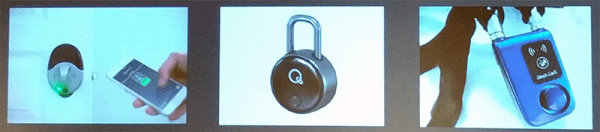
Bluetooth isn’t limited to wearables, either; deadbolts, garage door openers, and security systems are shipping with Bluetooth modules. Manufacturers of physical security paraphernalia are wont to add the Internet of Things label to their packaging, it seems. Although these devices should be designed with security in mind, most aren’t, making the state of Bluetooth smart locks one of the most inexplicable trends in recent memory.

At this year’s DEF CON, [Anthony Rose] have given a talk on compromising BTLE locks from a quarter-mile away. Actually, that ‘quarter mile’ qualifier is a bit of a misnomer – some of these Bluetooth locks are terrible locks, period. The Kwikset Kevo Doorlock – a $200 deadbolt – can be opened with a flathead screwdriver. Other Bluetooth ‘smart locks’ are made of plastic.

The tools [Anthony] used for these wireless lockpicking investigations included the Ubertooth One, a Bluetooth device for receive-only promiscuous sniffing, a cantenna, a Bluetooth USB dongle, and a Raspberry Pi. This entire setup can be powered by a single battery, making it very stealthy.

The attacks on these Bluetooth locks varied, from sniffing the password sent in plain text to the lock (!), replay attacks, to more advanced techniques such as decompiling the APK used to unlock these smart locks. When all else fails, brute forcing locks works surprisingly well, with quite a few models of smart lock using eight digit pins. Even locks with ‘patented security’ (read: custom crypto, bad) were terrible; this patented security was just an XOR with a hardcoded key.

What was the takeaway from this talk? Secure Bluetooth locks can be made. These locks use proper AES encryption, a truly random nonce, two factor authentication, no hard-coded keys, allow the use of long passwords, and cannot be opened with a screwdriver. These locks are rare. Twelve of the sixteen locks tested could be easily broken. The majority of Bluetooth smart locks are not built with security in mind, which, by the way, is the entire point of a lock.

[Anthony]’s work going forward will concentrate expanding his library of scripts to exploit these locks, and evaluate the Bluetooth locks on ATMs. Yes, ATMs also use Bluetooth locks. The mind reels.

Hackaday Prize Entry: A WiFi Swiss Army Knife

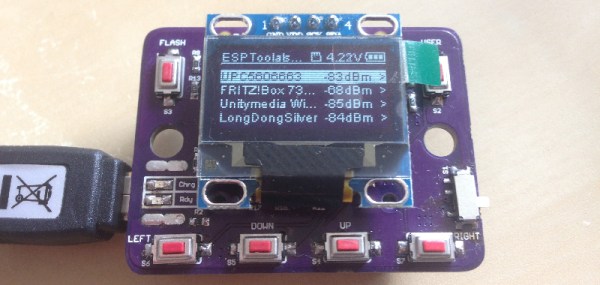
WiFi is all around us, but if you want to work with this ubiquitous networking protocol, you’ll need to pull out a laptop or smartphone like a caveman. [Daniel] has a better idea. It’ s a simple, compact tool for cracking WiFi passwords or sending deauth packets to everyone at the local Starbucks. It’s an ESP Swiss Army Knife, and a great entry for the Hackaday Prize.

As you would expect, this WiFI Swiss Army Knife is powered by the ESP8266 and features a tiny OLED display and a bunch of buttons for the UI. With this, [Daniel] is able to perform a deauth attack on a network, kicking anyone off the network, provided this device already has the MAC address of the victim.

This tiny wireless tool also has an SD card, making it possible to collect authentication frames for later decryption on a device that actually has the power to crack a network. With a LiPo charge controller and a sufficiently large battery, this tiny device could be left in the corner of an office collecting authentication packets for days until it’s later retrieved, opening up the network to anyone with a sufficiently fast computer. It’s a great build and very useful, making this a great entry for The Hackaday Prize.

Hackaday Links: August 7, 2016

The Starship Enterprise (no bloody A, B, C, or D) recently got a makeover. It was donated to the Smithsonian, and the workers at the Air and Space Museum took it apart and put it back together. Why? It’s the 50th anniversary of TOS. Hopefully the new show will be using some practical effects.

After years of trying, we’ve finally attained max buzzword. Here’s a pentesting hacker quadcopter drone, “a hacker’s laptop that can fly.” Why would anyone do this? Because, “You need to be close to the wireless signal to be able to read it. [Danger Drone] removes that barrier of physical access.” For just $500, you can do the same thing a coat hanger yagi can do. Amazing.

Q2 reports for 3D printer companies! Lulzbot is going gangbusters yet again. We’re looking at the greatest success of Open Source Hardware here. Stratasys, on the other hand, lost less money in Q2 2016. That’s their good news.

About a year ago, we heard about an LCD that was one inch high and ten inches long. That’s bizarre, but great for rackmount gear. The company behind this weird LCD is updating this weird and wonderful LCD and giving it touchscreen capability.

On this week’s edition of, ‘you’re going to cut your arm off with that thing’, here’s an angle grinder converted into a chainsaw.

A few weeks ago, we posted a link to this video, demonstrating an absurdly clever method for creating a mold for a fiberglass dome. You can just use a pendulum and a pile of dirt. Now, the mold for this fiberglass dome is complete. [J Mantzel] has already pulled 1/8th of his gigantic fiberglass sphere out of his mold, and there are only seven more to go. After that, he’ll find out if these sphere sections actually line up.

UK peeps! Hackaday and Tindie are doing a London Meetup! Details to come, but follow the event page on Hackaday.io.

I arrived in Vegas a day (or two) early for DEF CON. Instead of contemplating the banality of existence on the strip, I decided on a meetup at the grave of James T. Kirk. The meetup was a huge success. Walking two miles in 115° heat was not a great idea, but I didn’t die.

DEF CON: BSODomizing In High Definition

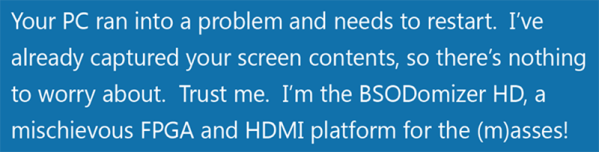
A few years ago, [Kingpin] a.k.a. [Joe Grand] (A judge for the 2014 Hackaday Prize) designed the most beautiful electronic prank ever. The BSODomizer is a simple device with a pass-through connection for a VGA display and an infrared receiver. Plug the BSODomizer into an unsuspecting coworker’s monitor, press a button on a remote, and watch Microsoft’s blue screen of death appear. It’s brilliant, devious, and actually a pretty simple device if you pick the right microcontroller.

The original BSODomizer is getting a little long in the tooth. VGA is finally dead. The Propeller chip used to generate the video only generates text, and can’t reproduce Microsoft’s fancy new graphical error screens. HDMI is the future, and FPGAs have never been more accessible. For this year’s DEF CON, [Kingpin] and [Zoz] needed something to impress an audience that is just learning how to solder. They’ve revisited the BSODomizer, and have created the greatest hardware project at this year’s DEF CON.

Continue reading “DEF CON: BSODomizing In High Definition”

Hackaday Prize Entry: Diagnosing Concussions

Athletes of every age receive a lot of blows to the head. After a few years of this and a lot of concussions, symptoms similar to Alzheimer’s can appear. For his Hackaday Prize entry, [Mihir] wanted to build a simple device that could be given to high school coaches that would diagnose concussions. He came up with HeadsUp, a device so simple even a high school gym teacher could use it.

The origins of HeadsUp began as an augmented reality device, but after realizing that was a difficult project, pivoted to something a bit easier and even more useful. HeadsUp tracks the wearer’s eye movements with a webcam while a series of LEDs strobe back and forth in front of the wearer’s eyes. This is the fastest and easiest way to test for a concussion, and making this automated means it’s the perfect device to throw in a gym bag.

DEF CON’s X86 Badge

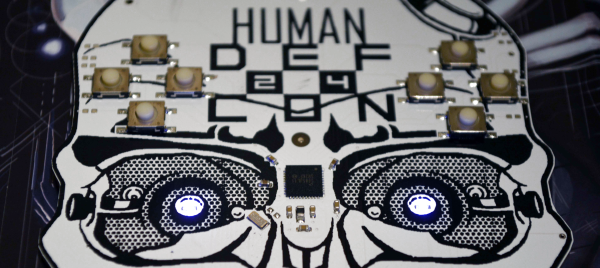
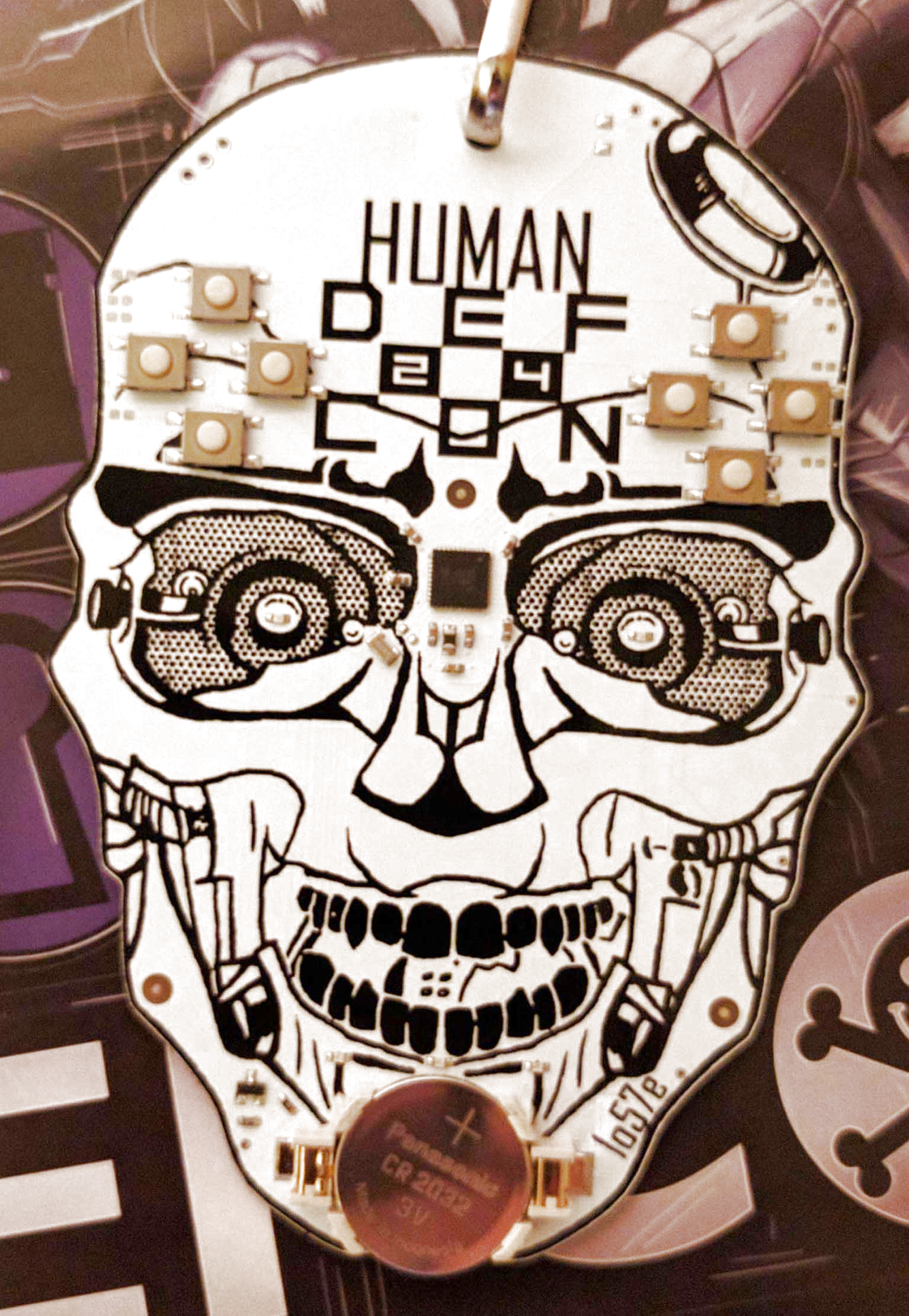
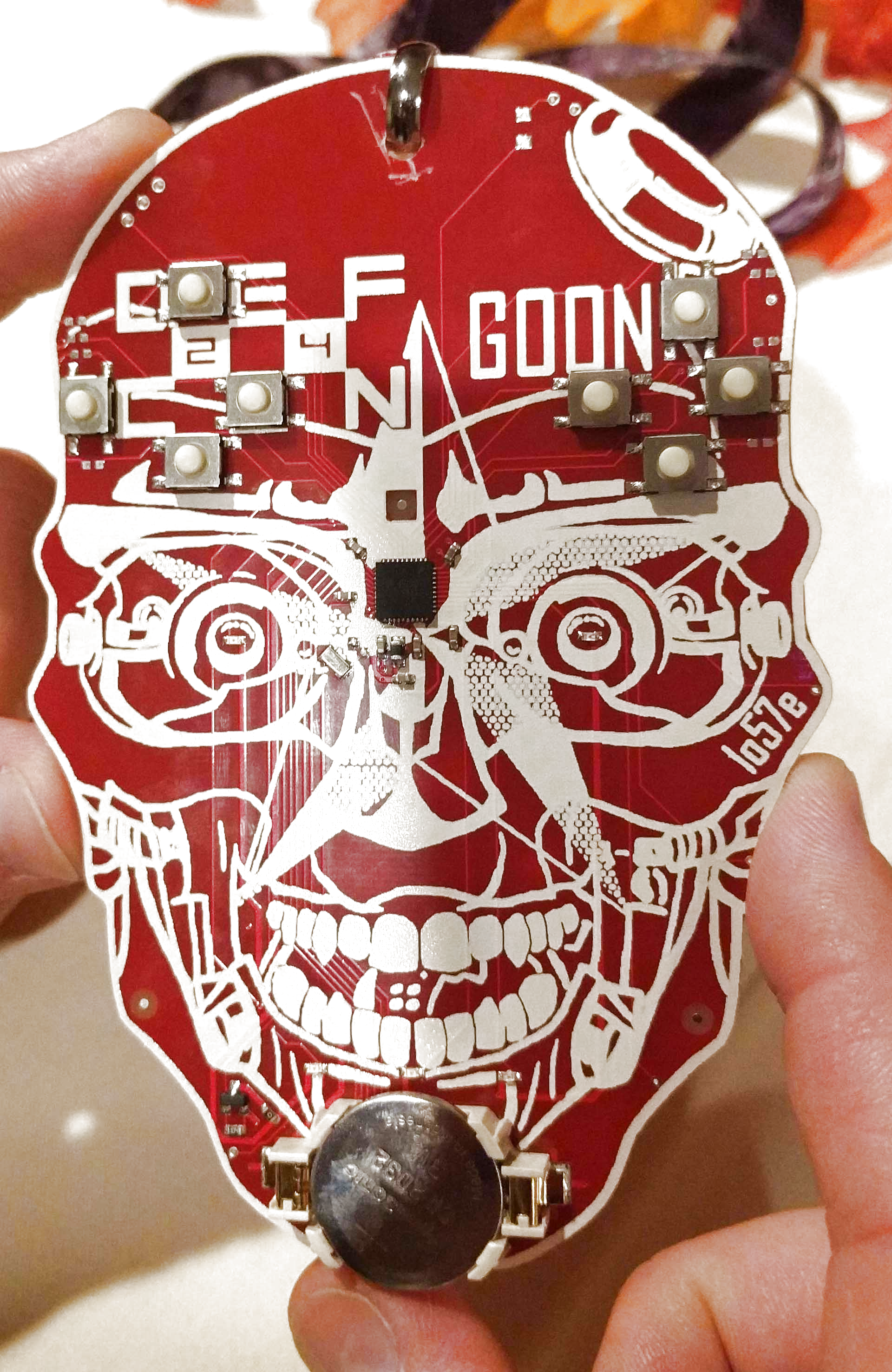
This year’s DEF CON badge is electronic, and there was much celebrating. This year’s DEF CON badge has an x86 processor, and there was much confusion.

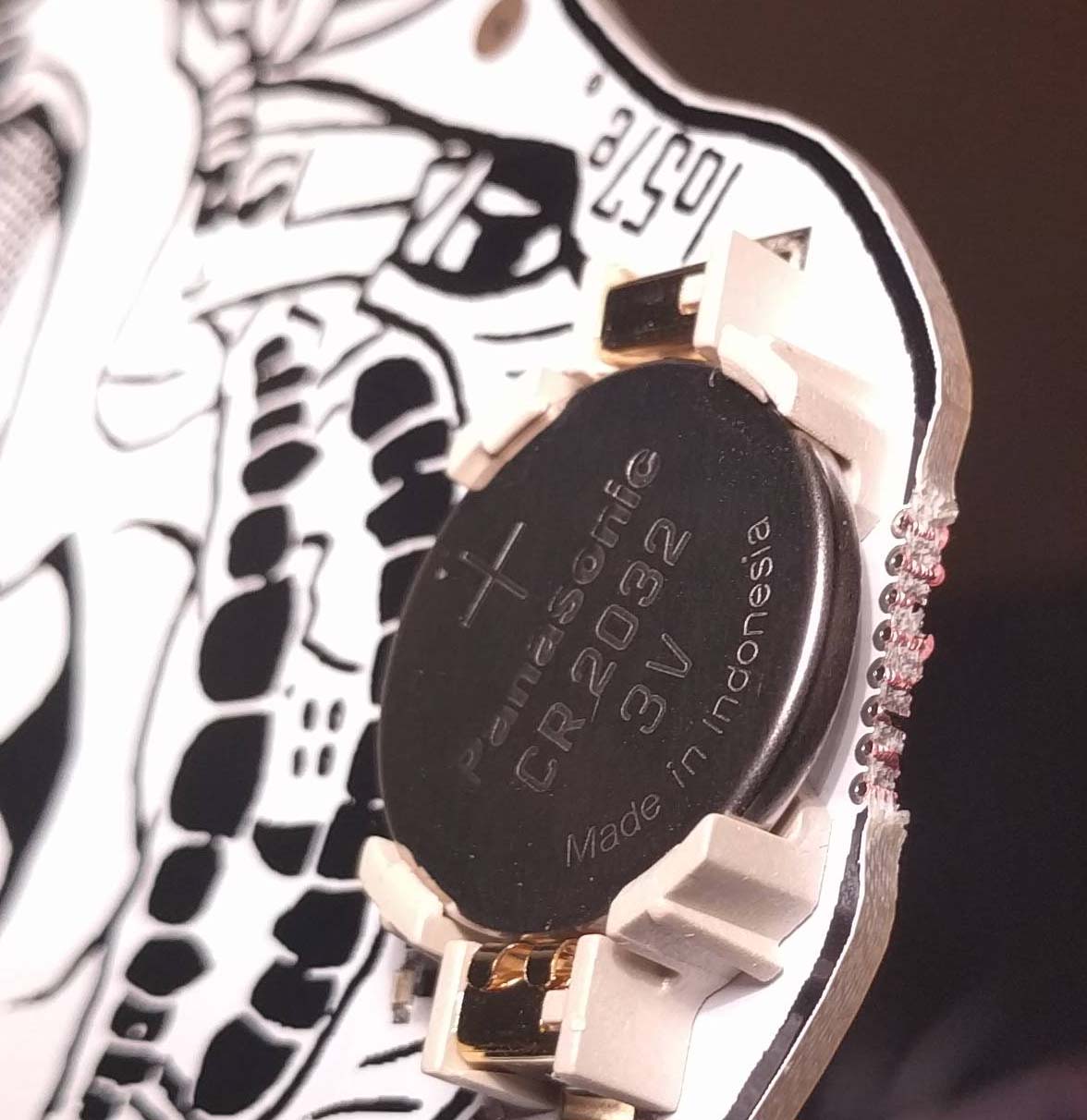
These vias are connected to something.

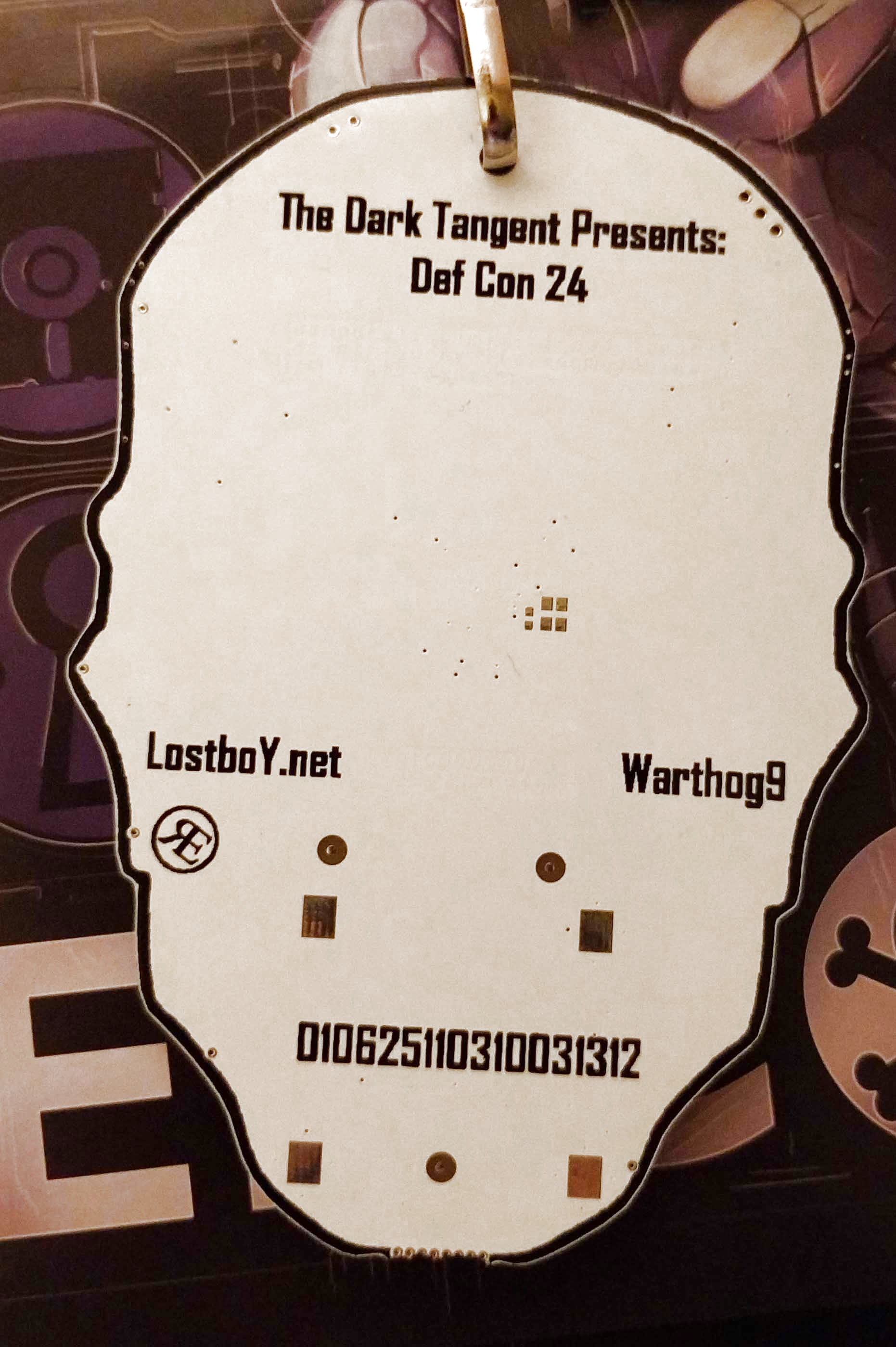
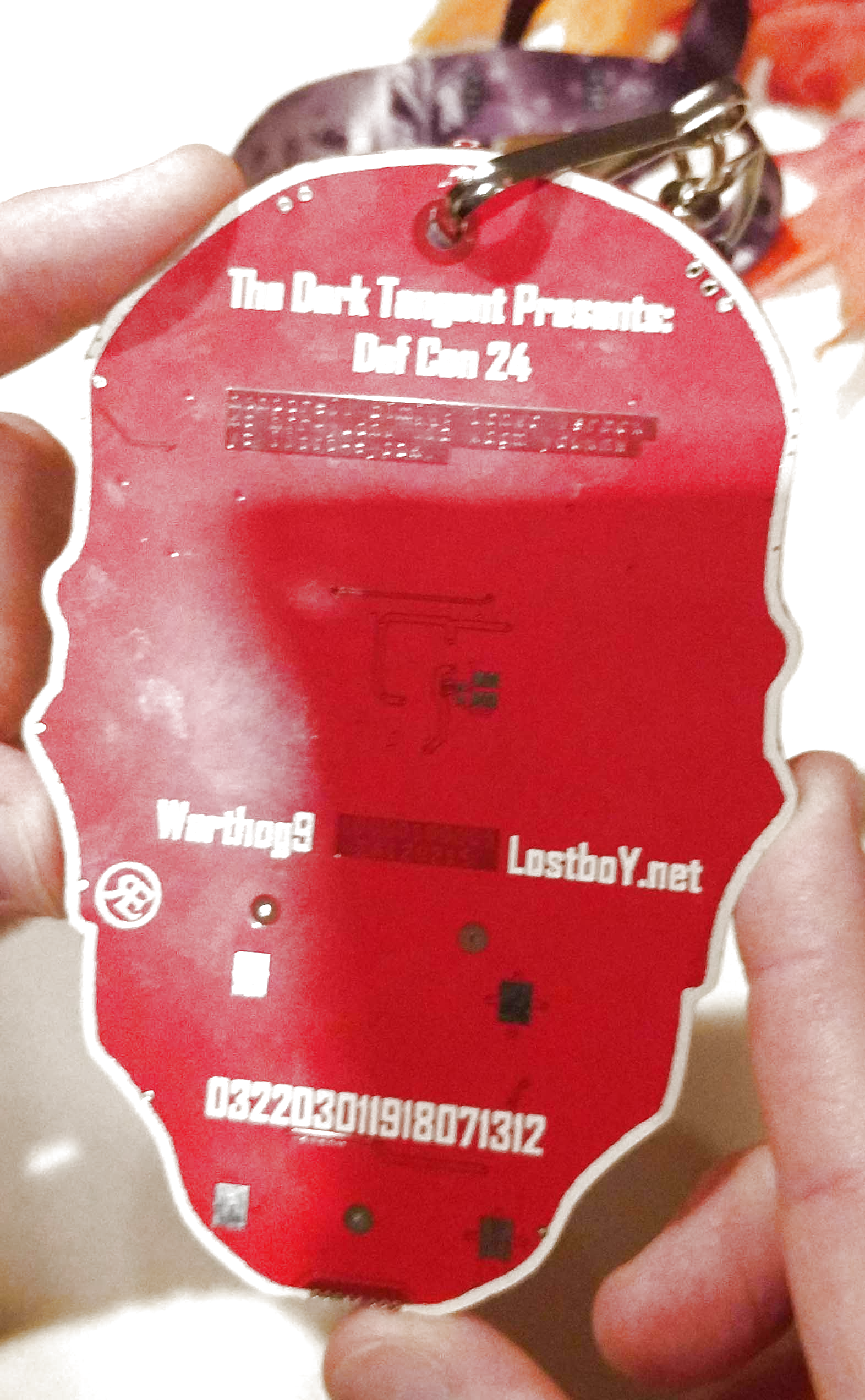
The badge this year, and every year, except badges for 18, 17, 16, 15, and 14, designed by [Joe Grand], and badges from pre-history designed by [Dark Tangent] and [Ping], was designed by [1057], and is built around an x86 processor. Specifically, this badge features an Intel Quark D2000 microcontroller, a microcontroller running at 32MHz, with 32kB of Flash and 8kB of RAM. Yes, an x86 badge, but I think an AT motherboard badge would better fulfill that requirement.

As far as buttons, sensors, peripherals, and LEDs go, this badge is exceptionally minimal. There are eight buttons, laid out as two directional pads, five LEDs, and a battery. There’s not much here, but with a close inspection of the ‘chin’ area of the badge, you can see how this badge was programmed.

As with any [1057] joint, this badge features puzzles galore. One of these puzzles is exceptionally hard to photograph as it is in the bottom copper layer. It reads, “nonpareil bimil: Icnwc lsrbcx kc htr-yudnv ifz xdgm yduxnw yc iisto-cypzk”. Another bottom copper text reads, “10000100001 ΣA120215”. Get crackin’.

A gallery of the Human and Goon badges follows, click through for the best resolution we have.

This post has been updated to correct the record of who designed badges for previous cons.