Turning A Typewriter Into A Mechanical Keyboard

Is your keyboard too quiet? Is your Cherry MX Blue board not driving your coworkers crazy enough? If the machine gun fire of a buckling spring keyboard isn’t enough for you, there’s only one solution: [Russell]’s typewriter turned into a mechanical keyboard.

Converting typewriters into keyboards has been done for a very long time; teletypes, the first computer keyboards, were basically typewriters, and the 1970s saw a number of IBM Selectrics converted into a keyboard with serial output. Even in recent years, typewriters have been converted into keyboards with the help of some switches and an ATMega. [Russell]’s mechanical keyboard improves on all of these builds by making the electronic interface dead simple, and a project that can be done by anyone.

Instead of installing switches underneath every key or futzing about with the weird mechanics of a Selectric typewriter, [Russell] is only installing a touch-sensitive position sensor into the frame of the typewriter. When a key is pressed, it strikes a crossbar in the frame of the typewriter. With a single ADC chip and a Raspberry Pi, [Russell] can determine which key was pressed and use that information to output a character to a terminal.

It’s a very simple solution for an electrical interface to a mechanical device, and the project seems to work well enough. [Russell] is using his new keyboard with Vim, even, something you can check out in the video below.

Continue reading “Turning A Typewriter Into A Mechanical Keyboard”

GoGo Starts Testing New In-Flight Internet Technology

GoGo, the largest provider of Internet above 30,000 feet, has announced they are now testing their next generation of in-flight Internet.

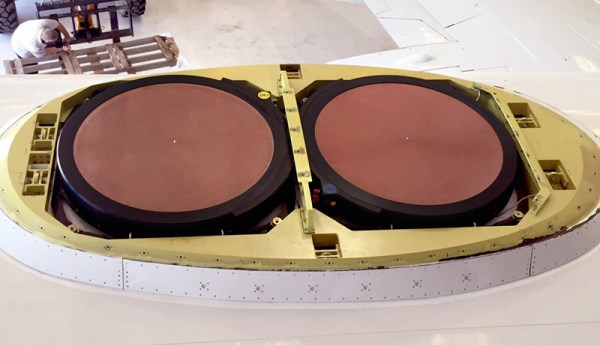
Of special interest in the new 2Ku system is the antennas strapped to the top of a GoGo-equipped plane’s fuselage. These antennas form a mechanically-phased-array that are more efficient than previous antennas and can provide more bandwidth for frequent fliers demanding better and faster Internet.

The Antenna Pod
The Antenna Pod

Currently, GoGo in-flight wireless uses terrestrial radio to bring the Internet up to 35,000 feet. Anyone who has flown recently will tell you this is okay, but you won’t be binging on Nexflix for your next cross country flight. The new system promises speeds up to 70Mbps, more than enough for a cabin full of passengers to be pacified by electronic toys. The 2Ku band does this with a satellite connection – much faster, but it does have a few drawbacks.

Because the 2Ku system provides Internet over a satellite connection, ping times will significantly increase. The satellites GoGo is using orbit at 22,000 miles above Earth, or about 0.1 light seconds away from the plane. Double that, and your ping times will increase by at least 200ms compared to a terrestrial radio connection.

While this is just fine for email and streaming, it does highlight the weaknesses and strengths of mobile Internet.

Hackaday Prize Semifinalist: CANcrusher

In 2007, everyone discovered you could blink an LED with an Arduino. A few years after that, someone discovered you could make a PID controller work with an Arduino, and a great number of sous vide cooker hacks showed up on the Internet. Trends in electronics projects come and go, and this year we have CANbus sniffers and development platforms. One of these CAN dev platforms, CANcrusher, is a semifinalist for the Hackaday Prize, and does a great job at poking and prodding a CANbus.

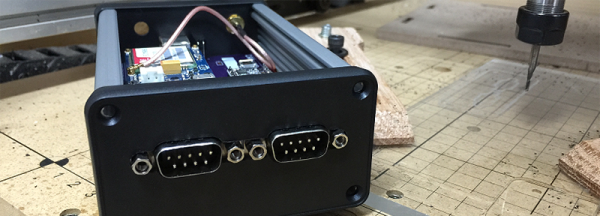
Like a lot of very excellent projects, the CANcrusher is based on a Teensy 3.1 microcontroller. This, along with the MCP2515 CAN controller gives the CANcrusher three independent CAN channels supporting DW-CAN, SW-CAN, and LSFT. The software for the device can stream data directly to a computer over USB.

Simply providing an interface for a CAN bus is something that has been done to death, and to improve upon the many CANbus projects out there, the CANcrusher is adding Bluetooth, a GSM radio, SD datalogging, and a real time clock. It’s a great project for the Hackaday Prize with multiple videos explaining how it works and what it can do. You can check out the entry video for the CANcrusher below.

The 2015 Hackaday Prize is sponsored by:

Continue reading “Hackaday Prize Semifinalist: CANcrusher”

ESP8266 In Commercial Products

The hobbyist electronics market is still tiny, and even though random companies are coming out with some very interesting hardware, these parts and components aren’t exactly meant for us. The ESP8266 WiFi module is a slight deviation from this trend, with hundreds of different ESP dev boards floating around, and weirdos buying them by the bag.

[4ndreas] finally found the ESP8266 in a product; it’s not a very noteworthy observation until you realize how much work has gone into the development of open source toolchains for the ESP.

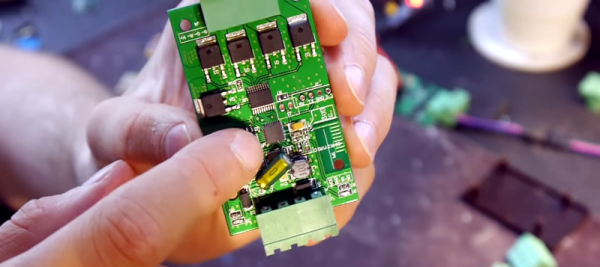
[4ndreas] found an RGB LED strip on Ali Express that could be controlled by WiFi. Inside, he found everyone’s favorite WiFi module, and by shorting two pins, he started up the controller in bootloader mode.

Because of the massive amount of open source development surrounding the ESP8266, there are a host of tools that can be used to program this cheap LED controller. [4ndreas] took a swing at writing his own firmware for the controller and came up with this project.

It’s not a killer project, but it does demonstrate the power of open source toolchains for cheap WiFi modules. This is only the first product found with an ESP8266 inside, but there are undoubtedly others out there just waiting to be taken apart and controlled in more advanced ways.

Continue reading “ESP8266 In Commercial Products”

The Problem With Kickstarter: A Lack Of Transparency

Since 2010, over one and a half billion dollars has been transferred from Kickstarter backers to project creators, and with Kickstarter’s 5% cut taken on each dollar collected, that means Kickstarter has had somewhere in the neighborhood of 75 to 80 million dollars in revenue in the last five years. That’s a success by any measure, and as with this huge amount of money, questions must be asked about the transparency of Kickstarter.

This is not a post about a Kickstarter project for an impossible project, a project that breaks the laws of physics, or one that is hyped beyond all reasonable expectations. This is a post about Kickstarter itself, and it’s been a long time coming. In the past, Kickstarter has shown at least some transparency by cancelling projects that are obvious rebrandings of white label goods – a direct violation of their rules. Kickstarter has even cancelled projects that violate the laws of physics, like this wireless charging Bluetooth tag. It’s a start, but Kickstarter has a much larger problem on its plate: the Staff Pick problem.

Continue reading “The Problem With Kickstarter: A Lack Of Transparency”

Two New FPGA Families, Designed In China

The two largest manufacturers of FPGAs are, by far, Altera and Xilinx. They control over 80% of the market share, with Lattice and others picking up the tail end. The impact of this can be seen in EE labs and alibaba; nearly every FPGA dev board, every instructional, and every bit of coursework is based on Altera or Xilinx chips.

There’s a new contender from the east. Gowin Semiconductor has released two lines of FPGAs (Google translate) in just under two years. That’s incredibly fast for a company that appears to be gearing up to take on the Altera and Xilinx monolith.

The FPGA line released last week, the GW1N family, is comprised of two devices with 1,152 and 8,640 LUTs. These FPGAs are built on a 55nm process, and are meant to compete with the low end of Altera’s and Xilinx’ offerings. This adds to Gowin’s portfolio introduced last May with the GW2A (Google translate) family, featuring devices ranging from 18,000 to 55,000 LUTs and DSP blocks. Packages will range from easily solderable QFN32 and LQFP100, to BGA packages with more pins than an eighteenth century seamstress at the royal ball.

For comparison, Xilinx’ Spartan-6 LX family begins with devices featuring 3,840 LUTs and 216kb of block RAM, with larger devices featuring 147,443 LUTs and up to 268kb of block RAM. Altera’s Cyclone IV E devices are similarly equipped, with devices ranging from 6,272 to 114,480 LUTs. Between the two device families introduced by Gowin recently, nearly the entire market of low-end FPGAs is covered, and they’re improving on the current offerings: the GW1N chips feature random access on-chip Flash memory. Neither the low-end devices from Altera nor devices from Lattice provide random-access Flash.

The toolchain for Gowin’s new FPGAs is based nearly entirely on Synopsys’ Synplify Pro, with dedicated tools from Gowin for transforming HDL into a bitstream for the chip. This deal was inked last year. As for when these devices will make it to market, Gowin is hoping to send out kits to well-qualified devs soon, and the devices may soon show up in the warehouses of distributors.

Gowin’s FPGAs, in contrast to the vast, vast majority of FPGAs, are designed and fabbed in China. This gives Gowin a unique home-field advantage in the land where everything is made. With LVDS, DSP, and other peripherals these FPGAs can handle, Gowin’s offerings open up a wide variety of options to developers and product engineers a few miles away from the Gowin plant.

The GW1N and GW2A families of FPGAs are fairly small when it comes to the world of FPGAs. This limitation is by capability though, and not number of units shipped. It’s nearly tautological that the largest market for FPGAs would be consumer goods, and Gowin is focusing on what will sell well before digging in to higher end designs. We will be seeing these chips show up in devices shortly, and with that comes a new platform to tinker around with.

If you’re looking to make your mark on the world of open source hardware and software, you could do worse than to start digging into the synthesis and bitstream of these Gowin chips. Just months ago, Lattice’s iCE40 bitstream was reverse engineered, and already there are a few boards capitalizing on a fully open source toolchain for programmable logic. With more capable FPGAs coming out of China that could be stuffed into every imaginable product, it’s a golden opportunity for hardware hackers and developers alike.

[Thanks for the tip Antti]