3D Printable LED Diffusors

While you can get an LED matrix in any size or shape, the really cool looking ones that are perfect for low-res displays all have diffusors. When they come from a nameless Chinese factory, these diffusors are thin sheets of plastic set into an extruded plastic frame. Since [Jana] has a 3D printer, she figured a custom diffusor was just a few bits of filament and a SCAD file away.

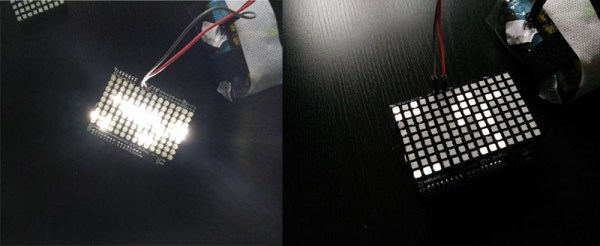
The basis for this custom LED diffusor was a LoL Shield given to [Jana] by the creator at the recent 31C3 conference. This shield is really only just 126 LEDs, multiplexed and in an Arduino form factor, and that many LEDs were just too bright and indistinct next to each other. The plan for a 3D printed diffusor was hatched.

After taking a few measurements, a pair of OpenSCAD files were whipped up and printed out. Assembly consisted of pressing 126 tiny little white diffusors into a frame, but once everything was attached to the matrix, the results were worth it.

Check out the video below for the before and after, demonstrating what a few bits of plastic can do to a LED matrix.
Continue reading “3D Printable LED Diffusors”

Prototyping With The ATMega1284P

While most people are moving onto ARMs and other high-spec microcontrollers, [Dave Cheney] is bucking the trend. Don’t worry, it’s for a good reason – he’s continuing work on one of those vintage CPU/microcontroller mashups that implement an entire vintage system in two chips.

While toying around with the project, he found the microcontroller he was using, the ATMega1284p, was actually pretty cool. It has eight times the RAM as the ever-popular 328p, and twice as much RAM as the ATMega2560p found in the Arduino Mega. With 128k of Flash, 4k of EEPROM, 32 IOs, and eight analog inputs, it really starts to look like the chip the Arduino should have been built around. Of course historical choices don’t matter, because [Dave] can just make his own 1284p prototyping board.

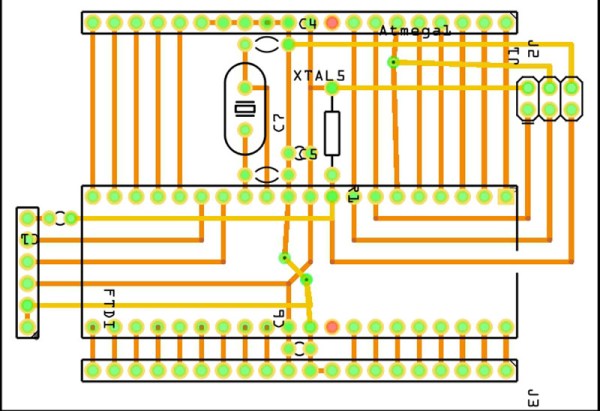
The board is laid out in Fritzing with just a few parts including a crystal, a few caps, an ISP connector, and pins for a serial connector. Not much, but that’s all you need for a prototyping board.

The bootloader is handled by [Maniacbug]’s Mighty 1284 Arduino Support Package. This only supports Arduino 1.0, not the newer 1.5 versions, but now [Dave] has a great little prototyping board that can be put together from perfboard and bare components in a few hours. It’s also a great tool to continue the development of [Dave]’s Apple I replica.

A Bluetooth Garage Door, Take Three

A few years ago, [Lou] came up with a pretty clever build to open his garage door with his phone. He simply took a Bluetooth headset, replaced the speaker with a transistor, and tied the transistor to a few wires coming out of his garage door opener. When the Bluetooth headset connected, the short beep coming from the speaker output opened the door.

The newest version of this build does away with the simple Bluetooth headset and replaces it with a Bluetooth 4.0 chip. The reason for this is that Apple and their walled garden of an App store would never allow a Samsung Bluetooth headset to be used with one of their iDevices.

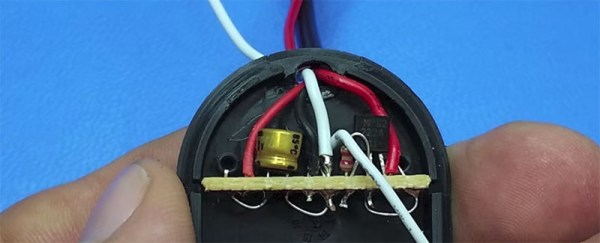
The latest build is just about as simple as using a Bluetooth headset. A board that appears to use TI’s CC2540 chip is attached to the garage door opener with a few passives and a transistor. Pairing the new circuit with a phone is as simple as shorting a pair of pins, and the new iOS app does exactly what it should – opens a garage door at the press of a non-button.

While it’s not something that can be put together with scraps from a junk drawer, it’s still an extremely simple solution to opening a garage door with a phone. Video below.

Continue reading “A Bluetooth Garage Door, Take Three”

Amazon Echo Becomes A Better Home Automation Appliance

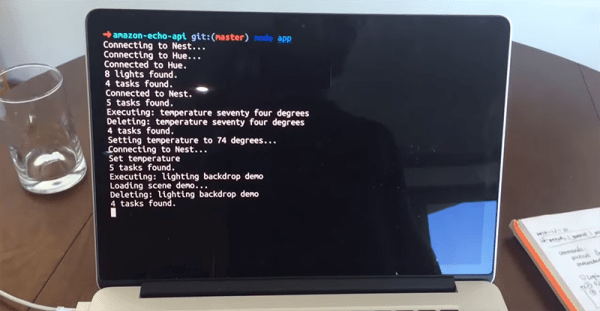
There’s a bright future ahead of us, filled with intelligent computerized assistants that will listen to everything we say and do our bidding. It’ll be like HAL from 2001: A Space Odyssey, but without unverified mission-critical software and a bunch of killing. Until then, we have a few Amazon Echo hacks that tease out a reasonably capable home automation system without a proper API.

This build was inspired by an earlier project that polled the to do list looking for key phrases. Saying, “Alexa, to do, lights on” would turn on an Internet-connected light bulb. Saying, “Alexa, to do, call home” would call a phone number set up with the ‘home’ keyword.

[Glen] has improved that earlier setup somewhat, mostly by getting rid of the requirement to say, ‘to do.’ The Git for the project still shows it’s exploiting the Amazon to do list, but this is a much cleaner build that should end up having a lot more possibilities.

So far, [Glen], or rather, Alexa, can control the temperature of the house through a Nest thermostat, the lighting of a room with a Phillips Hue light bulb, and other random tasks like playing an audio file through the speakers. Not bad, and something that really demonstrates the potential of a smart, connected home.

A Dev Board For The ESP Lua Interpreter

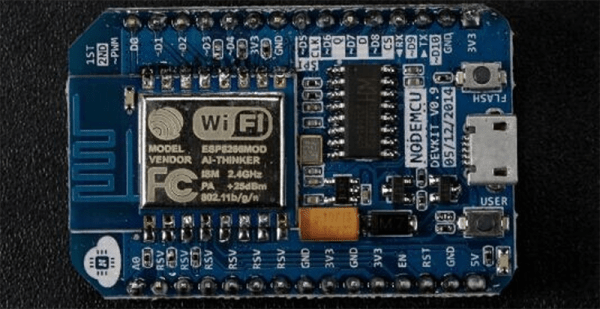
From the great minds behind the NodeMCU Lua interpreter for the ESP8266 comes a proper dev board for the WiFi platform of 2015. They are calling it, the NodeMCU-devkit, and it’s a reasonable, cheap, and breadboardable breakout board for the ESP8266.

The version of ESP8266 used in this project is the ESP-12, the newer, fancier model with RF shielding, a questionable FCC logo, and every single one of the GPIOs exposed on castellated connectors. The rest of the board is a USB to serial converter (the CH340G – probably the cheapest USB to serial chip out there), a few passives, and a USB micro connector. It’s simple, cheap, and open source. You can’t do better than that.

This dev board is explicitly designed to work with the NodeMCU firmware, a Lua-based firmware for the ESP. Already we’ve seen some projects make the Hackaday front page with this firmware. Sure, it’s just a garage door opener, but that’s extremely impressive for a chip that’s only a few months old.

Thanks [Baboon] for the tip.

Parametric Spherical Speakers Are Not A Moon

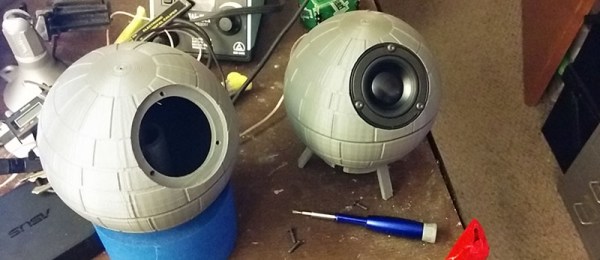
A good speaker enclosure is not just about building a box out of plywood and covering it with carpet, although playing with 1F capacitors is pretty cool. No, for a good speaker enclosure you need the right internal volume, the right size bass port, the right speaker, and it should definitely, certainly, not be a moon.  [Rich] figured out he could do all of this with a 3D printer, resulting in the NOMOON: The NOMOON Orbital Music-Making Opensource, Openscad-generated Nihilator.

This work is a continuation of earlier work that designed parameterized speakers in the shape of Borg cubes. Now [Rich] is on to Borg scout ships,  and this version has everything you would expect for speaker design.

The NOMOON is available on the Thingiverse Customizer with variables for the internal diameter, the volume of the enclosure in liters, wall thickness, speaker hole, bass port, and wire holes. Of course a customized design is also possible with a stock OpenSCAD installation.

[Rich] has printed a few of these not moons and even with a speaker with terrible bass response, he has a pretty good-sounding setup as far as Youtube videos go. You can check that out below.

Continue reading “Parametric Spherical Speakers Are Not A Moon”

Running Nintendo DS Unsigned Code With Audio

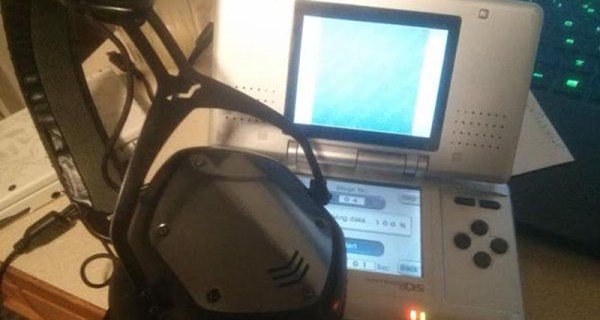
Even if you haven’t ripped off the top screen of your original DS to create an even better Game Boy Advance yet, there still might be some life left in that old bit of hardware. [Smea] is running unsigned code on the Nintendo DS, using only a bargain-bin game and an audio file.

The exploit this time comes in a form that might be familiar to anyone who has ever installed the homebrew channel on a Wii. Like SmashStack, this exploit uses a level editor/transfer feature in a game, this time with a 6 year old DS game Bangai-O Spirits.

[smea] is using the sound-based level transfer feature to load unsigned code into the DS. This level-transfer feature works by sending a single period sine wave at 1024Hz with a given amplitude; a binary 1 is a few dB louder than a binary 0, and with a buffer overrun it’s possible to load code into a DS and jump into that code. There’s no redundancy, error correction, and is not the thing you want when loading unsigned code onto a DS. It does, however, work.

The code to generate the audio payload for this exploit is available on github and if you have a copy of Bangai-O Spirits, you can try it out for yourself by playing this file (headphone warning).

Thanks [gudenau] for the tip

Continue reading “Running Nintendo DS Unsigned Code With Audio”