Custom Heaters For A DIY BBQ Smoker

Spring is in the air, and with that comes savory meals cooked over the course of dozens of hours. While preparing for your yearly allotment of pork and beef, check out [Brett Beauregard]’s custom heater elements he built for a DIY wood smoker.

This build follows the very successful smoker [Brett] built last year. This year, he’s using the same toaster oven heating elements, only cut down to make the heater smaller and more efficient. Basically, [Brett] is making a small cartridge heater out of the equipment he already has.

After cutting the toaster oven heating elements to length, [Brett] reamed out the ends to expose the nichrome wire. A short hit with a TIG welder bonded the lead to the heating element. Insulated with furnace cement, [Brett] had a custom heater perfect for charring chunks of mesquite or hickory.

Meat smokers aren’t very complicated – they can be built with a flowerpot and a hotplate, and will still cook up a delicious dinner. We might have to borrow [Brett]’s technique when we build this year’s smoker.
Facial Recognition Software Can Tell When You’re Frustrated With Xbox Live

Most of us have been faced with the anguish of being shot in the head repeatedly by 12-year-olds. There are also the times when we’re overjoyed by defeating the Mother Brain and making it out of the caverns of Zebes. If we wanted to scientifically quantify how happy, sad, or angry we are while playing video games, we wouldn’t know what to do. [Dale] came up with a very interesting way to gauge someone’s state of mind while either playing Xbox, or watching TV.

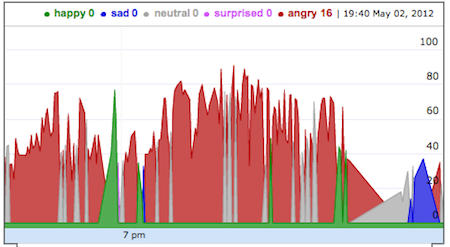
To get a measure of how happy or sad he is, [Dale] put a webcam underneath his TV and pointed it towards his couch. Every 15 seconds or so, the webcam snaps a picture and sends if off to the face.com API. After face.com sends a blob of JSON containing information about all the faces detected in the photo, a short Python script plots it on a graph.

[Dale] admits he’s not entirely scientific with this project; the low resolution of the webcam, coupled with images being captured every 15 seconds means he runs into the limitations of his hardware very quickly. Also, there’s the confound of [Dale] paying attention to something else in the room – like his kids – rather than the TV. Still, it’s an interesting use of hardware and software that would be loved by a market researcher or QA designer.

Giving An Old Atari Computer A Much Needed Upgrade

As a kid, [Boisy] cut his teeth on the TRS-80 Color Computer. It was a wonderful machine for its day, featuring a relatively powerful Motorola 6809 CPU. Although his CoCo was theoretically more powerful than its Commodore and Apple contemporaries, the graphics and sound capabilities of [Boisy]’s first love paled in comparison to his friends 6502-based machines. A little jealously and thirty years go a long way, because now [Boisy] is adding a 6809 microprocessor to the 6502-based machines Atari put out.

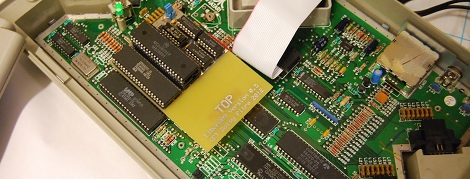
[Boisy]’s goal for his Liber809 project was simple: Put a 6809 CPU in an Atari XEGS and get NitrOS-9, the Unix-like OS for the TRS-80 CoCo running on his Frankenputer. After a few months of work, [Boisy] completed his goal and more so: the Liber809 also works on the Atari 1200XL.

To put [Boisy]’s work in perspective, it’s like he took a Macintosh from 1993 and made it run on an Intel 486. While that’s not a terribly accurate analogy, we hope our readers will understand the fortitude needed to make a computer run on a completely different processor.

After the break, you can check out a neat demo app written by [SLOR] from the AtariAge forums showcasing a 6809 running in a machine designed for a 6502. Awesome work for all involved

Continue reading “Giving An Old Atari Computer A Much Needed Upgrade”

Board Games Over IP Means Telepresence Chess

Correspondence chess, or playing a game of chess via email or snail mail, is well-known in the chess community. [FunGowRightNow] thought he could bring correspondence chess into the 21st century, so he built two robotic chess boards that communicate over the Internet. The end result makes for an awesome senior project for school.

Instead of a simple monitor displaying the other player’s moves (and having to manually move both black and white pieces), the positions of all the pieces are controlled via a laptop an Arduino underneath each board. An electromagnet mounted on an xy frame moves one piece at a time. To detect the positions of the pieces, an 8×8 grid of reed switches open and close with magnets put in the base of each piece. The end result is a nearly seamless chess game that can be played by two people separated by hundreds of miles.

Right now, all we have are a few videos and the descriptions of the inner machinations of the chessbots. [FunGow] promised the Internet design specs after he turns this in as his senior project on April 10th. Until then, you can enjoy a few of the videos he’s posted after the break.

via reddit

Continue reading “Board Games Over IP Means Telepresence Chess”

Closing In On Nixie Cuff Links

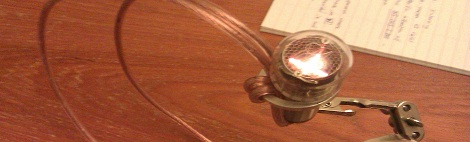
It’s not Nixie cuff links yet, but we’re seeing a lot of potential for a few very classy accoutrements with [thouton]’s Nixie tube necklace.

The build was inspired by this much clunkier necklace that found its way onto the MAKE blog. Unlike the previous necklace, [thouton] used a much smaller Mullard ZM1021 indicator bulb. Instead of the normal 0-9 digits in a Nixie, this tube displays only A V Ω + - % and ~, betraying its pedigree as part of the display from an ancient multimeter.

To power the bulb, [thouton] is using a single AA battery and a boost converter salvaged from a camera flash unit. All the circuitry is on a little piece of perfboard encased in a handsome aluminum tube. Power is delivered through two terminals with a bit of audio cable standing in as the chain of the necklace. We suppose this could be re-engineered to use a coin cell battery; although a coin cell doesn’t offer as many amp hours as a AA cell, [thouton] is confident the AA will last for a few days. A coin cell would be more than enough for a night on the town, though.

Meet The TM65 Liquid Propellant Rocket Engine

While we’re reluctant to say it for fear of being misinterpreted, the new liquid fuel rocket engine being built by Copenhagen Suborbitals is one of the most impressive, daring, and nearly the sexiest machine we’ve ever seen. Although the engine hasn’t been fired yet, [Peter Madsen], Chief launch vehicle designer at Copenhagen Suborbitals, gives an amazing 18-minute-long rundown of the function of each and every tank and tube of the TM65 in this video.

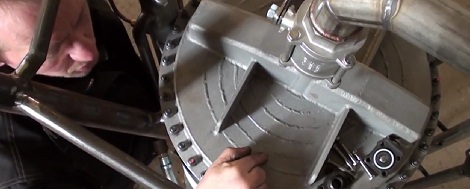
When the TM65 engine begins its firing sequence, valves attached to tanks of alcohol and liquid Oxygen are opened. The Oxygen pours directly into an injector manifold that atomizes the liquid in the combustion chamber, while the alcohol makes a much longer trip down to the engine bell, flowing between the double wall of the chamber and nozzle for cooling. Once the alcohol and Oxygen in the combustion chamber ignite, two gigantic tanks of Helium are opened and the gas is forced down to a heat exchanger at the end of the nozzle, increasing the temperature and pressure of the Helium. The Helium is then routed to the tanks, pressurizing them and forcing fuel and oxidizer into the combustion chamber at 40 liters per second. This entire process happens in only eight seconds; after that, the rocket attached to the TM65 will be on its way upward.

We’re not going to say the TM65 is the best engine ever seen on Hackaday; we’ll leave you to decide that. We can’t wait for the video of the test fire to hit the Internet, though.

Sphere Morphing Hexabot Now Rolls Around

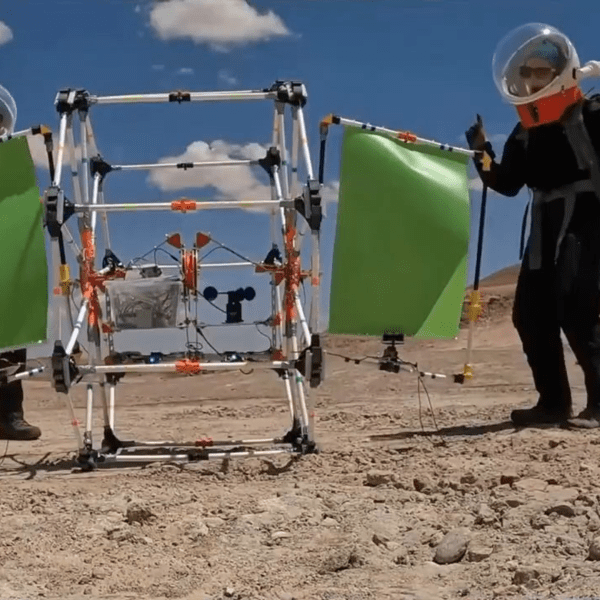
[Zenta] has been building his MorpHex rolling hexapod for nearly a year now, and good things come to those who wait. After a ton of development and fabrication, [Zenta] finally has his mechanical jellyfish robot rolling and walking around.

This isn’t the first time we’ve seen [Zenta]‘s MorpHex robot in action. A year ago, we saw the beginnings of the project with that included 25 servos mounted on a custom chassis. Last winter, the top hemisphere of the MorpHex was added, but rolling locomotion was still on the drawing board. A lot has changed since then, and now [Zenta]’s robot can roll or walk across the floor.

From the video (available after the break), we see that [Zenta] kept the one degree of freedom for the panels on the upper cylinder. He’s thinking about making the MorpHex more symmetrical; just copying the plans for the bottom hemisphere onto the top, for instance. This plan would allow the MorpHex to roll in a straight line, so we can’t wait to see what [Zenta] cooks up next.

Continue reading “Sphere Morphing Hexabot Now Rolls Around”