Cecilia Payne-Gaposchkin Saw Through The Stars

We as humans are limited in the ways we can look at things ourselves, and rely on on the different perspectives and insights of others to help make sense of things. All it takes is one person to look at a data set and find something completely different that changes our fundamental perception of the universe.

Cecilia Payne-Gaposchkin discovered that stars are primarily made of hydrogen and helium, at a time when astronomers thought that the Sun and the Earth had no significant elemental differences. She proposed that hydrogen wasn’t only more common, but that it was a million times more common.

This outlandish conclusion was roundly dismissed at the time, and she aquiesced to tone down some of the conclusions in her thesis, until her findings were widely confirmed a few years later. Truly groundbreaking, the discovery of the prevalence of hydrogen in stars paved the way for our current understanding of their role as the furnaces for the heavier elements that we know and love, and indeed are composed of.

Meteorites, Comets, and Bee Orchids

Cecilia Helena Payne was born May 10th, 1900 in Wendover, Buckinghamshire, England. She was one of three children born to Emma and Edward, a lawyer, historian, and musician. Her father died with she was four years old, leaving her mother to raise the family alone. Continue reading “Cecilia Payne-Gaposchkin Saw Through The Stars”

Little Red Night Light Is Just Right

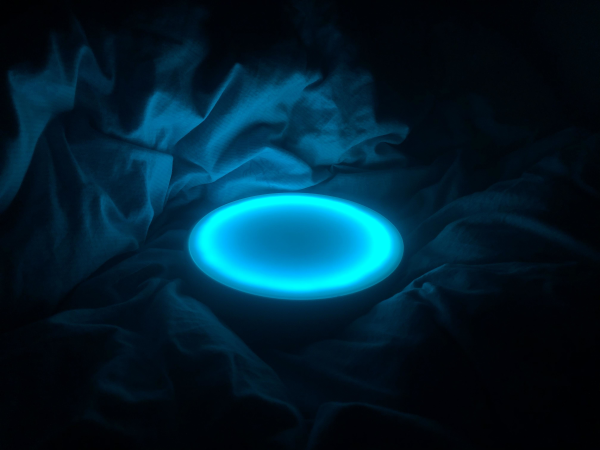
Don’t you hate getting up in the middle of the night to use the bathroom? The worst part is not being able to see what you’re doing, but if you turn on a light, you’ll lose your night vision. Nightlights are supposed to be the best solution, but are usually too bright for 3 AM excursions and can end up leaking light into the bedroom. What the bathroom needs is a purpose-built nightlight that uses red light so you don’t lose your night vision.

This simple, wall-mounted night light is just the thing. All it takes is two AA batteries, a resistor, a red LED, and an SPST push button. [Vchaney] even made their own battery contacts. The genius part of this build is in the adjustable LED, which is fitted into a ball that moves around in a socket so you can aim it wherever you need to see. All the files are available if you want to print one for yourself.

Those who sit might prefer to shine the light on the toilet paper roll. Here’s a smart roll holder that doubles as a night light, albeit a terribly bright one.

Can You Use An Easy-Bake Oven For Reflow Soldering?

The answer is yes, yes you can. As long as you have one made after about 2011, at least. In the video after the break, [Blitz City DIY] takes us briefly through the history of the venerable Easy-Bake Oven and into the future by reflow soldering a handful of small blinky boards with it.

You’re right, these things once used special light bulbs to cook pint-sized foods, but now they are legit ovens with heating elements that reach 350°F and a little above. The only trouble is that there’s no temperature controller, so you have to use low-temperature solder paste and an oven thermometer to know when to pull the little tray out. Other than that, it looked like smooth sailing.

If you’re only doing a board every once in a while, $40 for a reflow oven isn’t too shabby. And yeah, as with all ovens, once you’ve reflowed a board in it, don’t use it for food.

If you’d rather build an oven, high-powered light bulbs will still do the trick.

Continue reading “Can You Use An Easy-Bake Oven For Reflow Soldering?”

A Beeping Toy Helps A Blind Dog Play Fetch

When a beloved pet goes blind, it doesn’t mean they can’t or don’t want to play fetch anymore, only that the game must change a bit. [Bud Bennett]’s dog Lucy has slowly lost her sight to progressive renal atrophy but is still up for playing with toys, so [Bud] decided to make a beeper that can go inside various stuffed toys to help Lucy locate them. Lucy doesn’t care for commercial toys that chime constantly, especially once she’s got it in her mouth.

This tiny package is centered around an LIS3DH accelerometer and programmed with a PIC16F18313. When the toy is thrown up in the air, the accelerometer determines that it’s in free fall and triggers an interrupt on the PIC. The piezo buzzer starts beeping so Lucy can find it, then stops a short while later and waits for the next free fall. The power dissipation is so low that [Bud] expects to charge the 120 mAh LiPo battery about once a year.

We bet that communication between [Bud] and Lucy is already pretty good, but maybe she could be more expressive with a doggy soundboard.

Gigantic Working Arduino Uses 1/4″ Cables

What is it about larger-than-life versions of things that makes them so awesome? We’re not sure exactly, but this giant working Arduino definitely has the ‘it’ factor, whatever that may be. It’s twelve times the size of a regular Uno and has a Nano embedded in the back of it. To give you an idea of the scale, the reset button is an arcade button.

The Arduino Giga’s PCB is made of 3/4″ plywood, and the giant components represent a week and a half of 3D printing. The lettering and pin numbers are all carved on a CNC and filled in with what appears to be caulk. They didn’t get carved out deeply enough the first time around, but [byte sized] came up with a clever way to perfectly re-register the plywood so it carved in exactly the same places.

Although we love everything about this build, our favorite part has to be the way that [byte sized] made the female headers work. Each one has a 1/4″ audio jack embedded inside of it (a task which required a special 3D printed tool), so patch cables are the new jumper cables. [byte sized] put it to the test with some addressable RGB LEDs on his Christmas tree, which you can see in the build video after the break.

You can buy one of those giant working 555 timer kits, but why not just make one yourself?

Continue reading “Gigantic Working Arduino Uses 1/4″ Cables”

A Whimsical Touch-Free Gumball Machine For These Trying Times

It sucks that certain stuff in public is off-limits right now, like drinking fountains and coin-operated candy and gum machines — especially the fun kind where you get to watch your gumball take a twisting trip down the tower and into the collection bin. Hopefully there will be commercial contact-free machines one of these days that take NFC payments. Until then, we’ll have to make them ourselves out of cardboard and whimsy and Micro:bits.

[Brown Dog Gadgets] also used one of their Crazy Circuits Bit Boards, which is a Micro:bit-to-LEGO interface module for building circuits with conductive tape. There’s a distance sensor in the rocket’s base, and a servo to dispense the gumballs. This entire build is fantastic, but we particularly like the clever use of a LEGO Technic beam to both catch the gumball and prevent the next one from going anywhere. You can see it in action after the break.

Wave hand, receive gumball is about as simple as it gets for the end user. The three robots approach takes much more work.

Continue reading “A Whimsical Touch-Free Gumball Machine For These Trying Times”

Mind-Controlled Beer Pong Gets Easier As You Drink

Wouldn’t it be nice if beer pong could somehow get easier the more you drink? You know, so you can drink more? [Ty Palowski] has made it so with automated, mind-controlled beer pong.

[Ty] started by making a beer pong table that moves the cups back and forth at both ends. An Arduino Nano controls a stepper that controls a slider, and the cups move with the slider through the magic of magnets. The mind control part came cheaper than you might think. Back in 2009, Mattel released a game called Mind Flex that involves an EEG headset and using brain waves to guide a foam ball on a stream of air through a little obstacle course. These headsets are available for about $12 on ebay, or at least they were before this post went up.

[Ty] cracked open the headset added an HC-06 Bluetooth module to talk to the Arduino. It’s using a program called Brainwave OSC to get the raw data from the headset and break it into levels of concentration and relaxation. The Arduino program monitors the attention levels, and when a certain threshold of focus is reached, it moves the cups back and forth at a predetermined speed ranging from 1 to an impossible-looking 10. Check out the two videos after the break. The first one covers the making of the the automatic beer pong part, and the second is where [Ty] adds mind control.

We’ve seen a different headset — the hacker-friendly NeuroSky Mindwave — pop up a few times. Here’s one that’s been hacked to induce lucid dreaming.

Continue reading “Mind-Controlled Beer Pong Gets Easier As You Drink”