Don’t Guess, Listen To Your Plants’ Pleas For Water

Plants are great to have around, but they all have different watering needs. If only they could cry out when they’re thirsty, right? Well, now they can. All you need to hear them suffer is your very own Klausner Machine. [RoniBandini] based the Klausner machine on one of Roald Dahl’s short stories, which features an inventor who builds a machine that can make audible the sound of plants shrieking whenever they’re cut.

In [RoniBandini]’s version of the Klausner Machine, the point is to judge the plant’s feelings based on its soil moisture content. An Arduino Nano reads in from the soil moisture sensor, and if the soil is dry, the plant screams. If the soil is moist, the plant emits happy sounds from DF Player Mini and SD card.  We think the analog meters are a great touch, and the jumping needles really anthropomorphize the plant.

Go forth and gain a better appreciation for your plants’ feelings, because this project is wide open. Maybe it will help you water them more often. Some plants need to be cut back, so we think it would be cool if you could make it scream when you take a cutting. Check out the demo after the break.

This is isn’t the first time we’ve seen an analog meter used in conjunction with soil moisture. What is a VU meter, anyway? Our own [Dan Maloney] really moved the needle on the subject a while back.

Continue reading “Don’t Guess, Listen To Your Plants’ Pleas For Water”

Trick Or Yeet Cannon Will Give Them Candy Shell Shock

One of our favorite things about Halloween is the sheer number of hacks that come out of it each year. This year, hacking is almost a requirement to keep things physically distanced, but that doesn’t mean we can’t have fun. You want fun? How about a candy cannon that launches sweet projectiles at trick-or-treaters from fifty feet?

[Paul McCabe]’s cannon uses a sprinkler valve and an air compressor to launch a pair of fun size candy bars, each encased in a film canister shell. Each trick-or-treater stomps a foot switch fifty feet away at the end of the driveway, and as long as someone is there holding down the primary ignition, the cannon will fire with a nice retort that sounds like a large wind instrument playing a D note.

We were sad to learn that the parachute idea didn’t shake out, but the glow sticks are a great addition for night time. Check out the demo after the break, which is followed by a build video and then some more launches for the fun of it.  Don’t have enough time to build a cannon of this caliber? You could put a spooky six-foot slide together pretty quickly.

Continue reading “Trick Or Yeet Cannon Will Give Them Candy Shell Shock”

Clacker Hacker: Popping A Cap In A Brother EP43 Thermal Typewriter

A few months ago, I fell down the internet rabbit hole known as Ted Munk’s typewriter site. I don’t remember if I just saw this Brother EP43 typewriter for sale and searched for information about them, or went looking for one after reading about them. Either way, the result is the same — I gained a typewriter.

Now I’m not really a typewriter collector or anything, and this is my first word processor typewriter. When it arrived from Goodwill, I anxiously popped four ‘C’ cells in and hoped for the best. It made a print head noise, so that was a good sign. But almost immediately after that, there was a BANG! and then a puff of smoke wafted out from the innards. My tiny typewriter was toast. Continue reading “Clacker Hacker: Popping A Cap In A Brother EP43 Thermal Typewriter”

Small Spotify Remote Broadens Musical Horizons

When was the last time you tried listening to a new genre of music, or even explored a sub-genre of something you already like? That’s what we thought. It’s good to listen to other stuff once in a while and remind ourselves that there’s a whole lot of music out there, and our tastes are probably not all that diverse. As a reminder, [sorghum] made a spiffy little Spotify remote that can cruise through the musical taxonomy that is Every Noise at Once and control any Spotify-enabled device.

There’s a lot to like about this little remote, which is based upon a LilyGo TTGO ESP32 board with on-board display. The circuitry is basically that and a rotary encoder plus a tiny LiPo battery. Can we talk about the finish on those prints? Yes, those are both printed enclosures. Getting that buttery smooth finish took two grits of wet/dry sandpaper plus nine grits of polishing cloths.

As you can see in the brief demo after the break, there are several ways to discover new music. [sorghum] can surf through all kinds of Japanese music for example, or surf by the genre’s ending word and listen to metalcore, deathcore, and grindcore from all over the globe. For extra fun, there’s a genre-ending randomizer so you can discover just how many forms of *core there are.

Want everyone in the room to know what you’re listening to? Behold the Spotify split-flap display.

Continue reading “Small Spotify Remote Broadens Musical Horizons”

Lewis Latimer Drafted The Future Of Electric Light

These days, we have LED light bulbs that will last a decade. But it wasn’t so long ago that incandescent lamps were all we had, and they burned out after several months. Thomas Edison’s early light bulbs used bamboo filaments that burned out very quickly. An inventor and draftsman named Lewis Latimer improved Edison’s filament by encasing it in cardboard, earning himself a patent the process.

Lewis had a hard early life, but he succeeded in spite of the odds and his lack of formal education. He was a respected draftsman who earned several patents and worked directly with Alexander Graham Bell and Thomas Edison. Although Lewis didn’t invent the light bulb, he definitely made it better and longer-lasting. Continue reading “Lewis Latimer Drafted The Future Of Electric Light”

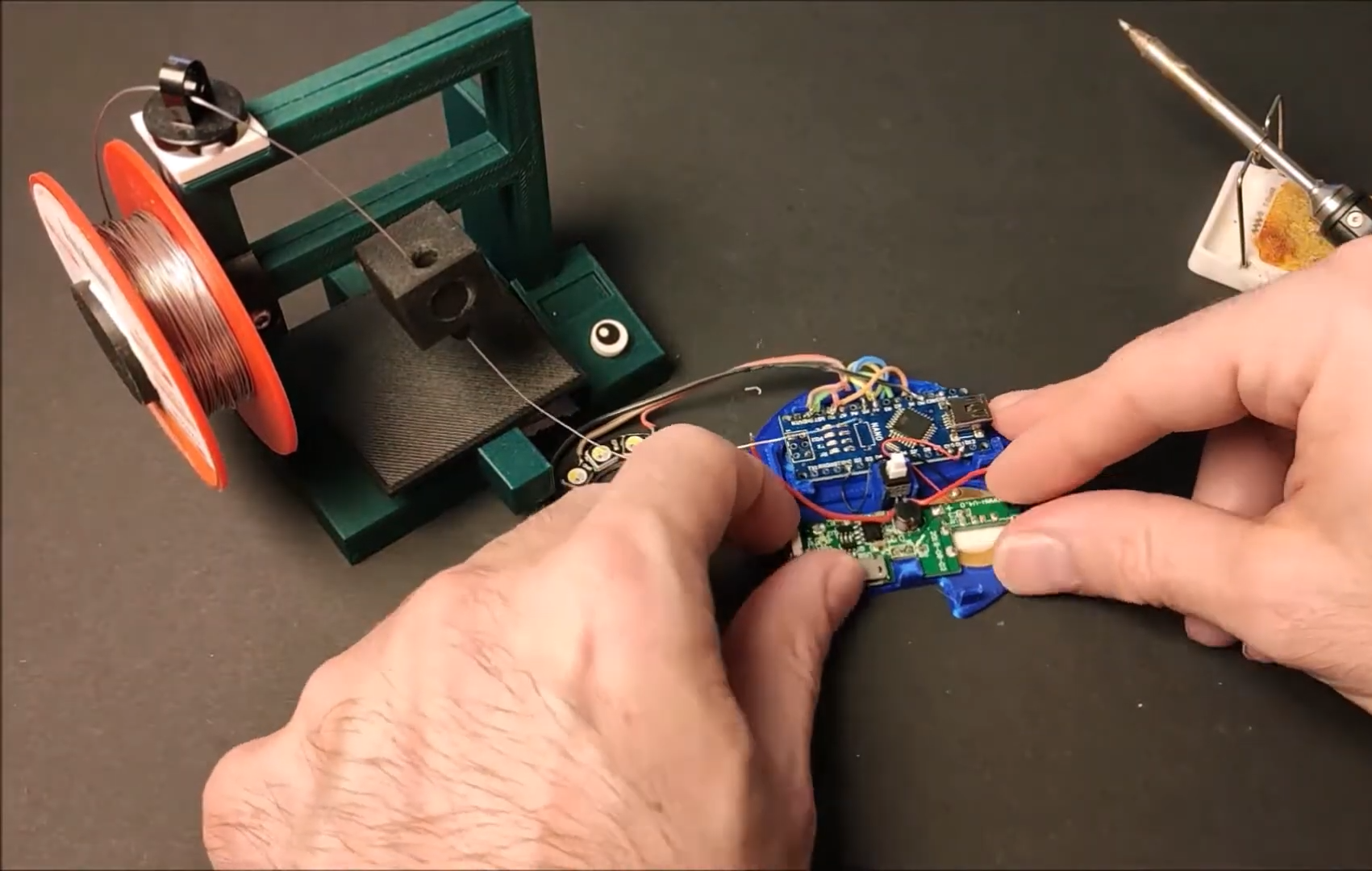
Arduino Bobbin Winding Machine Is Freaky Fast

One of the worst things about sewing is finding out that your bobbin — that’s the smaller spool that works together with the needle and the larger spool to make a complete stitch — ran out of thread several stitches ago. If you’re lucky, the machine has a viewing window on the bobbin so you can easily tell when it’s getting dangerously close to running out, but many machines (ours included) must be taken halfway apart and the bobbin removed before it can be checked.

Having spare bobbins ready to go is definitely the answer. We would venture to guess that most (if not all) machines have a built-in bobbin winder, but using them involves de-threading the machine and setting it up to wind bobbins instead of sew. If you have a whole lot of sewing to do and can afford it, an automatic bobbin winder is a godsend. If you’re [Mr. Innovative], you build one yourself out of acrylic, aluminium, and Arduinos.

Here’s how it works: load up the clever little acrylic slide with up to twelve empty bobbins, then dial in the speed percentage and press the start button. The bobbins load one at a time onto a drill chuck that’s on the output shaft of a beefy 775 DC motor. The motor spins ridiculously fast, loading up the bobbin in a few seconds. Then the bobbin falls down a ramp and into a rack, and the thread is severed by a piece of nichrome wire.

An important part of winding bobbins is making sure the thread stays in place at the start of the wind. We love the way [Mr. Innovative] handled this part of the problem — a little foam doughnut around a bearing holds the thread in place just long enough to get the winding started. The schematic, BOM, and CAD files are available if you’d like to make one of these amazing machines for yourself. In the meantime, check out the demo/build video after the break.

Still not convinced that sewing is cool enough to learn? Our own [Jenny List] may be able to convert you. If that doesn’t get you, you might like to know that some sewing machines are hackable — this old girl has a second life as a computerized embroidery machine. If those don’t do it, consider that sewing machines can give you a second life, too.

Continue reading “Arduino Bobbin Winding Machine Is Freaky Fast”

Stomp Button, Receive Candy

If there’s any holiday that is worth adjusting for strange times, it’s gotta be Halloween. Are you inclined to leave a bowl of candy on the porch to avoid the doorbell? If so, this is the perfect year to finally figure out some sort of metering apparatus so that greedy preteens are less likely to steal your stash in one sweep. There’s still time to make something fun like [Brankly]’s automatic candy dispenser, which we think ought to stick around for many years to come. Video is posted after the break.

Underneath that skeleton’s jack-o-lantern head is the heart of this build — an orange 5-gallon bucket that matches it perfectly. Simply step on the giant lighted arcade button, and the equally giant NEMA-23 stepper motor moves a 3D-printed turntable inside the bucket with the help of an Arduino Nano. This moves the candy toward the 3D-printed ramp and out the mouth of the jack-o-lantern, where it lands in a bowl that lights up when it hits the bottom thanks to a relay and a second Nano.

[Brankly] made clever use of IR break-beam switches, which sit underneath the two square holes in the ramp. Once candy passes over one of them, the turntable stops and rotates backward to move the candy where it can’t be reached.

Frankly, we love that [Brankly] reused the sound effects module that came with the jack-o-lantern. This build is totally open, and [Brankly] is even giving away 40 PCBs if you want to make your own. For now, you can check out the code and start printing the STLs.

If time is tight, build a spooky slide that puts six feet between you and the trick or treaters.

Continue reading “Stomp Button, Receive Candy”