Hackaday Podcast 242: Mechanical Math, KaboomBox, And Racing The Beam

This week, Editor-in-Chief Elliot Williams and Kristina Panos met up from their separate but equally pin drop-quiet offices to discuss the best hacks of the previous week. Well, we liked these one, anyway.

First up in the news, it’s finally time for Supercon! So we’ll see you there? If not, be sure to check out the talks as we live-stream them on our YouTube channel!

Don’t forget — this is your last weekend to enter the 2023 Halloween Hackfest contest, which runs until 9 AM PDT on October 31st. Arduino are joining the fun this year and are offering some spooky treats in addition to the $150 DigiKey gift cards for the top three entrants.

It’s time for a new What’s That Sound, and Kristina was able to stump Elliot with this one. She’ll have to think of some more weirdo sounds, it seems.

Then it’s on to the hacks, beginning with an insanely complex mechanical central air data computer super-teardown from [Ken Shirriff]. We also learned that you can 3D-print springs and things by using a rod as your bed, and we learned whole lot about rolling your own electrolytic capacitors from someone who got to visit a factory.

From there we take a look at a Commodore Datassette drive that sings barbershop, customizing printf, and a really cool dress made of Polymer-dispersed Liquid Crystal (PDLC) panels. Finally we talk about racing the beam when it comes to game graphics, and say goodbye to Kristina’s series on USPS technology.

Check out the links below if you want to follow along, and as always, tell us what you think about this episode in the comments!

Download and savor at your leisure.

Continue reading “Hackaday Podcast 242: Mechanical Math, KaboomBox, And Racing The Beam”

Interactive Chameleon Lamp Changes Color At Your Whim

You never forget your first diorama, especially when it’s interactive. Although admittely a bit late to celebrate Erntedankfest (Germanic Thanksgiving), [Markus Bindhammer] is ahead of the curve when it comes to the American version.

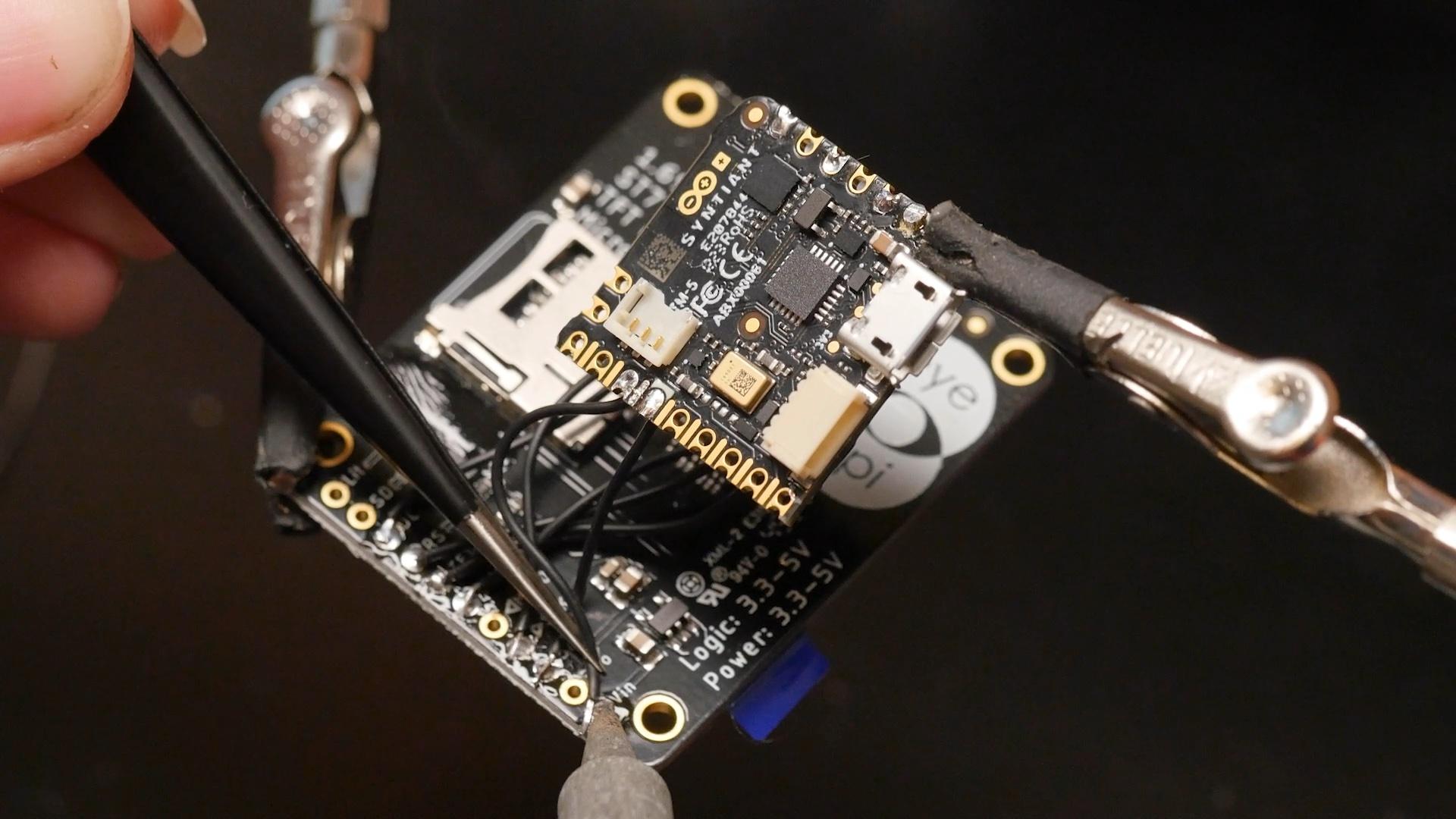
This interactive diorama lamp features a cute chameleon that [Markus sculpted from a wire frame and a lump of clay]. In the chameleon’s midsection is a ping pong ball that does the work of diffusing an RGB LED. Wires run out the far side and through the bamboo stand and connect to a TCS34725 RGB color sensor and an Arduino Pro Micro.

The lamp does what you think — hold any colored object up to the color sensor, and the chameleon will change colors to match. When no one is interacting with the lamp, it slowly runs through a rainbow of colors. Be sure to check out the build video after the break.

Don’t have a color sensor? You can roll your own with an RGB LED, a photocell, and not much else. If you’re wondering how they work, we’ve seen the color sensor demystified.

Continue reading “Interactive Chameleon Lamp Changes Color At Your Whim”

Illustrated Kristina with an IBM Model M keyboard floating between her hands.

Keebin’ With Kristina: The One With The Foot Keyboard

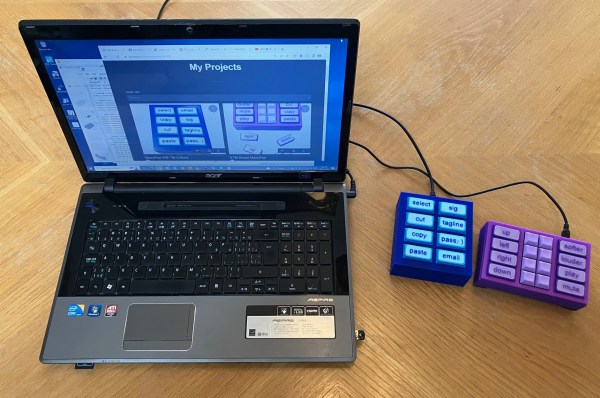
[crispernaki]’s opening comments to this VCR head scroll wheel project lament that overall technical details aren’t “complex, ground-breaking, or even exciting.” Since when does that matter? The point is that not only did the thing finally, eventually get built, it gets daily use and it sparks joy in its owner.

This feel-good story is one of procrastination, laziness, and one aha! moment, and it’s roughly twelve years in the making. Inspired by an Instructable from long ago, [crispernaki] ran straight to the thrift store to get a VCR and take it apart.

The original plan was to just reuse the VCR head’s PCB and hide it in an enclosure, and then figure out way to block and unblock the path between an IR emitter/receiver pair. After many disemboweled mice and fruitless attempt, the project was once again shelved.

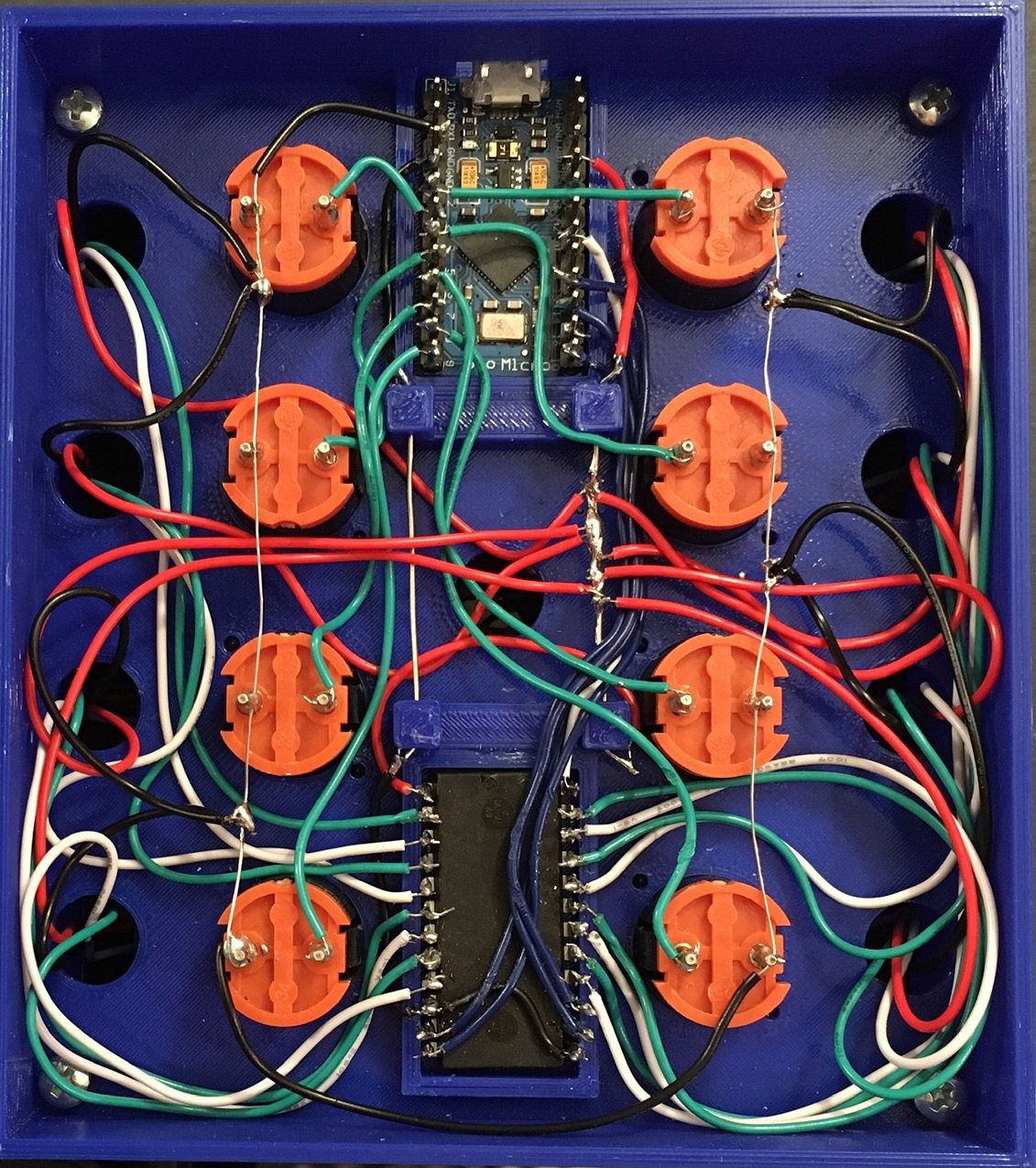
But then, [crispernaki] remembered the magnetic rotary encoder demo board that was just sitting around, along with various microcontrollers and Altoids tins. And it all quickly came together with a Teensy 2.0 and some bits and bobs, including a magnet glued on the shaft of the VCR head. A chip on the demo board does all the heavy lifting, and of course, the Teensy does the work of emulating an HID.

Continue reading “Keebin’ With Kristina: The One With The Foot Keyboard”

KaboomBox Is A Firecracker Of A Music Player

Ka-chunk. Let’s face it, 8-tracks were not that great. But the players, that’s another story. The Panasonic RQ-830S, aka the dynamite or TNT player is just one of many lovely designs that used to grace the shelves of electronics stores. Hackaday alum [Cameron Coward] came across a non-working model and used it to create the KaboomBox.

Just like before, all [Cameron] has to do is stick a tape in, and music starts playing. But now, instead of using rust on tape, the music is accessed via RFID and lives on an SD card inside the 8-track player.

Power it on, and a tiny LCD screen showing through the track number window first displays the KaboomBox logo, then shows a timer whenever it’s waiting for a tape. And just like before, pushing down on the plunger skips to the next track.

The new guts include a Raspberry Pi Pico and an RFID reader, plus a DF Player Mini to handle the digital-to-analog conversion and amplify the signal, and an SD card to store the music. Now, [Cameron] is only limited by the size of the SD card. Check out the demo video after the break.

We’ve seen all kinds of boomboxen around here, from the lit to the Bluetooth to the payphone variety.

Continue reading “KaboomBox Is A Firecracker Of A Music Player”

Spinning Up A New Laundry Monitor

For all that modern washers and dryers do, they don’t let you know when they’re finished. Or they do, but it’s only a short victory song that plays once and can be easy to miss. What most of us need is a gentle reminder that there’s damp laundry festering in the washer, or fresh laundry in the dryer getting wrinkly.

This laundry monitor from [Sparks and Code] is version 2.0. The first version was working fine, but it was based on vibration (or lack thereof). Fast forward a few years, and [Sparks and Code] got a modern pair that’s so finely tuned, it doesn’t produce enough vibration to register. Back to the drawing board [Sparks and Code] went, and eventually came up with version 2.0.

Now, [Sparks and Code] is detecting whether the machines are on using a pair of split-core transformers to monitor power at the breaker box. With these, you just run the wire through the hole, and it gives the relative mV value going through the wire on a 3.5mm cable. Those cables are connected to an ESP32 inside the 3D-printed box, which is mounted above the cabinet door. Since [Sparks and Code] already has home assistants all over the house, it was easy to integrate and have them all play the message ‘please flip the laundry’.

Once this project was all buttoned up, they thought of one issue — the self-cleaning cycle. Since it takes about four hours, they like to run it overnight. You can see the problem here — no one wants to hear Alexa at 3AM. Fortunately, [Sparks and Code] was able to adjust the Python script to ignore these events. Be sure to check out the build video after the break.

If only the dryer could empty itself and fold the clothes. Oh wait, there’s a robot for that.

Continue reading “Spinning Up A New Laundry Monitor”

2023 Halloween Hackfest: Haunted Keyboard Is Free From Ghosting

This may look like another DIY mechanical keyboard, but it’s hiding a secret. [Mx. Jack Nelson] has combined Halloween and keyboards in glorious, haunted fashion. Type a line, any line into this bad boy and you get a spooky, sort of cryptic response generated by AI.

Essentially, a Raspberry Pi Pico W does all the work, it handles the keyboard matrix, connects to Wi-Fi, sends the input to ChatGPT, and spits the response out on the screen wherever the cursor happens to be. Incidentally, it turns out [Mx. Jack Nelson] used ChatGPT to generate much of the CircuitPython code.

The layout is a custom 40% that is heavily influenced by the Akko 40%, with the Ctrl, Alt, and Win keys replaced by Ctrl, Cmd, and Opt. This was [Mx. Jack Nelson]’s first PCB, and you never forget your first. You don’t want to miss the demo video after the break.

Are keyboards just not spooky enough for you? Here’s a creepy baby doll that does basically the same thing.

Continue reading “2023 Halloween Hackfest: Haunted Keyboard Is Free From Ghosting”

Commodore Datassette Does Barbershop Quartet

Okay, now this is just plain fun. [Linus Åkesson] modified a Commodore Datassette player to move its “mouth” and, when quadrupled, sing a clever barbershop tune called “Sweet End of Line” that’s a play on “Sweet Adeline“, a top hit from the summer of 1903.

What? Let us explain. Those with Commodore 64s who lacked disk drives often had the Datassette — a magnetic storage tape device, or cassette player used to load and save files. But they couldn’t open the doors themselves with a keypress, and they certainly couldn’t sing barbershop.

First off, [Linus] redirected the current that drives the magnetizing tape head through a speaker coil instead. Then he replaced the motor with a servo that opens the lid from the inside. A simple rubber band pulls the lid back shut. Software-wise, [Linus] is using a timer interrupt to run code that toggles the output signal, the rate of which determines the pitch.

Don’t worry — all of these modifications are reversible, so no Datassettes were truly harmed in the making. Don’t forget to check out the brief build/demo video after the break.

We’ve seen our share of tape players, but we’d never seen one with a crank until recently.

Continue reading “Commodore Datassette Does Barbershop Quartet”