Toast Keyboard Raises A Glass To Short Index Fingers

Custom keyboards? They’re totally great. And we can keep telling you this, but you really won’t feel it until you try a few and find one or two that are right for you. If you’re already on board, we wonder: is there any limit to what custom keyboards can provide in terms of a good, comfortable time for your fingers, wrists, arms, shoulders, and neck? We think not, and as time goes on, there is more and more evidence to support this.

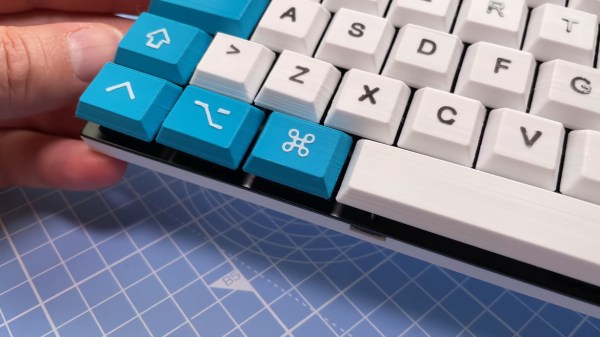
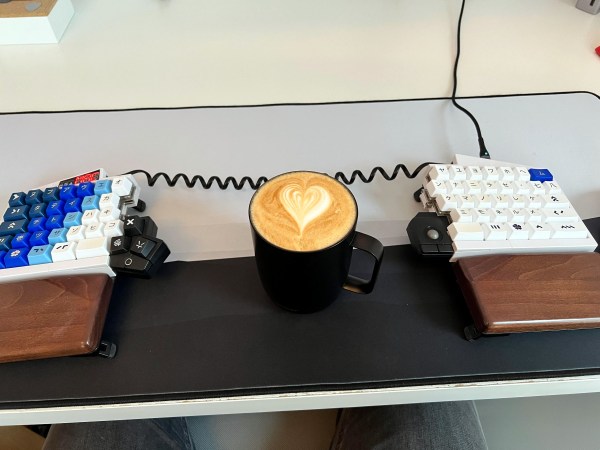
Take [vpzed]’s Toast keyboard for example. The beauty of customization is that as with any other human input problem, you’ll discover many more people who share your misery once you present a solution. In this case, it is the portion of the population whose index fingers are shorter than their ring fingers (which is evidently men in general). This is known as the 2D:4D ratio and is decided during gestation. At first, the phenomenon was thought to be due to high testosterone exposure in the womb, but subsequent studies have debunked this belief.

Toast aims to sate the need for a keyboard layout that accounts for a significantly shorter 2D than 4D by way of aggressively staggering the index finger’s key positions and staggering the columns overall. As you might imagine, there are no inner keys for length-challenged index fingers to grasp at — that would just be cruel. But there is another pinky column on each hand, which bring the key total to 34. We like the square boards, and frankly wish they were bread-shaped.

Not enough keys for you? Take a look at this many-keyed monoblock split with a numpad in the middle.

via KBD

Fireball-Flinging Figurine Feeds Fiction

If you’re writing a screenplay or novel, there will likely be points along the way at which you can’t get enough encouragement from friends and family. While kind words are kind, acts such as [scubabear]’s can provide a push like no other. By commissioning another 3D designer friend to model a character from the first friend’s screenplay so he could print and animate it, [scubabear] fed two birds with one scone, you might say.

Designer friend [Sean] modeled the mighty Braomar in Maya and Z-brush, and [scubabear] did test prints on a Formlabs Form2 as they went along to keep an eye on things. Eventually, they had a discussion about making space for wires and such, so [Sean] took to Blender to make Braomar hollow enough for wires, but not so empty that he would collapse under the stress of being (we presume) the main character.

Braomar stands upon a sigil that changes color thanks to an RGB LED ring in the base that’s driven by an Arduino Nano. A single pixel in the fireball is wired through Braomar’s body and flickers with the help of an addressable LED sequencer board.

Our favorite part of this build has to be the power scheme. Not content to have a wire running out from the base or even a remote control for power-draining concerns, [scubabear] used disc magnets in the base to switch on the 9 V battery when Screenplay Friend rotates it.

Of course, if you need inspiration to even thing about beginning to write a screenplay or novel, maybe you should lead with the maquette-building and then construct a story around your creation.


This project was an entry into the 2022 Sci-Fi Contest. Check out all of the winning entries here.

Chonky Palmtop Will Slide Into Your Heart

You probably know what a cyberdeck is by now, but you’ll find that people’s definitions differ. Some use the term rather loosely, applying it to things that are luggable at best. But we think you’ll agree that the “Chonky Palmtop” created by [Daniel Norris] AKA [a8ksh4] is without a doubt, quite cyberdeckian.

One of the hallmarks of a cyberdeck is that it folds up, often like a laptop in the screen-over-keyboard sense. Not only does chonky palmtop do that, but the split keyboard (more on that later) has this impressive pivot geometry and really satisfying slider mechanism thing going on. The whole thing folds up into a little brick, which [Daniel] says is about the size of an old Asus EEE laptop. (Remember those bad boys? Those were the days.)

Inside the brick is some stuff you might expect, like a Raspberry Pi 4 and a 7″ touchscreen. [a8ksh4] also packed in an AmpRipper 3000 LiPo charger, which is especially good for high voltage projects. Speaking of, there is a voltage button to check the battery level, which is then displayed on a trio of 7-segment displays that are smack dab in the middle below the screen.

Now about that split keyboard — that’s a Corne, which is kind of a happy medium between a lot of keys and too few, and 42 is probably enough keys for most people. Considering the overall size, we think that is a great amount of keys.

Not that you can tell by the keycaps on those Chocs, but [a8ksh4] is rocking the Miryoku layout and firmware. Slide past the break to watch chonky palmtop unfurl, boot into Ubuntu, and close back up in a brief demo video.

Continue reading “Chonky Palmtop Will Slide Into Your Heart”

Hackaday Podcast 165: Old Printers, Dark Towers, 3DP Gaskets, And Wavy Traces

Join Hackaday Editor-in-Chief Elliot Williams and Assignments Editor Kristina Panos as we gab about the most interesting hacks and stories of the previous week. This time, we start off by marveling over everything happening this weekend. Most urgently, it’s your last chance to enter the 2022 Sci-Fi contest, which closes Monday, April 25th at 8:30 AM Pacific Time sharp. Already got your hat in the ring? If you’re anywhere in the neighborhood of New Jersey, don’t miss the VCF’s Vintage Computer Festival East. Don’t want to leave the house? Then check out all the talks that start approximately right now, assuming you get your Hackaday Podcasts hot off the server.

In this episode, we’ll fawn over a KiCAD plug-in that gives your PCBs that old-timey look, discuss ancient telephone exchanges and the finest in 70s-era custom telephones, and dream about building a wall of sound out of Raspberry Pis. Then we’ll talk about awesome old printers and the elegance of RSS feeds, developing your own digital film, and a really cool line follower robot that works without a brain. Stay with us to find out where Kristina likes her taskbar, and we’ll tell you the cool-kid name for the the Commodore key.

Direct download!

Check out the links below if you want to follow along, and as always, tell us what you think about this episode in the comments below!

Continue reading “Hackaday Podcast 165: Old Printers, Dark Towers, 3DP Gaskets, And Wavy Traces”

Electric Chopsticks Bring The Salt, Not The Pain

The Japanese people love their salt, perhaps as much as Americans love their sugar high fructose corn syrup and caffeine. But none of these are particularly good for you. Although humans do need some salt in their diets to continue existing, the average Japanese person may be eating too much of it on a regular basis — twice the amount recommended by the World Health Organization, according to Reuters. Cue the invention of electric chopsticks, which provide salty flavor without the actual sodium.

No, you won’t get shocked — not even a fresh 9 V to the tongue’s worth. The tips of the chopsticks are made of something food-safe and conductive, and one is wired to a bracelet that contains a small computer. Using a weak current, the chopsticks transmit sodium ions from the food to the tongue, which increases the perceived saltiness by 1.5x. The device was co-created by a Meiji University professor and a Japanese beverage maker, who hope to commercialize it sometime next year.

This isn’t the first time humans have used trickery when it comes to diets. The older among you may remember the miracle berry weight loss craze of the 1970s. When ingested first, miracle berries make sour things taste sweet, so chowing down on grapefruits and lemons suddenly sounds like a good idea. What people failed to realize was that the acidity would still wreak havoc on their teeth and tongues, leaving them regretful the next day.

Images via Reuters

Mobile-Focused Windows 11 Leaves Taskbar Stuck Along The Bottom

Yeah, I’ll admit it: I’m a Windows person. Two years ago this summer, I traded in an overworked Windows 7 laptop that was literally screaming in pain for a SFF Windows 10 box as my main machine. But 10 might mean the end for this scribe, who has used Windows since the late 1980s. Admittedly, it’s for a fairly petty reason — Microsoft have gotten rid of alternate-location taskbar support in Windows 11. As in, you can have the taskbar anywhere you want, as long as it’s the bottom of the screen.

Years ago, I switched my taskbar to the top for various reasons. For one, it just made more sense to me to have everything at the top, and nothing at the bottom to interrupt visual flow while reading a web page or a document. Plenty of people move it to one of the sides or hide it when not in use for the same reason. More importantly, I thought moving the taskbar to the top would help with my neck/shoulder strain issues, and I believe that it has. So oddly enough, this one little thing may be the dealbreaker that gets me to switch after thirty-something years to Linux, where top-aligned taskbars are more or less the norm.

Continue reading “Mobile-Focused Windows 11 Leaves Taskbar Stuck Along The Bottom”

Edible Electronics Let Us Hear The Lamentations Of The Chocolate Bunnies

Yet another Day of the Chocolate Bunnies has passed by, and what did you do to mark the occasion? You likely kicked back and relaxed, surrounded by whatever you gave up for Lent, but good for you if you mixed chocolate and electronics like [Repeated Failure] did. They created a completely edible chocolate Easter bunny that screams when bitten.

So obviously, the hardest part is figuring out something to build the circuit with that is both conductive and safe to eat. [Repeated Failure] spent a lot of time with carbon oleogel paste, which is made from natural oils and waxes. Not only was it less conductive than [Repeated Failure]’s skin, it came out pitch black and tasted like nothing, which kind of a bonus, when you think about it.

Then came the cake paint, which [Repeated Failure] laced with trace amounts of silver powder. While that worked somewhat better, a successful circuit would have likely required near-fatal amounts of the stuff. Yikes!

The winner turned out to be edible silver leaf, which is like gold leaf but cheaper. Ever had Goldschläger? Gold leaf is what’s suspended inside. The really nice thing about silver leaf is that it comes in thin sheets and can easily be cut into circuit traces with scissors and connected to I/O pins with copper tape. Be sure to check it out after the break, including [Repeated Failure]’s friend’s reaction to innocently biting the chocolate bunny’s ears off, as one tends to do first.

Think you’d rather hear plants giggle? Sure, it sounds cute, but it’s actually kind of creepy.

Continue reading “Edible Electronics Let Us Hear The Lamentations Of The Chocolate Bunnies”