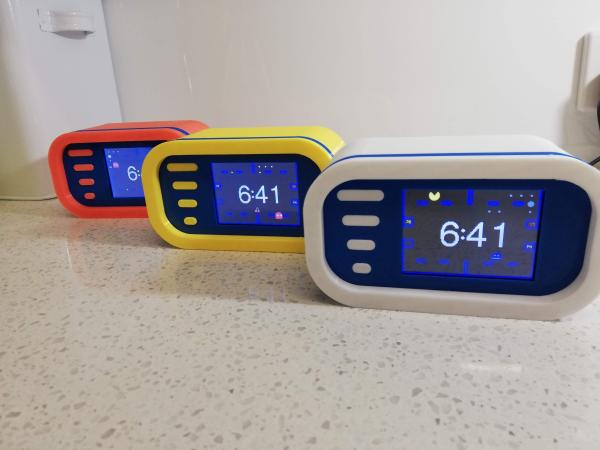
An array of open-source clocks that play Pac-Man (or Mrs. Pac-Man).

ESP32 Pac-Man Clock Keeps Track Of How Long You Watch It

There are so many elements that make a good clock worth looking at for much longer than necessary. Not only is this clock quite cool to behold, it plays Pac-Man around the time! Yes, of course you can interact with the Pac-Man — touching the edges of the screen will make him go left, right, up, or down accordingly. You can also change to Ms. Pac-Man and make all the animations go normal speed, fast, or crazy-fast.

[TechKiwiGadgets] built a Pac-Man clock a few years ago that was well-received, but not cheap or easy to mimic. Since then, they have ported the code to the ESP32 and made a new version that has fewer and friendlier components. Not only that, they have great instructions for building the ESP32 shield on protoboard and also offer the shield as an open-source fab-able PCB. Still too much work? The complete kit version is available over on Tindie. Be sure to check it out in crazy speed mode action after the break.

Although this isn’t the first Pac-Man clock we’ve seen, it devotes equal attention to the time and the game, whereas this one is more about the game itself.

Continue reading “ESP32 Pac-Man Clock Keeps Track Of How Long You Watch It”
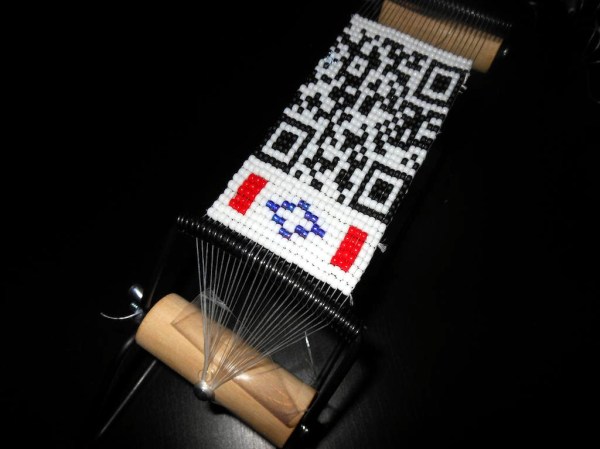
This beaded QR code tells a story when scanned.

Beaded QR Code Bracelets Weave A Storytelling Interface

For centuries, people have been using patterns to communicate information in an eye-catching way. QR codes are no different, although they require a barcode scanner to decode rather than a knowledge of Navajo Native American history.

November is National Native American Heritage Month, and as part of their celebration, [ngaskins] and their students are making seed bead bracelets with QR codes. When scanned, each QR triggers a story written by the student in the form of an audio file, a video clip, or an animation. [ngaskins] says that this project was inspired by eyeDazzler, a beadwork tapestry made with software that generates Navajo weaving patterns.

The students started by designing their bracelets on graph paper, software, or a virtual loom before getting the seed beads and the tweezers out, and decided whether they would use a static or dynamic QR code. Aside from the aesthetics of beadwork, the bead loom is good for teaching math and computational ideas because the beads are laid out in rows and columns. It’s also a good tool for teaching lines of symmetry.

QR codes can hold quite a bit of information. In fact, there’s enough room in a version 40 QR for an executable version of Snake.

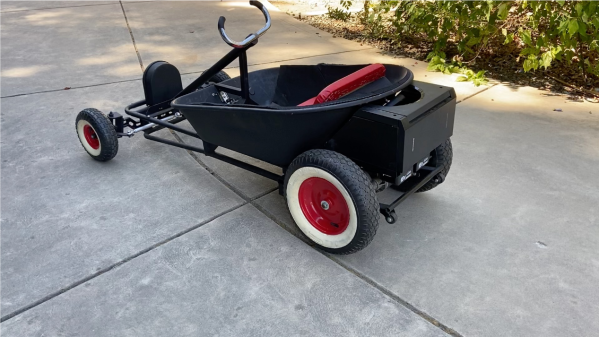
An electric mini rat rod made from mostly recycled parts.

Electric Mini Rat Rod Starts ‘Em Young

These days, a lot of people barely even say hello to their neighbors. But not [dewey302]. They’re so tight with the people next door that they built this bad-ass electric mini rat rod for the neighbors’ five-year-old kid. Talk about community!

Nearly every bit of this rod is recycled — the body is a wheelbarrow, the transaxle is from a mobility scooter, and the frame was welded together from scrap tubing including the wheelbarrow itself, and old bike or two, and some broken lawn chairs. The rear wheels are also from the ‘barrow, though the front ones were purchased (one of few new parts. Power comes from a pair of 18 V tool batteries wired in series and running through the Curtis controller from the scooter. Depending on the weight of the driver, this baby will do 10-12 MPH.

We love the look of this little rat rod, and wish we were [dewey302]’s neighbor. When you’re done poring over the pile of build pictures, be sure to watch [dewey302] and [The Kid] tear up the cul-de-sac in the video after the break.

You may have noticed the mailbox grille. Surprisingly, this is not the first mail-themed rat rod we’ve covered. Here’s one that really delivers.

Continue reading “Electric Mini Rat Rod Starts ‘Em Young”

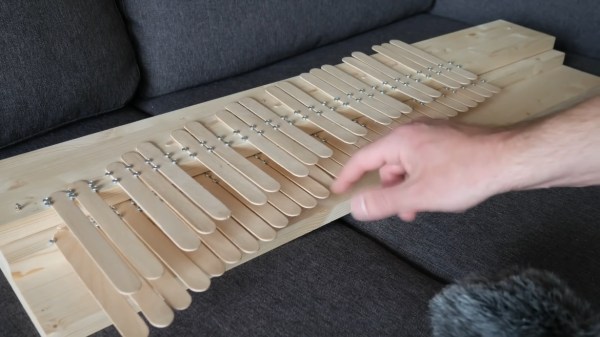
Wooden sticks sound good if you clamp them down at one end.

Popsicle-Stick Piano Sounds Sweet

Technically, this is a kalimbaphone, and not a piano or even a chordophone since there are no strings. But this handcrafted instrument doesn’t just sound sweet, it’s also mellow, and it’s much nicer than you’re probably imagining. Go check out the short build video, which starts with a demo.

[Mash] started by drilling a bunch of holes into a rectangular piece of wood, and then twisted in wood screws far enough to stay in. Then [Mash] laid Popsicle sticks between each set of screws and tuned them one at a time, starting with middle C. The Popsicle stick version didn’t sound so great, so [Mash] upgraded to tongue depressors and moved the black keys up to their own layer. Unfortunately, the owner has turned off embeds for the video, so you’ll have to watch it on YouTube.

We’d love to see [Mash] figure out a way to make the sticks resonate. In the meantime, check out this 3D-printed grand piano mechanism. And if this build has you in the mood to listen to Popcorn on a homemade instrument, well, we’ve got you covered there.

Thanks to [Keith] for the tip!

Light projected through prisms on to laser-cut letters submerged in water.

YOU Are A Projection Of Your Influences

Who are you? No, who are you really? You’re an amalgamation of influences from your family, your friends, the media, and the parasocial relationships you have with fictional characters. It’s okay; we all are. It can’t be helped that there’s a lot of it about.

[Kim Pimmel]’s YOU examines this question of identity in the form of  projected typography. YOU are solidly laser-cut at birth, but then come the influences — the water of everyday life that surrounds you, the lights that mask your dread or lay you bare, and the prisms of circumstance that twist the light into brilliant patterns that burn memories into your brain.

In this case, the light comes from a hacked camping headlamp that was past its prime. [Kim] laser-cut the letters from acrylic and submerged them in water, which can be manipulated to enhance the effect and mimic the turmoil of life. For added effect, [Kim] held prisms in the light’s path to refract it and cause the patterns to dance. Be sure to check it out after the break, and don’t forget to turn on the sound so you can hear [Kim]’s original composition.

Want to see more trippy typography? Check out this vector art that started as Perlin noise.

Continue reading “YOU Are A Projection Of Your Influences”

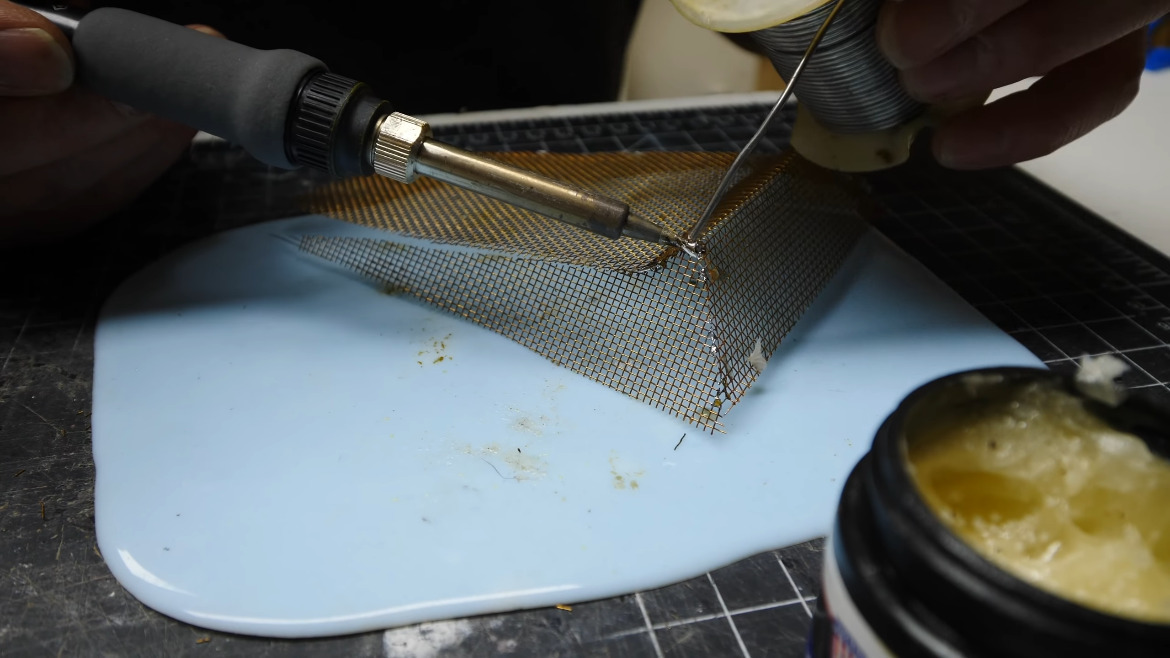
Brass screen is soldered together into a large mold for cardboard pulp.

How To Make A Classy, Brassy Cardboard Pulp Mold

When we last checked in with prolific prototypist [Eric Strebel], he was perfecting the design of an eco-friendly wireless charger and turning his initial paper prototype into a chipboard version 2.0 that takes manufacturing concerns into consideration. At the end of this second video in a series, [Eric] was printing out the early versions of the form by which he would eventually make a brass screen mold for working with cardboard pulp. You know, the stuff that some egg cartons are made from.

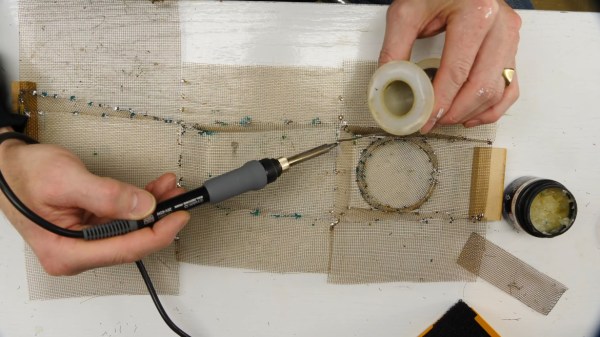
Soldering brass screen into a mold.In the video below, it’s time to build the pulp mold by creating three smaller molds and then joining them into one horizontal mold. The result is a single piece that then gets folded up into a charging stand, much like the egg carton. [Eric] is using brass screen here, but says that copper would be a good choice, too.

After cutting the brass with scissors and pounding them flat, he uses the 3D-printed molds from the previous video to press them into the correct shapes. Each of the three pieces needs a frame, which [Eric] makes from more brass screen, then stitches it to the mold piece with loose screen threads before securing the unions with solder.

Since the weight of all the water would likely bend the brass out of shape, [Eric] finished off the mold by soldering on a frame of flat brass strip. Check out this awesome process below, and stay tuned for the next video when [Eric] pulps some cardboard and pumps out some eco-friendly chargers.

Does this look too complicated? You could always skip the whole mesh mold thing and shape your cardboard confetti directly into 3D printed parts.

Continue reading “How To Make A Classy, Brassy Cardboard Pulp Mold”

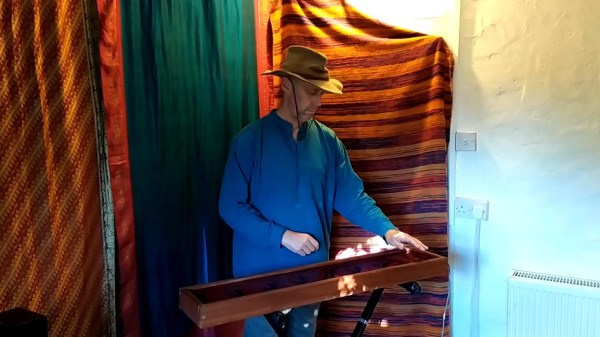
This is a MIDI harp that is played by waving your hands in the air over the infrared distance sensors.

Teensy MIDI Air Harp Sounds Huge

Some of the coolest sounds come from wild instruments like orchestra strings, fretless basses, and theremins — instruments that aren’t tied down by the constraints of frets and other kinds of note boundaries. [XenonJohn]’s air harp is definitely among this class of music makers, all of which require a certain level of manual finesse to play well.

Although inspired by Jean-Michel Jarre’s laser harp, there are no lasers here. This is a MIDI aetherharp, aka an air harp, and it is played by interrupting the signals from a set of eight infrared distance sensors. These sensors can be played at three different heights for a total of 24 notes, plus there’s a little joystick for doing pitch bends.

Inside the wooden enclosure of this aetherharp is a Teensy 3.5 and eight infrared distance sensors with particularly long ranges. On top is a layer of red acrylic that doesn’t affect the playability, except in bright sunlight. Although you could use most any MIDI software to produce the actual sounds, [XenonJohn] chose VMPK (Virtual MIDI Piano Keyboard). Be sure to check it out in action after the break.

Not dangerous enough for you? Here’s a laser harp that involves a Tesla coil.

Continue reading “Teensy MIDI Air Harp Sounds Huge”