Demonstrating ThermoAcoustics With The Rijke Tube

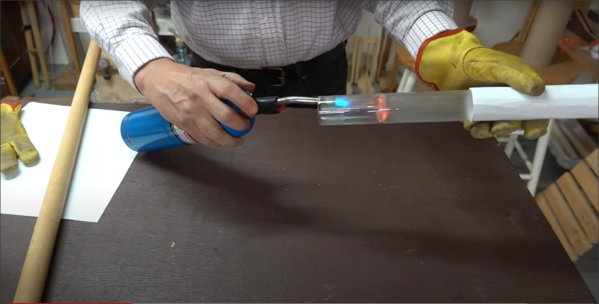
The Rijke tube is a very simple device that demonstrates the principle of thermoacoustics quite clearly. Construction is quite straightforward, simply place a metal gauze at the bottom end of a tube, approximately one quarter of the way up, apply a source of heat to the gauze, and instant sound. The heat produces convection, setting up a longitudinal standing wave. This is due to air passing over the hot gauze, suddenly expanding and causing a pressure change, which rushes out the tube. Next, the airflow cools and slows, and air starts to head back into the tube, and the cycle repeats. Adjusting the tube length by slipping a sleeve over it, adjusts the pitch of the note, simply because the air has a different distance to travel. If there is a flame aimed at the gauze from below, the sound will stop since the air is already hot when it hits the hot gauze, no pressure change occurs, and no oscillation.

As [Keith], the reader who sent in the tip, suggests it would be fun to attach a servo to a sleeve on the tube, build multiple units and hang the whole thing off a MIDI controller. This could make for some fun times, and we have to agree. The problem of keeping the gauze hot could be solved in a number of ways, direct resistive heating could work, but maybe inductive heating would be cleaner?

Now, we can’t find an instrument which works in this manner, which sounds like a hack in the making for someone out there so inclined.

There have been a few fire-orientated musical devices over the years, such as this Rijke Tube Organ, various variants on the pyrophone, including this neat one performing with a tesla coil, and while we’re talking about music fire, howsabout a two dimensional rubens’ tube variant?

Continue reading “Demonstrating ThermoAcoustics With The Rijke Tube”

Raspberry Pi Plots World Wide Earthquakes

What do you do when you stumble across a website posting real-time earthquake data? Well, if you’re [Craig Lindley] you write some code to format it nicely onto a display, put it in a box, and watch it whilst making dinner.

[Craig] started off with coding in Forth on the ESP32, using ESP32Forth, but admits it didn’t go so well, ditching the ESP32 for a Raspberry Pi 3 he had lying around, and after a brief detour via C++, he settled on a Python implementation using Pygame.

A case was 3D printed, which he says worked OK, but needs a little tuning to be perfect. There is no shortage of casing options for the Pi with the official 7″ display, [Craig] suggests that it probably wasn’t worth the effort to 3D print the case and if he was building it again would likely use a commercially available option which had a better fit.

When developing the code, and watching it work, he noted clusters of earthquakes around Hawaii, then he found out Kilauea had just gone up. Wow.

For a similar take, check out this other recent build using an ESP32 and the same data source.

Forget Digital Computing, You Need An Analog Computer

The analog computer of decades-gone-by is something many of us younger engineers never got the chance to experience first hand. It’s pretty much a case of reading about them on these fine pages or perhaps looking at a piece of one behind glass in one of the more interesting museums out there. But now, there is another option, (THAT) The Analog Thing. Developed by Berlin-based Analog computer-on-chip specialist Anabrid, THAT is an Open Source analog computer you can build yourself (eventually) or buy from them fully assembled. At least, that’s their plan.

From the 1970s onwards, digital computers became powerful enough to replace analog computers in pretty much every area, and with the increased accuracy this brought, the old analog beasts became obsolete overnight. Now, there seems to be a move to shift back a little, with hybridized analog-digital approaches looking good for some applications, especially where precision is not paramount. After all, that pile of fatty grey matter between your ears is essentially a big analog computer, and that’s pretty good at problem solving.

Looking over the project Wiki there are a few application examples and some explanatory notes. Schematics are shown, albeit only images for now. We can’t find the PCB files either, but the assembly instructions show many bodge wires, so we guess they’re re-spinning the PCB to apply fixes before releasing them properly. This is clearly work-in-progress and as they say on the main site, their focus is on chips for hybrid analog-digital computing, with a focus on energy-efficient approximate methods. With that in mind, we can forgive that the community-focused learning tools are still being worked on. All that said, this is still a very interesting project, and definitely would be a Christmas present this scribe would be more than happy to unwrap.

Continue reading “Forget Digital Computing, You Need An Analog Computer”

CO2 laser cutting ceramic sheet under water film

Water Is The Secret Ingredient When Laser Cutting Ceramics To Make Circuits

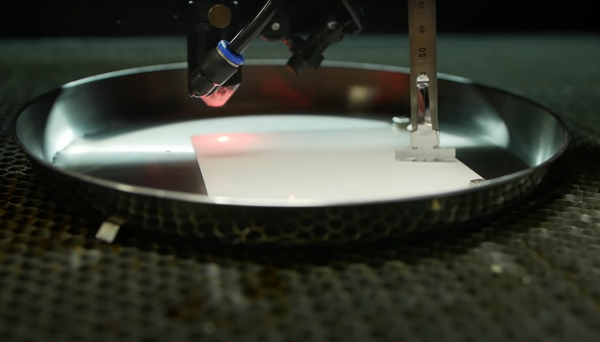
[Ben Krasnow] over at Applied Science was experimenting with cutting inexpensive ceramic sheets with his cheap CO2 laser cutter when he found that (just as expected) the thermal shock of the CO2 beam would cause cracking and breaking of the workpiece. After much experimentation, he stumbled upon a simple solution: submersion under a thin layer of water was sufficient to remove excess heat, keeping thermal shock at bay, and eventually cutting the material. Some prior art was uncovered, which we believe is this PHD thesis (PDF) from Manchester University in the UK. This is a great read for anyone wanting to dig into this technique a little deeper.

The CO2 laser cutter is a very versatile tool, capable of cutting and etching a wide range of materials, many of natural origin, such as cardboard, leather and wood, as well as certain plastics and other synthetic materials. But, there are also materials that are generally a no-go, such as metals, ceramics and anything that does not absorb the laser wavelength adequately or is too reflective, so having another string in one’s bow is a good thing. After all, not everyone has access to a fibre laser.

After dispensing with the problem of how to cut ceramic, it got even more interesting. He proceeded to deposit conductive traces sufficiently robust to solder to. A mask was made from vinyl sheet and a squeegee used to deposit a thick layer of silver and glass particles 1 um or less in size. This was then sintered in a small kiln, which was controlled with a Raspberry Pi running PicoReFlow, and after a little bit of scrubbing, the surface resistance was a very usable 2 mΩ/square. Holes cut with the laser, together with some silver material being pushed through with the squeegee formed through holes with no additional effort. That’s pretty neat!

Some solder paste and parts were added to the demo board, and with an added flare for no real reason other than he could, reflowed by simply applying power direct to the board. A heater trace had been applied to the bottom surface, rendering the board capable of self-reflowing. Now that is cool!

Continue reading “Water Is The Secret Ingredient When Laser Cutting Ceramics To Make Circuits”

Awesome Python Video Tutorials Keep You Motivated

Programming languages are one of those topics that we geeks have some very strong and often rather polarised opinions about. As new concepts in computing are dreamt up, older languages may grow new features, if viable, or get left behind when new upstarts come along and shake things up a bit. This scribe can remember his early days programming embedded systems, and the arguments that ensued when someone came along with a project that required embedded C++ or worse, Java, when we were mostly diehard C programmers. Fast forward a decade or two, and things are way more complicated. So much choice, so much opinion.

So it’s really nice to come across some truly unique and beautifully made Python tutorial videos, that are engaging and fun to watch. Fronted by Canadian actress [Ulka Simone Mohanty] who some may recognise from such lofty titles as the game “Magic: The Gathering Arena” and various films and TV shows, she delivers a dead-pan avatar-like presentation of the most important areas of Python. We were particularly amused by the comment “Loopus Interruptus” as the exception condition iterating off the end of a list. 

Continue reading “Awesome Python Video Tutorials Keep You Motivated”

Microwave Ovens: Need More Power? Use Lasers Instead!

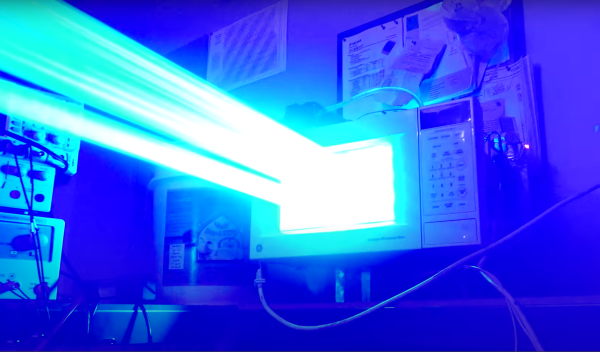
You know how it is, you get in late from work, you’ve been stuck in traffic for what seems like an eternity, and you’re hungry. You reach for the microwave meal, and think, if only I didn’t have to wait that three-and-a-half minutes, 900 watts just isn’t enough power. What you need is a laser microwave, and as luck would have it, [Styropyro] has built one, so you don’t have to. No, really, don’t.

After he observed a microwave only operating on a half-wave basis, and delivering power 50% of the time, he attempted to convert it to full-wave by doubling up the high voltage transformer and rectification diodes. While this worked, the poor suffering magnetron didn’t go the full mile, and died somewhat prematurely.

Not to be disheartened, the obvious thing was to ditch the whole concept of cooking with boring old radio waves, and just use a pile of frickin’ lasers instead. Now we’re not sure how he manages to get hold of some of the parts he uses, and the laser array modules look sketchy to say the least, and to be frank, we don’t think they should be easy to get given the ridiculous beam power they can muster.

With the build completed to the usual [Styropryo] level of excellent build quality, he goes on to produce some mouthwatering delicacies such as laser-charred poptart, incinerated steak with not-really-caramelised onions and our favourite laser-popcorn. OK, he admits the beam has way too much power, really should be infrared, and way more diffuse to be even vaguely practical, but we don’t care about practicality round these parts. Who wouldn’t want the excitement of going instantly blind by merely walking into the kitchen at the wrong time?

We’ve covered a fair few microwave oven related hacks before, including a neat microwave kiln, and hacks using microwave parts, such as a janky Jacob’s ladder, but this is probably the first laser microwave we’ve come across. Hopefully the last :)

And remember kids, as [Styropyro] says in pretty much every video on his channel:

All the crazy stuff I’m about to do was done for educational purposes, in fact if you were to try any of this stuff at home, you’d probably die…

Continue reading “Microwave Ovens: Need More Power? Use Lasers Instead!”

3D Printed Research Robotics Platform Runs Remotely

The Open Dynamic Robot Initiative Group is a collaboration between five robotics-oriented research groups, based in three countries, with the aim to build an Open Source robotics platform based around the torque-control method. Leveraging 3D printing, a few custom PCBs, and off-the-shelf parts, there is a low-barrier to entry and much lower cost compared to similar robots.

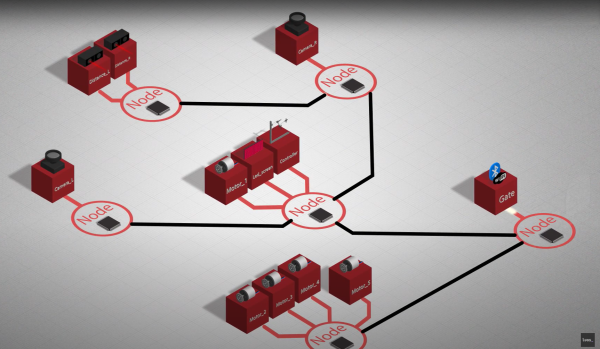
The eagle-eyed will note that this is only a development platform, and all of the higher level control is off-machine, hosted by a separate PC. What’s interesting here, is just how low-level the robot actually is. The motion hardware is purely a few BLDC motors driven by field-orientated control (FOC) driver units, a wireless controller and some batteries. The FOC method enables very efficient motor commutation, giving excellent efficiency and maximum torque.  A delve into the maths of how this method operates will be an eye opener for the uninitiated. Optical encoders attached to the motors give positional feedback for the control loop.

It is this control loop that’s kinda weird, in that operates over Wi-Fi! Normally one would do all the position, torque and speed sensing locally within the leg unit, with local control loops, as well as running all the limb kinematics and motion planning. This would need some considerable local processing grunt, which can make development more difficult.

This project side-steps this, by first leveraging the ESPNOW protocol, initially aimed at the ESP8266 and friends. By patching Ubuntu Linux, and enabling preemptive multitasking for real-time scheduling, as well as carefully selecting Wi-Fi drivers, it was possible to get raw packets out to robot in about 1 ms, enabling control loop bandwidths of around 1 Khz. And, that, was fast enough to run at least sixteen motors in parallel.

Continue reading “3D Printed Research Robotics Platform Runs Remotely”