DIY Neuroscience Hack Chat

Join us on Wednesday, February 24 at noon Pacific for the DIY Neuroscience Hack Chat with Timothy Marzullo!

Watch a film about a mad scientist from the golden age of Hollywood and chances are good that among the other set pieces, you’ll see human brains floating in jars of cloudy fluid wired up to electrodes and fancy machines. It’s all made up, of course, but tropes work because they’re based on a kernel of truth, and we in the audience know that our brains and the other parts of our nervous system do indeed work on electricity. Or more precisely, excitable tissues in our nervous systems pass electrochemical signals between themselves as waves of potential across cell membranes.

Studying this electrical world locked away inside our heads is a challenging, but by no means impossible, pursuit. Usable signals can be picked up, amplified, digitized, and recorded to help us understand what’s going on when we think, feel, move, sleep, wake, or just be. Neuroscience has made tremendous strides looking at these signals, but the equipment to do so has largely remained the province of large universities and teaching hospitals with ample budgets, leaving the amateur neuroscientist out of luck.

Tim Marzullo, co-founder of Backyard Brains, is looking to change all that. While working on his Ph.D. in neuroscience at the University of Michigan, he and Greg Gage looked for ways to make the tools of neuroscience research affordable to everyone. The result is the Neuron SpikerBox, a low-cost bioamplifier that can tap into the “spikes” of action potential in live neurons. Open-source tools like these have helped educators bring neuroscience experiments to STEM students, and even helped other scientists set up novel, low-cost experiments.

Tim will join us on the Hack Chat to talk about doing DIY neuroscience and designing the instruments that make it possible. Bring your “mad scientist” questions as we push back the veil of ignorance on how our brains work, one neuron at a time.

join-hack-chatOur Hack Chats are live community events in the Hackaday.io Hack Chat group messaging. This week we’ll be sitting down on Wednesday, February 24 at 12:00 PM Pacific time (UTC-8). If time zones have you tied up, we have a handy time zone converter.

Click that speech bubble to the right, and you’ll be taken directly to the Hack Chat group on Hackaday.io. You don’t have to wait until Wednesday; join whenever you want and you can see what the community is talking about.


 

Continue reading “DIY Neuroscience Hack Chat”

Hackaday Links Column Banner

Hackaday Links: February 21, 2021

Well, that was quite a show! The Perseverance rover arrived on Mars Thursday. Don’t tell the boss, but we spent the afternoon watching the coverage in the house on the big TV rather than slaving away in the office. It was worth it; for someone who grew up watching Jules Bergman and Frank Reynolds cover the Apollo program and the sometimes cheesy animations provided by NASA, the current coverage is pretty intense. A replay of the coverage is available – skip to about the 1:15:00 mark to avoid all the filler and fluff preceding the “Seven Minutes of Terror” main event. And not only did they safely deliver the package, but they absolutely nailed the landing. Perseverance is only about 2 km away from the ancient river delta it was sent to explore for signs of life. Nice shooting!

We’re also being treated to early images from Jezero crater. The first lowish-rez shots, from the fore and after hazard cameras, popped up just a few seconds after landing — the dust hadn’t even settled yet! Some wags complained about the image quality, apparently without thinking that the really good camera gear was stowed away and a couple of quick check images with engineering cameras would be a good idea while the rover still had contact with the Mars Reconnaissance Orbiter. Speaking of which, the HiRISE camera on the MRO managed to catch a stunning view of Perseverance’s descent under its parachute; the taking of that photo is an engineering feat all by itself. But all of this pales in comparison to a shot from one of the down-looking cameras in the descent stage, show Perseverance dangling from the skycrane just before touchdown. It was a really good day for engineering.

Would that our Earthly supply chains were as well-engineered as our Martian delivery systems. We’ve been hearing of issues all along the electronics supply chain, impacting a wide range of industries. Some of the problems are related to COVID-19, which has sickened workers staffing production and shipping lines. Some, though, like a fire at the AKM semiconductor plant in Japan, have introduced another pinch point in an already strained system. The fire was in October, but the impact on the manufacturer depending on the plant’s large-scale integration (LSI) and temperature-compensated crystal oscillators (TCXO) products is only just now being felt in the amateur radio market. The impact is likely not limited to that market, though — TCXOs pop up lots of gear, and the AKM plant made LSI chips for all kinds of applications.

What do you get when you combine a 3D-printer, a laser cutter, a CNC router, and a pick-and-place robot? Drones that fly right off the build plate, apparently. Aptly enough, it’s called LaserFactory, and it comes from MITs Computer Science and Artificial Intelligence Lab. By making different “bolt-on” tools for a laser cutter, the CSAIL team has combined multiple next-generation manufacturing methods in one platform. The video below shows a drone frame being laser-cut from acrylic, to which conductive silver paste is added by an extruder. A pick-and-place head puts components on the silver goo, solders everything together with a laser, and away it goes. They also show off ways of building up 3D structures, both by stacking up flat pieces of acrylic and by cutting and bending acrylic in situ. It’s obviously still just a proof of concept, but we really like the ideas presented here.

And finally, as proof that astronomers can both admit when they’re wrong and have fun while doing so, the most remote object in the Solar System has finally received a name. The object, a 400-km diameter object in a highly elliptical orbit that takes it from inside the orbit of Neptune to as far as 175 astronomical units (AU) from the Sun, is officially known as 2018 AG37. Having whimsically dubbed the previous furthest-known object “Farout,” astronomers kept with the theme and named its wayward sister “Farfarout.” Given the rapid gains in technology, chances are good that Farfarout won’t stay the Sun’s remotest outpost for long, and we fear the (Far)nout trend will eventually collapse under its own weight. We therefore modestly propose a more sensible naming scheme, perhaps something along the lines of “Farthest McFaraway.” It may not scale well, but at least it’s stupid.

This Slimline Word Clock Uses Laser Etching To Keep Things Simple

Judging by the tips we get, it seems like the popularity of word clocks has perhaps started falling off lately. But back at peak word clock, we were seeing dozens of designs, some better than others. This simple but classy word clock seems to benefit from all that prior art, making the design just about as simple as it can get while still looking great.

The main tool for [t0mg]’s build is a laser cutter, which is a great choice for keeping the design simple. The tricky part of word clocks is getting the “word search” matrix executed cleanly, and we’ve seen everything from laser-cut wood to inkjet prints, and even commercially produced PCBs, used for the job. [t0mg] opted instead to spray paint a piece of glass and etch away the characters with the laser, which results in superb text quality. Etching the underside of the glass also has the advantage of protecting the paint layer while giving the finished clock a glossy face that really looks nice. Under the template lie layers of MDF that hold the Neopixel strips and act as light guides, while an ESP32 and RTC perform timekeeping and LED-driving duties. [t0mg] finished off the clock with a nice web interface to set the clock, change the colors, and perform maintenance functions. The video below shows the software in use.

We really think this clock looks great, and for those with access to a laser cutter, it seems like a great way to go about building your own.

Continue reading “This Slimline Word Clock Uses Laser Etching To Keep Things Simple”

Homebrew Doorknob Caps For High-Voltage Fun

Mouser and Digi-Key are great for servicing most needs, and the range of parts they offer is frankly bewildering. But given the breadth of the hardware hacking community’s interests, few companies could afford to be the answer to everyone’s needs.

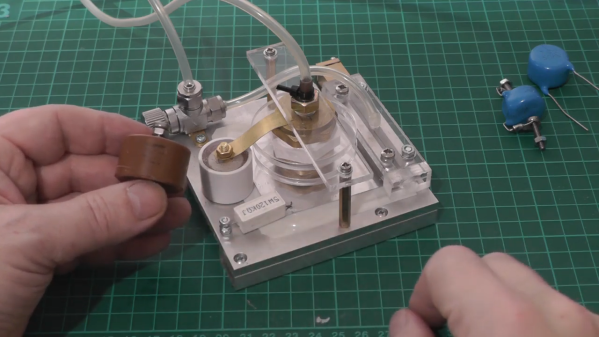
That’s especially true for the esoteric parts needed when one’s hobby involves high voltages and homemade lasers, like [Les Wright]. He recently came up with a DIY doorknob capacitor design that makes the hard-to-source high-voltage caps much easier to obtain. We’ve seen [Les] use these caps in his transversely excited atmospheric (TEA) lasers, a simple design that uses high-voltage discharge across a long, narrow channel filled with either room air or nitrogen. The big ceramic caps are needed for the HV supply, and while [Les] has a bunch, they’re hard to come by online. He tried a follow-up using plain radial-lead ceramic capacitors, and while the laser worked, he did get some flashover between the capacitor leads.

[Les]’s solution was to dunk the chunky caps in acetone for a week or so to remove their epoxy covering. Once denuded, the leads were bent into a more axial configuration and soldered to brass machine screws. The dielectric slug is then put in a small section of plastic tubing and potted in epoxy resin with the bolts protruding from each end. The result is hard to distinguish from a genuine doorknob cap; the video below shows the build process as well as some testing.

Hats off to [Les] for taking pity on those of us who want to replicate his work but find ourselves without these essentials. It’s nice to know there’s a way to make unobtanium parts when you need them.

Continue reading “Homebrew Doorknob Caps For High-Voltage Fun”

Laser Galvos And An ESP32 Recreate Old-School Asteroids

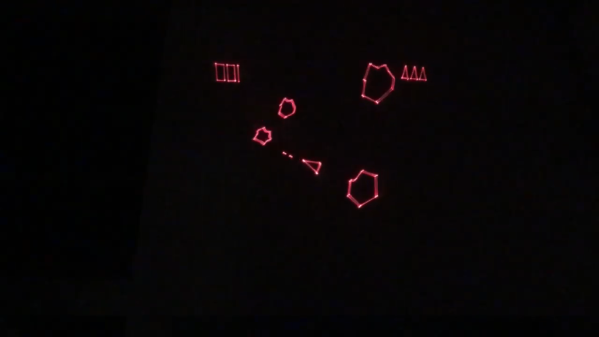
Playing Asteroids now isn’t quite what it used to be when it came out 40 years ago. At the time, the vector-scan display was part of the charm; making do with an emulator running on a traditional raster display just doesn’t quite do it for purists. But if you manage to build your own laser-projector version of the game like [Chris G] did, you’re getting close to capturing some of the original magic of the game.

There’s a lot to unpack about this project, and the video below does a good job explaining it. Where the original game used a beam of electrons flashing inside a CRT to trace out each object in the game, [Chris] substituted an off-the-shelf two-axis galvanometer from eBay and a 5-mW laser LED. This can project a gamefield on a wall up to two meters on a side, far bigger than any version of the machine ever built. The galvos are driven by op-amp drivers and an SPI DAC on a custom PCB. And in comparison to the discrete logic chips and 6502 running the original game, [Chris] opted for an ESP32.

As interesting as the hardware for this is, the real story is in the software. [Chris] does an excellent job running through his design, making the bulk of the video feel like a master class in game programming. His software is from scratch — no emulations here. As such it doesn’t perfectly reproduce the original games — no flying saucers and no spaceship explosion animations (yet) — but when coupled with the laser vector display, it certainly captures the feel of the original.

Being devoted Asteroids fans from back in the day, this one really pushes our buttons. We’ve seen laser-based recreations of the game before, but this one makes us think we can finally afford to recapture the glory of our misspent youth.

Continue reading “Laser Galvos And An ESP32 Recreate Old-School Asteroids”

Hackaday Links Column Banner

Hackaday Links: February 16, 2021

This is it; after a relatively short transit time of eight months, the Mars 2020 mission carrying the Perseverance rover has almost reached the Red Planet. The passage has been pretty calm, but that’s all about to end on Thursday as the Entry Descent and Landing phase begins. The “Seven Minutes of Terror”, which includes a supersonic parachute deployment, machine-vision-assisted landing site navigation, and a “sky-crane” to touch the rover down gently in Jezero crater, will all transpire autonomously 480 million km away. We’ll only learn about how it goes after the eleven-minute propagation delay between Mars and Earth, but we’ll be glued to the NASA YouTube live stream nonetheless. Coverage starts on February 18, 2021 at 11:15 AM Pacific Standard Time (UTC-8). We’ve created a handy time zone converter and countdown so you don’t miss the show.

As amazing as the engineering on display Thursday will be, it looks like the US Navy has plans to unveil technology that will make NASA as relevant as a buggy-whip company was at the turn of the last century. That is, if you believe the “UFO Patents” are for real. The inventor listed on these patents, Dr. Salvatore Pais, apparently really exists; he’s had peer-reviewed papers published in mainstream journals as recently as 2019. Patents listed to Dr. Pais stretch back to 2004, when he invented a laser augmented turbojet propulsion system, which was assigned to defense contractor Northrup Grumman. The rest of the patents are more recent, all seemingly assigned to the US Navy, and cover things like a “high-frequency gravitational wave generator” and a “craft using an inertial mass-reduction device”. There’s also a patent that seems to cover a compact fusion generator. If any of this is remotely true, and we remain highly skeptical, the good news is that maybe we’ll get things like the Epstein Drive. Of course, that didn’t end well for Solomon Epstein. Or for Manéo Jung-Espinoza.

Of course, if you’re going to capitalize on all these alien patents, you’re going to need some funding. If you missed out on the GME short squeeze megabucks, fret not — there’s still plenty of speculative froth to go around. You might want to try your hand at cryptocurrency mining, but with GPUs becoming near-unobtainium, you’ll have to get creative, like throwing together a crypto mining farm with a bunch of laptops. It looks like the Weibo user who posted the photos has laptops propped up on every available surface of their apartment, and there’s also a short video showing a more industrial setup with rack after rack of laptops. These aren’t exactly throw-aways from some grade school, either — they appear to be brand new laptops that retail for like $1,300 a pop. The ironic part is that the miner says this is better than the sweatshop he used to work in. Pretty sure with all that power being dissipated in his house, it’ll still be a sweatshop come summer.

A lot of people have recently learned the hard lesson that when the service is free, you’re the product, and that what Google giveth, Google can taketh away in a heartbeat, and for no discernable reason. Indie game studio Re-Logic and its lead developer Andrew Spinks found that out last week when a vaguely worded terms-of-service violation notice arrived from Google. The developer of the popular game Terraria was at a loss to understand the TOS violation, which resulted in a loss of access to all the company’s Google services. He spent three weeks going down the hell hole of Google’s automated support system, getting nothing but canned messages that were either irrelevant to his case or technically impossible; kinda hard to check your Gmail account when Google has shut it down. The lesson here is that building a business around services that can be taken away on a whim is perhaps not the best business plan.

And finally, we watched with great interest Big Clive’s secrets to getting those crisp, clean macro shots that he uses to reverse-engineer PCBs. We’ve always wondered how he accomplished that, and figured it involved some fancy ring-lights around the camera lens or a specialized lightbox. Either way, we figured Clive had to plow a bunch of that sweet YouTube cash into the setup, but we were surprised to learn that in true hacker fashion, it’s really just a translucent food container ringed with an LED strip, with a hole cut in the top for his cellphone camera. It may be simple, but you can’t argue with the results.

Continue reading “Hackaday Links: February 16, 2021”

Signal Conditioning Hack Chat This Wednesday

Join us on Wednesday, February 17 at noon Pacific for the Signal Conditioning Hack Chat with Jonathan Foote!

The real world is a messy place, because very little in it stays in a static state for very long. Things are always moving, vibrating, heating up or cooling down, speeding up or slowing down, or even changing in ways that defy easy description. But these changes describe the world, and understanding and controlling these changes requires sensors that can translate them into usable signals — “usable” being the key term.

Making a signal work for you usually requires some kind of signal processing — perhaps an amplifier to boost a weak signal from a strain gauge, or a driver for a thermocouple. Whatever the case, pulling a useful signal that represents a real-world process from the background noise of all the other signals going on around it can be challenging, as can engineering systems that can do the job in sometimes harsh environments. Drivers, filters, amplifiers, and transmitters must all work together to get the clearest picture of what’s going on in a system, lest bad data lead to bad decisions.

To help us understand the world of signal conditioning, Jonathan Foote will drop by the Hack Chat. You may remember Jonathan as the “recovering scientist” who did a great Remoticon talk on virtual modular synthesizers. It turns out that synths are just a sideline for Dr. Foote, who has a Ph.D. in Electrical Engineering and a ton of academic experience. He’s a bit of a Rennaissance man when it comes to areas of interest — machine learning, audio analysis, robotics, and of course, signal processing. He’ll share some insights on how to pull signals from the real world and put them to work.

join-hack-chatOur Hack Chats are live community events in the Hackaday.io Hack Chat group messaging. This week we’ll be sitting down on Wednesday, February 17 at 12:00 PM Pacific time. If time zones have you tied up, we have a handy time zone converter.

Click that speech bubble to the right, and you’ll be taken directly to the Hack Chat group on Hackaday.io. You don’t have to wait until Wednesday; join whenever you want and you can see what the community is talking about.
Continue reading “Signal Conditioning Hack Chat This Wednesday”