We all know that version one of a project is usually a stinker, at least in retrospect. Sure, it gets the basic idea into concrete form, but all it really does is set the stage for a version two. That’s better, but still not quite there. Version three is where the magic all comes together.
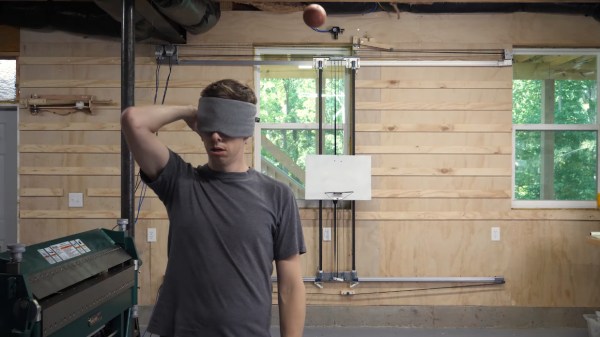
At least that’s how things transpired on [Shane Wighton]’s quest to build the perfect basketball robot. His first version was a passive backboard that redirected incoming shots based on its paraboloid shape. As cool as the math was that determined the board’s shape, it conspicuously lacked any complicated systems like motors and machine vision — you know, the fun stuff. Version two had all these elaborations and grabbed off-target shots a lot better, but still, it had a limited working envelope.
Enter version three, seen in action in the video below. Taking a page from [Mark Rober]’s playbook, [Shane] built a wickedly overengineered CoreXY-style robot to cover his shop wall. Everything was built with the lightest possible materials to keep inertia to a minimum and ensure the target ends up in the right place as quickly as possible. [Shane] even figured out how to mount the motor that tilts the backboard on the frame rather than to the carriage. A Kinect does depth-detection duty on the incoming ball — or the builder’s head — and drains pretty much every shot it can reach.
[Shane] has been doing some great work automating away the jobs of pro athletes. In addition to basketball, he has tackled both golf and baseball, bringing explosive power to each. We’re looking forward to versions two and three on both of those builds as well.
It’s a common enough Hollywood trope that we’ve all probably seen it: the general, chest bespangled with medals and ribbons, gazes at a big screen swarming with the phosphor traces of incoming ICBMs, defeatedly picks up the phone and somberly intones, “Get me the president.” We’re left on the edge of our seats as we ponder what it must be like to have to deliver the bad news to the boss, knowing full well that his response will literally light the world on fire.
Scenes like that work because we suspect that real-life versions of it probably played out dozens of times during the Cold War, and likely once or twice since its official conclusion. Such scenes also play into our suspicion that military and political leaders have at their disposal technologies that are vastly superior to what’s available to consumers, chief among them being special communications networks that provide capabilities we could only have dreamed of back then.
As it turns out, the US military did indeed have different and better telephone capabilities during the Cold War than those enjoyed by their civilian counterparts. But as we shall see, the increased capabilities of the network that came to be known as AUTOVON didn’t come so much from better technology, but more from duplicating the existing public switched-telephone network and using good engineering principles, a lot of concrete, and a dash of paranoia to protect it.
Michelle is deeply involved in designing the virtual CTF challenge for this month’s GNU Radio Conference. Her experience includes dreaming up both in-person and virtual “Capture the Flag” style challenges that span both hardware and software. It’s fun to compete and a powerful way to learn, but how do you choose the hardware and dial-in the scope and difficulty for each part of the challenge? Join us for the chat as Michelle walks through how she builds great challenges.
Click that speech bubble to the right, and you’ll be taken directly to the Hack Chat group on Hackaday.io. You don’t have to wait until Wednesday; join whenever you want and you can see what the community is talking about.
The news was recently abuzz with stories of how the Mars 2020 mission, which launched from Cape Canaveral at the end of July, had done something that no other spacecraft had done before: it had successfully charged the batteries aboard a tiny helicopter that is hitching a ride in the belly of the Mars 2020 rover, Perseverance.
Although the helicopter, aptly named Ingenuity, is only a technology demonstrator, and flight operations will occupy but a small fraction of the time Mars 2020 is devoting to its science missions, it has still understandably captured the popular imagination. This will be humanity’s first attempt at controlled, powered flight on another planet, after all, and that alone is enough to spur intense interest in what amounts to a side-project for NASA. So here’s a closer look at Ingenuity, and what it takes to build a helicopter that will explore another world.
Tech history is rife with examples of bizarre product demos, but we’ve got to think that Elon Musk’s Neuralink demo this week will have to rank up there with the weirdest of them. Elon’s job here was to sell the proposition that having a quarter-sized plug removed from your skull by a surgical robot and having it plunge 1,024 tiny wires into your gray matter will be totally normal and something that all the cool kids will be doing someday. We watched the 14-minute supercut of the demo, which went on for considerably longer than that due to the realities of pig wrangling, and we remain unsold on the technology. Elon selling it as “a Fitbit in your skull, with tiny wires” probably didn’t help, nor did the somewhat terrifying appearance of the surgical robot needed to do the job. On the other hand, Gertrude the Bionic Pig seemed none the worse for her implant, which was reportedly wired to her snout and sending data wirelessly. The demonstration of reading joint positions directly from the brain was honestly pretty neat. If you want to dive deeper into Neuralink, check out Maya’s great article that separates fact from science fiction.
Jerry Carr, NASA astronaut and commander of the third and final crewed Skylab mission, passed away this week at the age of 88. Carr’s Skylab 4 mission was record-breaking in 1974, with the three astronauts living and working in the orbiting workshop for 84 days. The mission contributed a vast amount of information on space medicine and the human factors of long-duration spaceflight. Carr retired from NASA in 1977 and had a long career as an engineer and entrepreneur. It’s sad to lose yet another of the dwindling number of heroes remaining from NASA’s manned-flight heyday.
Speaking of spaceflight, the closest most of us DIYers can get to space is likely courtesy of a helium-filled balloon. If you’ve ever considered sending something — or someone — aloft, you’ll find this helium balloon calculator an invaluable tool. Just plug in the weight of your payload, select from a few common balloon sizes, and the calculator will tell you how many you need and how much gas it will take to fill them. It’s got a second section that tells you how many more balloons it’ll take to get to a certain altitude, should merely getting off the ground not be enough for you.
If 2020 has proven anything, it’s that time is, at best, a negotiable concept. Improbably, September is only a day away, after an August that somehow took forever to go by in the blink of an eye. With that in mind, October is OSHWA’s Open Hardware Month, with this year’s theme being “Label and Certify”. We’re a little bit in love with the Open Hardware Facts generator, which takes your open-source hardware, software, and documentation license and generates a USDA “Nutrition Facts”-style label for your product. They’ve also added tools to make it easier to get OSHWA certification for your project.
And finally, what would it be like to pilot a giant exoskeleton? Like, a 9,000 pound (4,100 kg), quadrupedal all-terrain beast of a mech? Turns out you can (theoretically) find out for yourself courtesy of Furrion Exo-Bionics and their monster mech, dubbed Prosthesis. The machine has been in development for a long time, with the vision of turning mech racing into the next big thing in sports entertainment. Their Alpha Mech Pilot Training Program will allow mere mortals to learn how to pilot Prosthesis at the company’s proving ground in British Columbia. Details are sparse, so caveat emptor, but it sure looks like fun.
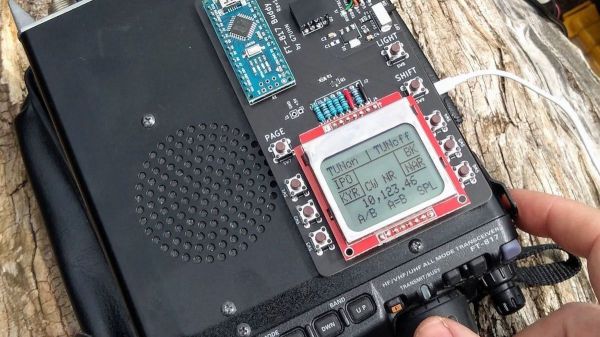
As popular as the venerable Yaesu FT-817 transceiver might be with amateur radio operators, it’s not without its flaws, particularly in the user interface department. [Andy (G7UHN)] is painfully familiar with these flaws, so he designed this auxiliary display and control panel for the FT-817 to make operating it a little easier.
There are a ton of ways to enjoy ham radio, but one of the more popular ways is to bust out of the shack and operate in the great outdoors. From the seashore to mountain peaks, hams love giving their rigs some fresh air and sunshine. The battery-powered, multimode, all-band FT-817 is great for these jaunts, but to fit as much radio into a small package as they did, Yaesu engineers had to compromise on the controls. Rather than bristling with buttons, many of the most-used features of the radio are buried within menus that require multiple clicks and twists to access.
[Andy]’s solution is a PCB bearing an Arduino Nano, an LCD screen, and a whole bunch of actual buttons. The board sits on top of the case and talks to the radio over a 8-pin mini-DIN cable using both documented and undocumented CAT, or Computer Aided Transceiver commands. The LCD displays the current status of various features and the buttons provide easy access to changing them, essentially by sending keystrokes to the radio.
Hats off to [Andy] for tackling this project. The only other FT-817 hack we’ve seen before was useful but far simpler, and didn’t require KiCad, which [Andy] had to teach himself for this one.
While there are many in the 3D-printing community who loudly and proudly proclaim never to have stooped to printing a 3DBenchy, there are far more who have turned a new printer loose on the venerable test model, just to see what it can do. But Benchy is getting a little long in the tooth, and with 3D-printers getting better and better, perhaps a better benchmarking model is in order.
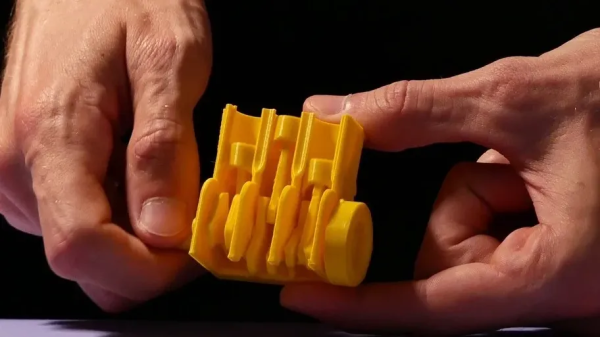
Knocking Benchy off its perch is the idea behind this print-in-place engine benchmark, at least according to [SunShine]. And we have to say that he’s come up with an impressive model. It’s a cutaway of a three-cylinder reciprocating engine, complete with crankshaft, connecting rods, pistons, and engine block. It’s designed to print all in one go, with only a little cleanup needed after printing before the model is ready to go. The print-in-place aspect seems to be the main test of a printer — if you can get this engine to actually spin, you’re probably set up pretty well. [SunShine] shares a few tips to get your printer dialed in, and shows a few examples of what can happen when things go wrong. In addition to the complexities of the print-in-place mechanism, the model has a few Easter eggs to really challenge your printer, like the tiny oil channel running the length of the crankshaft.
Whether this model supplants Benchy is up for debate, but even if it doesn’t, it’s still a cool design that would be fun to play with. Either way, as [SunShine] points out, you’ll need a really flat bed to print this one; luckily, he recently came up with a compliant mechanism dial indicator to help with that job.