Improbably Cheap Pocket Welder Gets An ESP32 Makeover

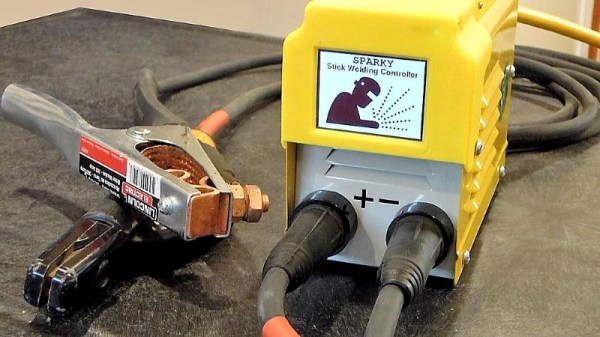
If you move in certain shady circles, you may have noticed the crop of improbably cheap “pocket welders” popping up on the market these days. They’re all variations on a theme, most with wildly optimistic specs minimal accessories of the lowest possible quality. But their tiny size and matching price make them irresistible to the would-be welder, as well as attractive to hardware hackers.

With a 220-V outlet in the garage waiting to be filled and well-knowing the risks, [Mr. RC-Cam] purchased one of these diminutive welding machines. Its shortcomings were immediately apparent, and a complete rework of the welder was undertaken. After addressing safety issues like the lack of a ground connection, [Mr. RC-Cam] added a color-matched 3D-printed hood to house a fancy new LCD touchscreen display. Backing that up is an ESP32 with Bluetooth, which supports remote control via a key fob. He also added a current sense board that uses the welder’s current shunt to measure welding current. Expediently calibrated using a waffle iron and a milli-ohmmeter, the sensor showed that the 200A max advertised for the welder was more like 100A. He tried adding some big electrolytics to fix the current issues, but no dice. With a decent stinger and ground clamp, the modified welder is good enough for his needs, and much was learned in the process. We call that a hacking win.

As an aside, [This Old Tony] recently did a review on a similar welder if you want more details on the internals. We also covered the conversion of a buzz-box to a TIG welder recently, should that be more your style.

Continue reading “Improbably Cheap Pocket Welder Gets An ESP32 Makeover”

ESP32 Makes Great MPPT Controller In Low-Cost Solar Installation

Solar power projects have become, in general, a matter of selecting components like panels and batteries, hooking them together with industry-standard connectors, and sitting back to watch the free electricity flow. As such, solar projects have become a bit boring, so it’s not often we see one that attracts our attention the way this dirt-cheap open-source solar project does.

The backstory on [Tim O’Brien]’s DIY off-grid PV system starts with his desire to charge his eWheel, which amounts to a battery-powered standing unicycle. They look like a fun option for getting around an urban environment if you have the requisite degree of coordination, which we clearly lack. But charging something like that or an eBike is a great use case for solar, especially since [Tim] happened upon a 450W PV panel on the cheap. Sadly, the panel was a commercial unit, and compatible off-the-shelf MPPT, or maximum power-point tracking, controllers are expensive.

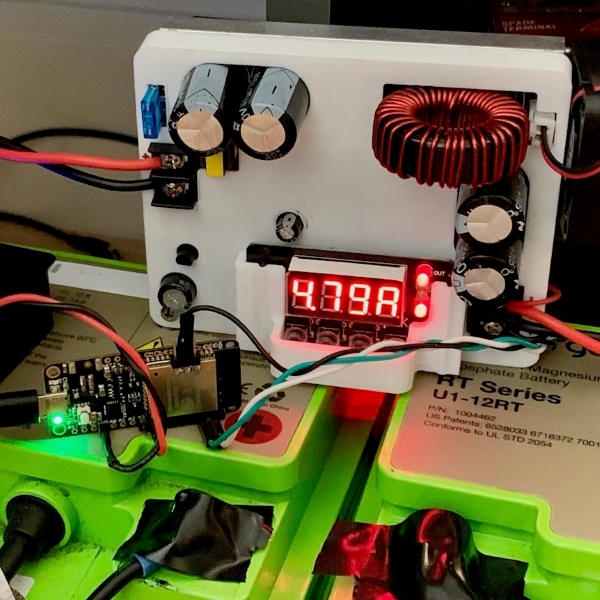
His solution was to build his own controller using a cheap DC-DC converter that just so happens to have serial remote control. An ESP32 monitors the panel voltage and controls the buck converter to run whatever he wants. When he’s not charging his eWheel, the system runs his laptop and router. As a bonus, the ESP32 talks to IoT services like Adafruit.io and Thingspeak, allowing him to track MPPT data without shipping it off to parts unknown.

While we appreciate a DIY MPPT controller and like [Tim]’s build, we feel like the documentation needs a bit of fleshing out. With solar installations, the devil is in the details, and not addressing seemingly mundane issues like cable routing and connector installation can lead to disaster.

Ambitious LED Cube Provides Endless Video Game Scrolling; Plays Castlevania

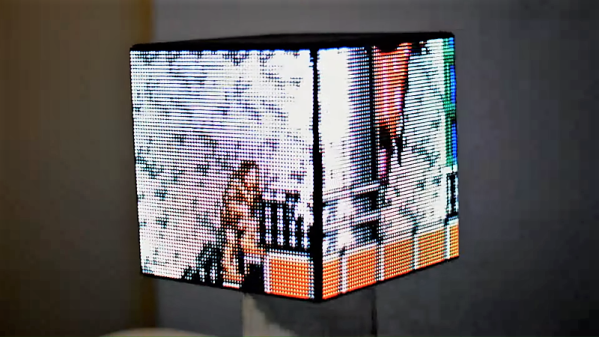
LED cubes are all the rage right now, and rightly so given the amount of work that goes into them and the interesting things people find to do with them. Not content to make yet another position-sensitive display or an abstract design, though, [Greig Stewart] opted for something a bit more ambitious: an LED cube with a playable game of Castlevania.

As ambitious projects often do, this one required leveraging the previous art, some of which we’ve featured before. [Greig] pulled inspiration and information from cube builders like [polyfloyd], [Greg Davill], and [kbob] to put the six 64-LED matrix panels to work. Getting the structural elements figured out was an early stumbling block, but [Greig] pulled it off with 3D-printed brackets and a hinge that’s a work of art in itself; the whole thing looks like something the Borg would have built. The Raspberry Pi inside made a Gameboy emulator possible, and his first stab at it was to have six different games running at once, one on each panel. He settled on just one game, the classic side-scroller Castlevania, played on just four of the panels. Some wizardry was required to de-scroll the game so that the character walks around the cube rather than having the background scroll; you can check out the results in the clip below.

Currently, the cube sits on a lazy susan with a small motor controlling the swiveling in response to a foot control. [Greig] wants to put the motor under control of the game so that physical scrolling is synced with gameplay; we heartily endorse that plan and look forward to the results.

Continue reading “Ambitious LED Cube Provides Endless Video Game Scrolling; Plays Castlevania”

Hackaday Links Column Banner

Hackaday Links: November 3, 2019

Depending on how you look at it, the Internet turned 50 years old last week. On October 29, 1969, the first message was transmitted between two of the four nodes that made up ARPANET, the Internet’s predecessor network. ARPANET was created after a million dollars earmarked for ballistic missile defense was diverted from the Advanced Research Projects Agency budget to research packet-switched networks. It’s said that ARPANET was designed to survive a nuclear war; there’s plenty of debate about whether that was a specific design goal, but if it was, it certainly didn’t look promising out of the gate, since the system crashed after only two characters of the first message were sent. So happy birthday, Internet, and congratulations: you’re now old enough to start getting junk mail from the AARP.

Good news for space nerds: NASA has persuaded Boeing to livestream an upcoming Starliner test. This won’t be a launch per se, but a test of the pad abort system intended to get astronauts out of harm’s way in the event of a launch emergency. The whole test will only last about 90 seconds and never reach more than 1.5 kilometers above the White Sands Missile Range test site, but it’s probably a wise move for Boeing to be as transparent as possible at this point in their history. The test is scheduled for 9:00 AM Eastern time — don’t forget Daylight Savings Time ends this weekend in most of the US — and will air on NASA Television.

Speaking of space, here’s yet another crowd-sourced effort you might want to consider getting in on if you’re of an astronomical bent. The Habitable Exoplanet Hunting Project is looking for a new home for humanity, and they need more eyes on the skies to do it. An introductory video explains all about it; we have to admit being surprised to learn that the sensitive measurements needed to see exoplanets transiting their stars are possible for amateur astronomers, but it seems doable with relatively modest equipment. Such are the advances in optics, CCD cameras, and image processing software, it seems. The project is looking for exoplanets within 100 light-years of Earth, perhaps on the hope that a generation ship will have somewhere to go to someday.

Space may be hard, but it’s nothing compared to running a hackerspace right here on Earth. Or at least it seems that way at times, especially when those times include your building collapsing, a police raid, and being forced to operate out of a van for months while searching for a new home, all tragedies that have befallen the Cairo Hackerspace over the last few years. They’re finally back on their feet, though, to the point where they’re ready to host Egypt’s first robotics meetup this month. If you’re in the area, stop by and perhaps consider showing off a build or even giving a talk. This group knows a thing or two about persistence, and they’ve undoubtedly got the coolest hackerspace logo in the world.

And finally, no matter how bad your job may be, it’s probably not as bad as restoring truck batteries by hand. Alert reader [rasz_pl] tipped us off to this video, which shows an open-air shop in Pakistan doing the dirty but profitable work of gutting batteries and refurbishing them. The entire process is an environmental and safety nightmare, with used electrolyte tossed into the gutter, molten lead being slung around by the bucketful, and not a pair of safety glasses or steel-toed shoes (or any-toed, for that matter) to be seen. But the hacks are pretty cool, like pouring new lead tabs onto the plates, or using a bank of batteries to heat an electrode for welding the plates together. We’ve talked about the recyclability of lead-acid batteries before and how automated plants can achieve nearly 100% reuse; there’s nothing automated here, though, and the process is so labor-intensive that only three batteries can be refurbished a day. It’s still fascinating to watch.

Continue reading “Hackaday Links: November 3, 2019”

Announcing The “Take Flight With Feather” Contest

The Adafruit Feather is the latest platform for microcontroller development, and companies like Particle, Sparkfun, Seeed Studios, and of course Adafruit are producing Feather-compatible devices for development and prototyping. Now it’s your turn! The Take Flight With Feather contest challenges you to design a board to fit in the Feather ecosystem, with the grand prize of having your boards manufactured for you and listed for sale on Digi-Key.

To get started, take a look at the current Feather ecosystem and get acquainted with this list of examples. From there, get to work designing a cool, useful, insane, or practical Feather. But keep in mind that we’re looking for manufacturability. Electron savant Lady Ada will be judging each board on the basis of manufacturability.

What’s a good design? We’re looking for submissions in the following categories:

  • The Weirdest Feather — What’s the most ridiculous expansion board you can come up with?
  • You’ll Cut Yourself On That Edge — We’re surrounded with bleeding-edge tech, what’s the coolest use of new technology?
  • Retro Feather — Old tech lives on, but can you design a Feather to interact with it? Is it even possible to build a vampire Ethernet tap or an old acoustically-coupled modem?
  • Assistive Tech — Build a Feather to help others. Use technology to improve lives.
  • Wireless Feather — Add a new wireless technology to the Feather ecosystem

In addition to the grand prize winner, five other entries (one in each of the 5 categories above) will receive $100 Tindie gift certificates. The contest begins now and runs through December 31st. To get started, start a project on Hackaday.io and use the “Submit Project To” dropdown box on the left sidebar of your project page to enter it in the contest.

Be Anyone Or Anything With Facial Projection Mask

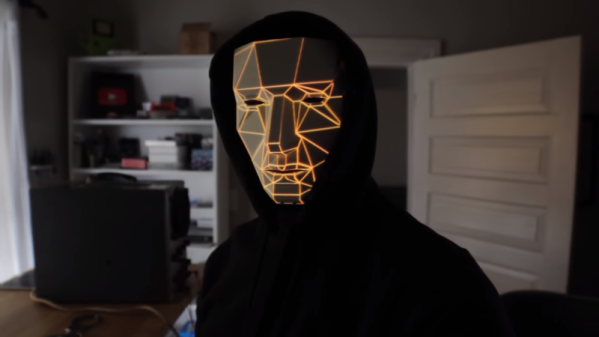
In the market for a low-poly change to your look? Hate the idea of showing up for a costume party only to find out someone is wearing the same mask as you? Then this face changing front-projection mask may be just the thing for you.

To be honest, we’re not sure just how much [Sean Hodgins]’ latest project has to do with cosplay. He seems to be making a subtle commentary about dealing with life in the surveillance state, even though this is probably not a strategy for thwarting facial-recognition cameras. [Ed Note: Or maybe it’s just Halloween?]

The build consists of a Raspberry Pi and a pico projector of the kind we’ve seen before. These are mated together via a custom PCB and live inside a small enclosure that’s attached to the end of a longish boom. The boom attaches to the chin of 3D-printed mask, which in turn is connected to the suspension system of a welding helmet. Powered by a battery pack and controlled by a smartphone app, the projector throws whatever you want onto the mask – videos, effects, even images of other people. Even with some Photoshop tweaks to account for keystone distortion from the low angle of projection, there’s enough distortion that the effect is more artistic than masquerade. But honestly, having your face suddenly burst into flames is pretty cool. We just wonder what visibility is like for the wearer with a bright LED blasting into your eyes.

As a bonus, [Sean] has worked this build into a virtual treasure hunt. Check out 13thkey.com and see what you can make from the minimal clues there.

Continue reading “Be Anyone Or Anything With Facial Projection Mask”

Multimeter Display Perked Up With Nixies, LEDs, And Neon Tubes

Just because something is newer than something else doesn’t automatically make it better. Of course the opposite is also true, but when it comes to displays on bench multimeters, a fancy LCD display is no guarantee of legibility. Take the Hewlett Packard HP 3478A multimeter; the stock transflective display with its 14-segment characters is so hard to read that people usually have to add a backlight to use it.

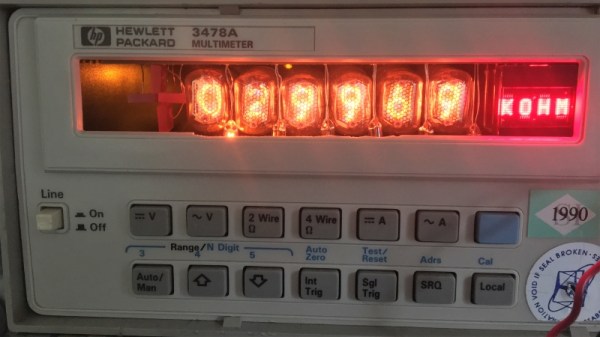
That wasn’t good enough for [cyclotronboy], though, who chose to completely replace the stock 3478A display with Nixie tubes. He noticed that with a little modification, six IN-17 tubes just fit in the window vacated by the LCD. He sniffed out the serial data stream going to the display with a collection of XOR gates and flip-flops, which let him write the code for a PIC18F4550. The finished display adds a trio of rectangular LEDs for the + and – indicators, and an HDLO-1414 four-character alphanumeric display to indicate units and the like. And the decimal points? Tiny neon bulbs. It already looks miles better than the stock display, and with the addition of a red filter, it should look even better.

If you’re stuck with a lame LCD multimeter but Nixies don’t quite do it for you, worry not – an LED conversion is possible too.