Custom Cut Pinwheel Makes A Useful HVAC Duct Flow Meter

Everyone is familiar with pinwheels, and few of us haven’t crafted one from a square of paper, a stick, and a pin. Pinwheels are pretty optimized from a design standpoint, and are so cheap and easy to build that putting a pinwheel to work as an HVAC duct flow meter seems like a great idea.

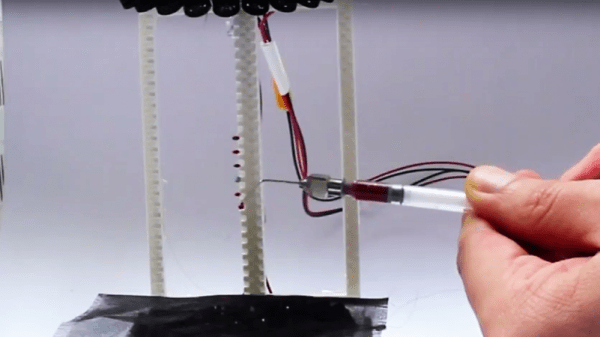
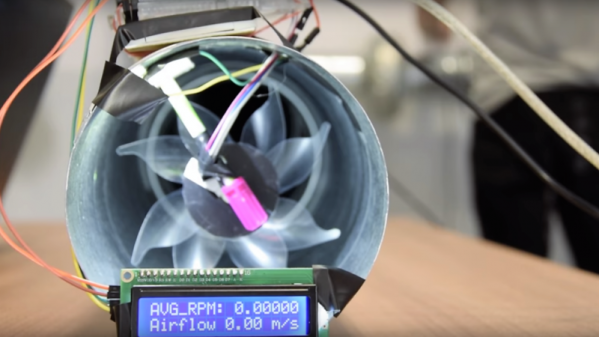
Great in theory, perhaps, but as [ItMightBeWorse] found out, a homemade pinwheel is far from an ideal anemometer. His experiments in air duct flow measurements, which previously delved into ultrasonic flow measurement, led him to try mechanical means. That calls for some kind of turbine producing a signal proportional to air flow, but a first attempt at using a computer fan with brushless DC motor failed when a gentle airflow couldn’t overcome the drag introduced by the rotor magnets. But a simple pinwheel, custom cut from patterns scaled down from a toy, proved to be just the thing. A reflective optosensor counts revolutions as the turbine spins in an HVAC duct, and with a little calibration the rig produces good results. The limitations are obvious: duct turbulence, flimsy construction, and poor bearings. But for a quick and dirty measurement, it’s not bad.

Looking for an outdoor anemometer rather than an HVAC flow meter? We’ve got one made from an old electric motor, or a crazy-accurate ultrasonic unit.

Continue reading “Custom Cut Pinwheel Makes A Useful HVAC Duct Flow Meter”
Eclipse 2017: Report From An Extinct Volcano

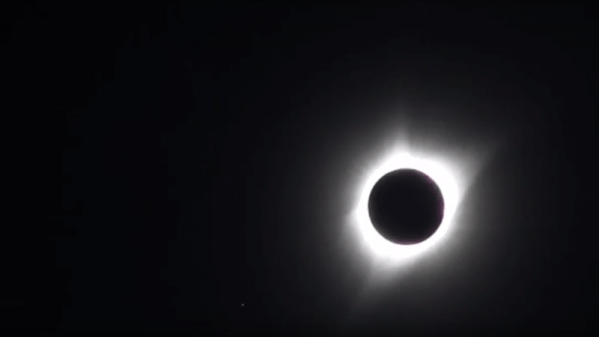
Location, location, location — what’s critical to real estate is also critical to eclipse watching, and without sounding too boastful, those of us atop South Menan Butte, an extinct volcano in southeast Idaho, absolutely nailed it. Not only did we have perfect weather, we had an excellent camping experience, great food, a magnificent natural setting, and a perch 800 feet above a vast plain stretching endlessly to the east and west. Everything was set up for a perfect eclipse experience, and we were not disappointed.

Continue reading “Eclipse 2017: Report From An Extinct Volcano”

Floating Ants And Drops Of Liquid With An Acoustic Levitator

Amuse your friends, amaze your enemies, and perplex ants and other insects, insofar as they are capable of perplexment. Accomplish all this and more with this handy dandy homebrew acoustic levitator.

Before anyone gets to thinking about using this technique to build a hoverboard that actually hovers, it’s best that you scale your expectations way, way down. Still, being able to float drops of liquid and small life forms is no mean feat, and looks like a ton of fun to boot. [Asier Marzo]’s Instructable’s post fulfills a promise he made when he first published results for what the popular press then breathlessly dubbed a “tractor beam,” which we covered back in January. This levitator clearly has roots in the earlier work, what with 3D-printed hemispherical sections bristling with ultrasonic transducers all wired in phase. A second section was added to create standing acoustic waves in the middle of the space, and as the video below shows, just about anything light enough and as least as cooperative as an ant can be manipulated in the Z-axis.

There’s plenty of room to expand on [Asier]’s design, and probably more practical applications than annoying bugs. Surface-mount devices are pretty tiny — perhaps an acoustic pick and place is possible?

Continue reading “Floating Ants And Drops Of Liquid With An Acoustic Levitator”

Credit Card Sized Spacecraft Poised To Sail To Alpha Centauri

As a space-faring species, we’ve done a fair job of exploring and exploiting our local neighborhood. We’re pretty good at putting people and machines into orbit, but our galactic-scale signature is pretty tiny. Our radio signals are no more than 100 light-years away, and our farthest physical artifact isn’t even a light-day away from us 40 years after it launched.

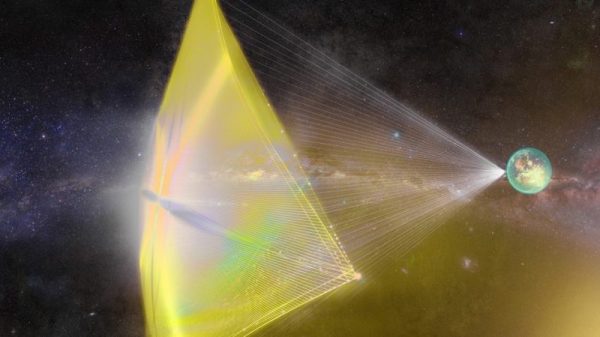
Clearly we need to do a better job of getting out there, and that’s the goal of Breakthrough Initiatives’ Starshot program, which aims to launch a nano-spacecraft to Alpha Centauri and get it there fast. The program aims to build solar-powered credit card-sized spacecraft with sensors, cameras, communications, and even MEMS thrusters for attitude control. Motive power will come from solar sails catching laser light shined onto it from Earth, eventually accelerating the craft to 20% of the speed of light and reaching its destination within a generation.

The thought that we could start spreading ourselves out into the galaxy within the lifespan of most of the people on Earth is intoxicating. Sure, a wafer of silicon is a far cry from a sleek starship with powerful warp engines and all the finest appointments, or a gritty star freighter that can make the Kessel Run in less than 12 parsecs. But the laws of physics and the limits of engineering conspire to keep us mostly stuck at the bottom of a deep gravity well, and if this means sending fleets of nanobots across the galaxy in our stead, so be it.

And no matter what form our first galactic spacecraft take, you can bet that the Deep Space Network will be supporting the mission. For now, you can listen in on the program’s test satellites currently in orbit if you tune to 437.240 MHz.

Continue reading “Credit Card Sized Spacecraft Poised To Sail To Alpha Centauri”

Embiggen Your Eclipse 2017 Experience With A Sun Funnel

As exciting as Eclipse 2017 is going to be this Monday, for some folks it might appear a bit — underwhelming. Our star only occupies about half a degree of the sky, and looking at the partial phase with eclipse glasses might leave you yearning for a bigger image. If that’s you, you’ll need to build a sun funnel for super-sized eclipse fun.

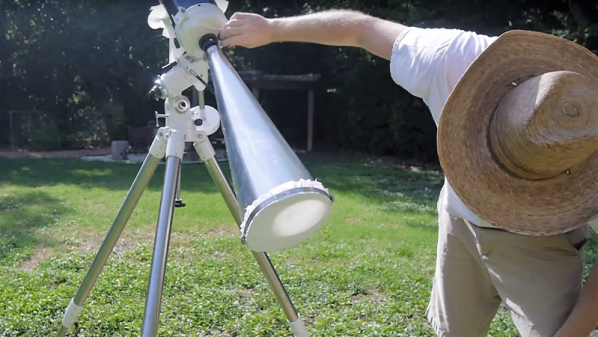
[Grady] at Practical Engineering is not going to be lucky enough to be within the path of totality, but he is going to be watching the eclipse with a bunch of school kids. Rather than just outfitting his telescope with a filter and having the kids queue up for a quick peek, he built what amounts to a projection screen for the telescope’s eyepiece. It’s just a long funnel, and while [Grady] chose aluminum and rivets, almost any light, stiff material will do. He provides a formula for figuring out how long the funnel needs to be for your scope, along with plans for laying out the funnel. We have to take exception with his choice of screen material — it seems like the texture of the translucent shower curtain might interfere with the image a bit. But still, the results look pretty good in the video below.

Eclipse 2017 is almost here! How are you planning to enjoy this celestial alignment? By proving Einstein right? By studying radio propagation changes? Or just by wearing a box on your head? Sound off in the comments.

Continue reading “Embiggen Your Eclipse 2017 Experience With A Sun Funnel”

It’s An Angle Grinder! No, It’s A Floor Sander!

Faced with the potentially arduous task of sanding a wood floor, what would you do? Hire a pro? Rent the proper tools and do it yourself? Perhaps even shell out big bucks to buy professional grade tools? Or would you root around in your junk pile and slap together a quick and dirty floor sander from an old angle grinder?

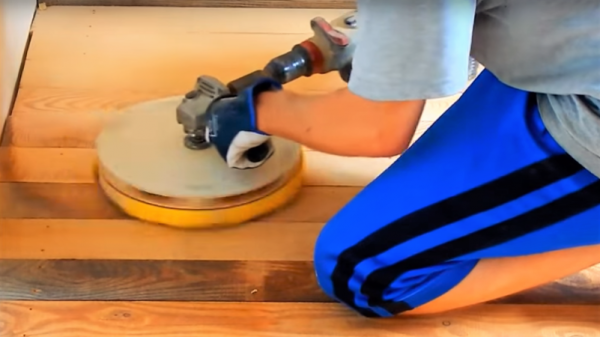
That’s what [Donn DIY] did when looking at the wide expanse of fresh floorboards in his new sauna. Never one to take the easy way out, and apparently with a thing for angled gear boxes, [Donn DIY] took the guts out of a burnt-out angle grinder for his impromptu floor sander. A drill attached to the old motor rotor provides the spin, and a couple of pieces of scrap wood make the platen. Sandpaper strips are clamped between the discs, and as seen in the video below, the whole contraption does an admirable job.

We’ve seen lots of angle grinder hacks before, some useful, some silly. This one gets the job done and is a nice quick hack that speaks to the value of a well-stocked junk pile.

Continue reading “It’s An Angle Grinder! No, It’s A Floor Sander!”

Catch The Eclipse With A Wearable Pinhole Camera

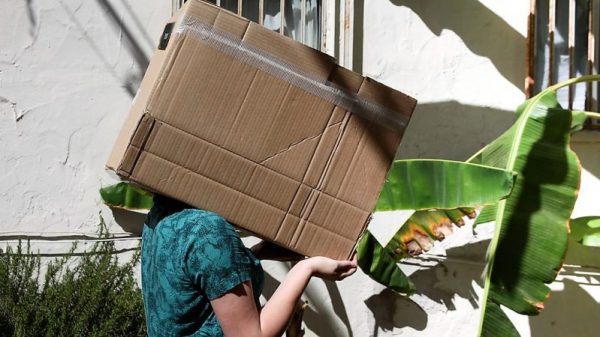
You say you didn’t have enough warning to order eclipse glasses, and now they’re too expensive to buy? Or maybe you did order some but they ended up being those retina-combusting knock-offs, and now you’ve got nothing to protect you during the partial phase of Monday’s eclipse? Don’t dump a ton of money on unobtainium glasses — just stick your head in a cardboard box.

You may end up looking like a Box Troll with the aptly named [audreyobscura]’s box on your head, but it really is a safe and effective way of watching the eclipse, or for gazing at our star anytime for that matter. It’s nothing more than a large pinhole camera, with a tiny hole in a scrap of aluminum soda can acting as an aperture. The pinhole in one end of a box casts a perfect image of the sun on a paper screen at the other end of the box. A hole for your head with a proper gasket around your neck — maybe the neck of an old T-shirt would be a bit more comfortable and light tight? — and you’re ready for the show. The bigger the box, the bigger (and dimmer) the image will be, so you’ll want to cruise the local home center for long boxes. Because walking around with a water heater box on your head is totally cool.

Really, though, Hackaday readers can’t say they didn’t know this was coming. We started covering this in January, we’ve got hundreds of eclipse meetups across the country, and we’ve even covered some citizen science opportunities you can partake in on Eclipse Day. If you don’t have your head in a box, that is.

Thanks to [Roger Guess] for the idea on this one.