Detecting Dire Diseases – With A Selfie?

They say the eyes are the windows to the soul. But with a new smartphone app, the eyes may be a diagnostic window into the body that might be used to prevent a horrible disease — pancreatic cancer. A research team at the University of Washington led by [Alex Mariakakis] recently described what they call “BiliScreen,” a smartphone app to detect pancreatic disease by imaging a patient’s eyes.

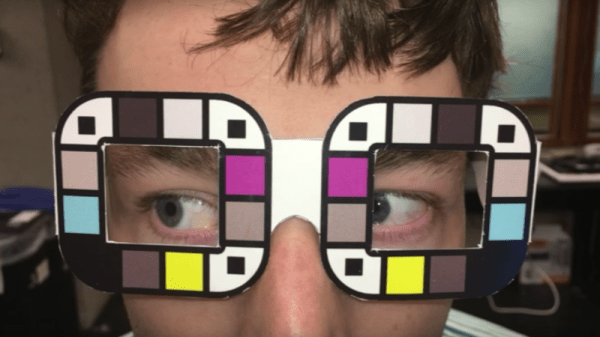
Pancreatic cancer is particularly deadly because it remains asymptomatic until it’s too late. One early symptom is jaundice, a yellow-green discoloration of the skin and the whites of the eyes as the blood pigment bilirubin accumulates in the body. By the time enough bilirubin accumulates to be visible to the naked eye, things have generally progressed to the inoperable stage. BiliScreen captures images of the eyes and uses image analysis techniques to detect jaundice long before anyone would notice. To control lighting conditions, a 3D-printed mask similar to Google’s Cardboard can be used; there’s also a pair of glasses that look like something from [Sir Elton John]’s collection that can be used to correct for ambient lighting. Results look promising so far, with BiliScreen correctly identifying elevated bilirubin levels 90% of the time, as compared to later blood tests. Their research paper has all the details (PDF link).

Tools like BiliScreen could really make a difference in the early diagnosis and prevention of diseases. For an even less intrusive way to intervene in disease processes early, we might also be able to use WiFi to passively detect Parkinson’s.
Continue reading “Detecting Dire Diseases – With A Selfie?”

Ultrasonic Array Gets Range Data Fast And Cheap

How’s your parallel parking? It’s a scenario that many drivers dread to the point of avoidance. But this 360° ultrasonic sensor will put even the most skilled driver to shame, at least those who pilot tiny remote-controlled cars.

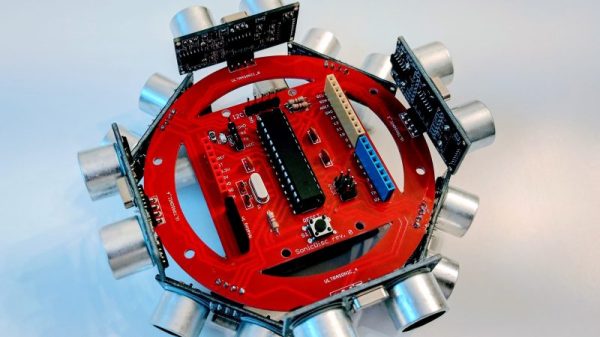
Watch the video below a few times and you’ll see that within the limits of the test system, [Dimitris Platis]’ “SonicDisc” sensor does a pretty good job of nailing the parallel parking problem, a driving skill so rare that car companies have spent millions developing vehicles that do it for you. The essential task is good spatial relations, and that’s where SonicDisc comes in. A circular array of eight HC-SR04 ultrasonic sensors hitched to an ATmega328P, the SonicDisc takes advantage of interrupts to make reading the eight sensors as fast as possible. The array can take a complete set of readings every 10 milliseconds, which is fast enough to allow for averaging successive readings to filter out some of the noise that gets returned. Talking to the car’s microcontroller over I2C, the sensor provides a wealth of ranging data that lets the car quickly complete a parallel parking maneuver. And as a bonus, SonicDisc is both open source and cheap to build — about $10 a copy.

Rather use light to get your range data? There are some pretty cheap LIDAR units on the market these days.

Continue reading “Ultrasonic Array Gets Range Data Fast And Cheap”

Spell Out The Time With Frickin’ Laser Beams

Clocks are a never-ending source of fascination to hackers. We get all kinds around here, from Steampunk Nixie clocks to retro cool flip clocks to clocks that don’t even look like clocks. But this is something new — a glow-in-the-dark laser tracing clock.

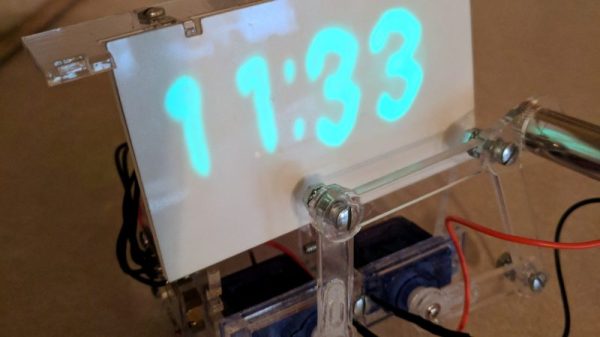
What [tuckershannon]’s clock lacks in practicality it makes up for in the gee-whiz department. The idea is simple: trace the characters out on a phosphorescent screen using a laser. To accomplish this, [tuckershannon] adapted the design of this whiteboard marker robot clock, replacing the drawing surface with glow-in-the-dark stickers. A 405 nm laser diode module is traced over the surface by the two-servo pantograph plotter, charging up the phosphors. He offers no clue as to how long the ghostly image lingers, but from the look of it, we’d bet that it lasts for a good fraction of a minute, especially in a dark room. Then again, you’d want the image totally faded before the next write cycle comes up, to prevent overwriting the previous time.

All in all, it’s a nice design and a clever new clock display modality. And who knows — maybe this whole glowing phosphor display thing could really catch on.

Continue reading “Spell Out The Time With Frickin’ Laser Beams”

Save Your Thumbs With This Netflix Password Sender

Chances are anyone who has an entry-level to mid-range smart TV knows that setting them up with your streaming account credentials is a royal pain. Akin to the days of texting on a flip phone, using the number pad or arrow keys to compose your user name and password seems to take forever.  So why not avoid the issue with this automated Netflix logger-inner?

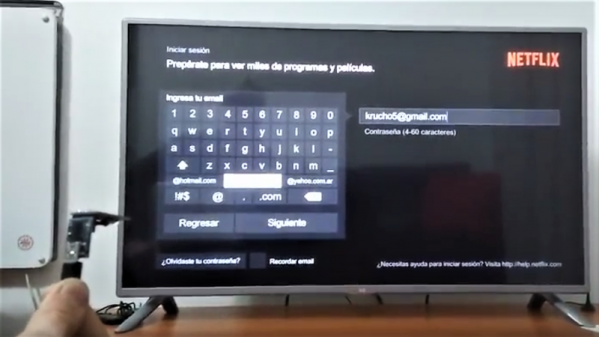
As if the initial setup wasn’t bad enough, when [krucho5]’s LG smart TV started asking for his Netflix credentials every few days, he knew something needed to be done. An Arduino to send “keystrokes” was the obvious solution, but when initial attempts to spoof the HID on the set proved fruitless, [krucho5] turned to the IR remote interface. He used an IR receiver module to capture the codes sent while entering user name and password, and an IR LED plays it back anytime the TV ask for it. The video below shows how much easier it is now, and the method should work just fine for any other online service accounts.

We like [krucho5]’s build, but the fit and finish are a little rough. Perhaps slipping them into a pair of Netflix-enabled socks would be a nice touch?

Continue reading “Save Your Thumbs With This Netflix Password Sender”

Color Sensor From An RGB LED And A Photocell

When you need to quantify the color of an object, you’ve got quite a few options. You can throw a Raspberry Pi camera and OpenCV at the problem and approach it through software, or you can buy an off-the-shelf RGB sensor and wire it up to an Arduino. Or you can go back to basics and build this reflective RGB sensor from an LED and a photocell.

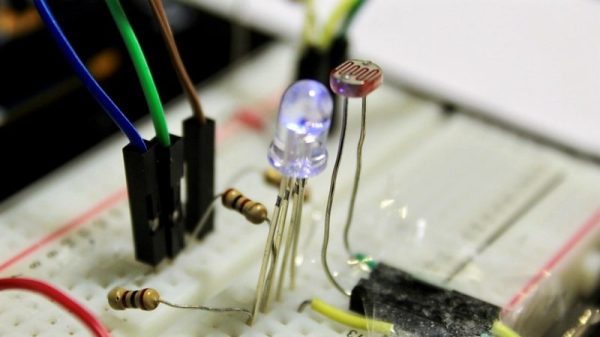
The principle behind [TechMartian]’s approach is simplicity itself: shine different colored lights on an object and measure how much light it reflects. If you know the red, green, and blue components of the light that correspond to maximum reflectance, then you know the color of the object. Their sensor uses a four-lead RGB LED, but we suppose a Neopixel could be used as well. The photosensor is a simple cadmium sulfide cell, which measures the intensity of light bouncing back from an object as an Arduino drives the LED through all possible colors with PWM signals. The sensor needs to be white balanced before use but seems to give sensible results in the video below. One imagines that a microcontroller-free design would be possible too, with 555s sweeping the PWN signals and op-amps taking care of detection.

And what’s the natural endpoint for a good RGB sensor? A candy sorter, or course, of which we have many examples, from the sleek and polished to the slightly more hackish.

Continue reading “Color Sensor From An RGB LED And A Photocell”

Cheap And Easy Magnetic DNA Separation Method Needs Your Help

When you consider that almost every single cell in your body has more than a meter of DNA coiled up inside its nucleus, it seems like it should be pretty easy to get some to study. But with all the other cellular gunk in a crude preparation, DNA can be quite hard to isolate. That’s where this cheap and easy magnetic DNA separation method comes in. If it can be optimized and tested with some help from the citizen science community.

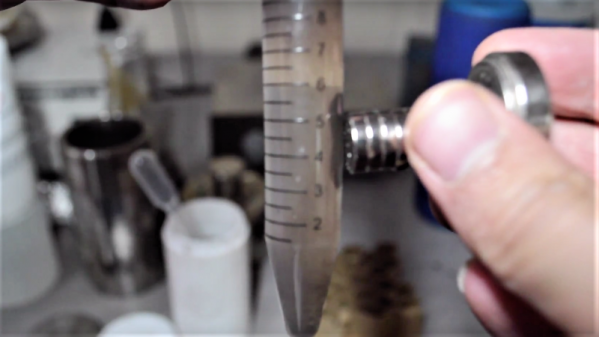
Commercial DNA separation methods generally involve mixing silica beads into crude cell fractions; the DNA preferentially binds to the silica, making it possible to mechanically separate it from the rest of the cellular junk. But rather than using a centrifuge to isolate the DNA, [Justin] from The Thought Emporium figured that magnets might do a better job. It’s not a new idea — biotech companies offer magnetic separation beads commercially, but at too steep a price for [Justin]’s budget. His hack comes from making magnetite particles from common iron compounds like PCB etchant and moss killer, and household ammonia cleaner. The magnetite particles are then coated with sodium silicate solution, also known as waterglass. The silica coating should allow the beads to bind to DNA, with the magnetic core taking care of separation.

[Justin] was in the process of testing his method when he lost access to the needed instruments, so he’s appealing to the larger science community for help optimizing his technique. Based on his track record of success in fields ranging from satellite tracking to graphene production, we’ll bet he’ll nail this one too.

Continue reading “Cheap And Easy Magnetic DNA Separation Method Needs Your Help”

Harvesting Copper From Microwave Ovens

Obsolete appliances were once a gold mine of parts, free for the taking with a few snips of your diagonal cutters. Times have changed, though, and most devices yield only a paltry supply of parts, so much so that only by harvesting raw materials can you get much value out of them. And so we have this example of reclaiming copper from used microwave ovens.

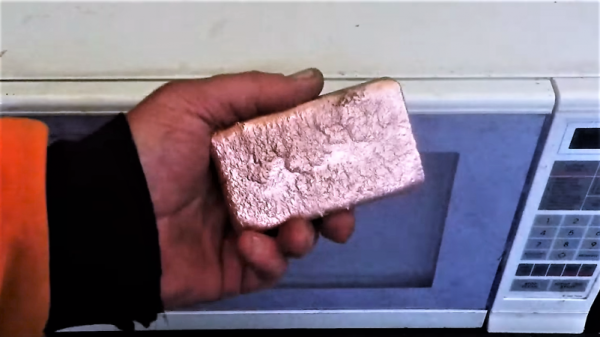
The primary source of copper in most microwaves is the transformer, which we usually see re-tasked for everything from spot welders to material handling electromagnets. But the transformer is not the only source of the red metal; [eWaste Ben] also harvests it from relay coils and the main coil and shading coils of the fan motor.  The bounty is melted down in an electric foundry and cast in a graphite mold into a lovely ingot.

Unless you’re into repeatedly casting copper trinkets, a large bar of reclaimed copper might not be something you have a burning need to possess. But bearing in mind that copper can go for about $2.50 a pound at the scrap yard, there’s some money to be made, especially with dead microwaves essentially free for the taking. As [Ben] points out, taking the extra step to melt and cast the copper harvested from microwaves makes no sense if all you’re going to do is sell the scrap, but it’s nice to know how to do it just the same.

Continue reading “Harvesting Copper From Microwave Ovens”