A Poor-Man’s Laser CNC Engraver

What do you get when you mix the disappointment that sometimes accompanies cheap Chinese electronics with the childhood fascination of torturing insects with a magnifying glass on a sunny day? You get a solar-powered CNC etcher, that’s what.

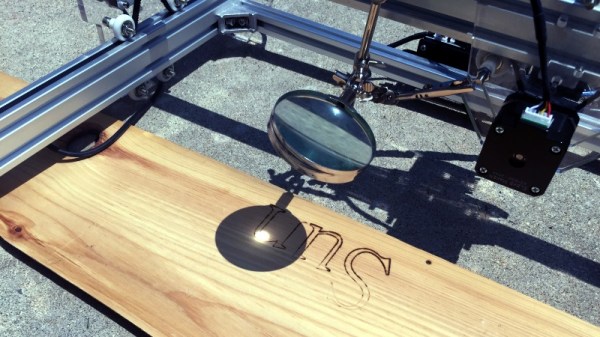
We all remember the days of focussing the sun on a hapless insect, or perhaps less sadistically on a green plastic army man or just a hunk of dry wood. The wonder that accompanied that intense white spot instantly charring the wood and releasing wisps of smoke stayed with you forever, as seemingly did the green spots in your vision. [drum303] remembered those days and used them to assuage his buyer’s remorse when the laser module on his brand new CNC engraver crapped out after the first 10 minutes. A cheap magnifying glass mounted to the laser holder and a sunny day, and he don’t need no stinkin’ lasers! The speed needs to be set to a super slow — 100mm per minute — and there’s the problem of tracking the sun, but the results are far finer than any of our childhood solar-artistic attempts ever were.

Do we have the makings of a possible performance art piece here? A large outdoor gantry with a big Fresnel lens that could etch a design onto a large piece of plywood would be a pretty boss beachside attraction. Of course, you’d need a simple solar tracker to keep things in focus.
Continue reading “A Poor-Man’s Laser CNC Engraver”

Old Chart Recorder Becomes Single-Pixel Scanner

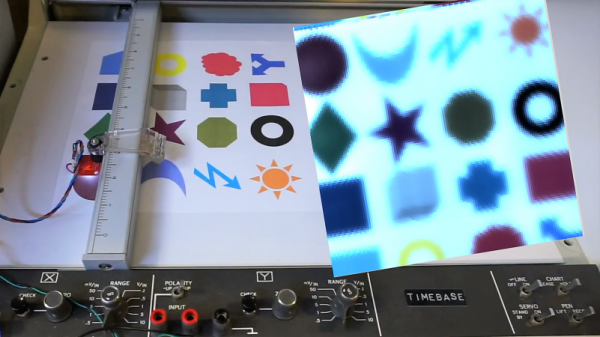
With so many ways to capture images from paper, do we really need another one? Especially one that takes 15 minutes to capture a 128×128 pixel image? Probably not, but building a single-pixel RGB scanner is pretty instructive, and good clean fun to boot.

We have to admit that when [Kerry Wong] scored an ancient Hewlett-Packard X-Y chart recorder a while back, we wondered if it would lead to anything useful. One may quibble with the claim that the Lorenz attractor plotter he built with it is useful, and this single pixel scanner is equally suspect, but we like the idea. Using an Arduino to drive the X- and X-axis of the recorder through a raster pattern over the bed and replacing the pen with an RGB sensor board, [Kerry] was able to collect the color data for each pixel and reconstruct the image. It wouldn’t be too hard to replicate this if you don’t have an analog X-Y recorder, which just goes to show that not everything needs to be steppers and digital to get something useful done. Or at least semi-useful.

As for the RGB sensor used, they’ve made appearances here many times before, mostly in M&M sorters but with the occasional synesthesia simulator.

Continue reading “Old Chart Recorder Becomes Single-Pixel Scanner”

Overhead Trolley Helps Clear The Air Over CNC Router

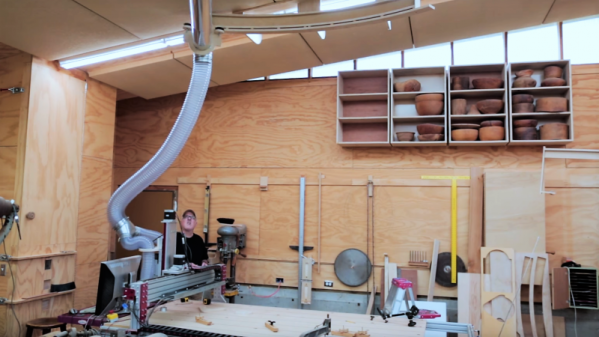
[Frank Howarth] has a shop most woodworkers would kill for, stuffed with enough tools to equip multiple hackspaces — four radial-arm saws alone! But while the CNC router in the middle of the shop, large enough to work on an entire sheet of plywood, is a gem of a machine, it was proving to be a dusty nightmare. [Frank]’s solution was as unique as his workspace — this swiveling overhead dust extraction system.

The two-part video below shows how he dealt with the dual problems of collection and removal. The former was a fairly simple brush-bristle shroud of the type we’ve featured before. The latter was a challenge in that the size of the router’s bed — currently 8′ but soon to be extended to 12′ — and the diameter of the hoses needed to move enough air made a fixed overhead feed impractical. [Frank]’s solution is an overhead trolley to support the hoses more or less vertically over the router while letting the duct swivel as the gantry moves around the work surface. There were a few pitfalls along the way, like hoses that shorten and stiffen when air flows through them, but in the end the system works great.

Chances are your shop is smaller than [Frank]’s, but you still need to control the dust. This dust collector for a more modest CNC router might help, as would this DIY cyclonic chip separator.

Continue reading “Overhead Trolley Helps Clear The Air Over CNC Router”

Anyone Need A Little Fuming Nitric Acid?

If there’s a chemical with a cooler name than “fuming nitric acid,” we can’t think of it. Nearly pure nitric acid is useful stuff, especially if you’re in the business of making rocket fuels and explosives. But the low-end nitric acid commonly available tops out at about 68% pure, so if you want the good stuff, you’ll have to synthesize fuming nitric acid yourself. (And by “good stuff”, we mean be very careful with the resulting product.)

Fuming nitric acid comes in two colors – red fuming nitric acid (RFNA), which is about 90% pure and has some dissolved nitrogen oxides, giving it its reddish-brown color. White fuming nitric acid (WFNA) is the good stuff — more than 99% pure. Either one is rough stuff to work with — you don’t want to wear latex or nitrile gloves while using it. It’s not clear what [BarsMonster] needs the WFNA for, although he does mention etching some ICs. The synthesis is pretty straightforward, if a bit dangerous. An excess of sulfuric acid is added to potassium nitrate, and more or less pure nitric acid is distilled away from the resulting potassium sulfate. Careful temperature control is important, and [BarsMonster] seems to have gotten a good yield despite running out of ice.

We don’t feature too many straight chemistry hacks around here, but this one seemed gnarly enough to be interesting. We did have a Hackaday Prize entry a while back on improvements to the Haber process for producing ammonia, which curiously is the feedstock for commercial nitric acid production processes.

Continue reading “Anyone Need A Little Fuming Nitric Acid?”

Hackaday Prize Entry: Wireless Weather Station Protects Crops From Frost

It seems like you hear it every year — a late or early frost threatens some crop or another, forcing farmers to take drastic action to avoid financial ruin. But even when the weather cooperates on a large scale, microclimates can still cause big problems in small enough areas to go unnoticed until after the damage is done.

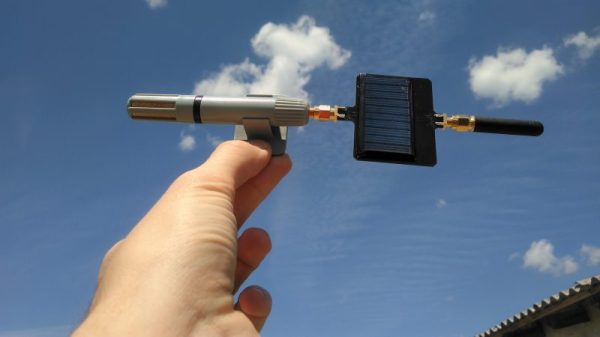
As always, better data can lead to better decisions, and increased granularity of environmental data could do wonders for certain kinds of agriculture. Enter SLoRa, a wireless weather station for agriculture. Aimed at providing a network of cheap, low-power temperature sensors, [Dorijan]’s proposed system would allow farmers to take active measures to protect their trees from frosts — smudge pots to heat the nascent fruit, sprinklers to apply a protective layer of ice, or even hovering helicopters to move massive amounts of warmer air into cold spots. With a solar powered sensor array and a LoRa link to a hilltop gateway, each SLoRa sensor deployed will be one more data point a farmer can use to determine where to deploy his or her limited resources.

Need to get up to speed on LoRa? You could do worse than learning how to listen in on LoRa signals with an SDR dongle.

LCaaS – Lawn Care As A Service?

As often happens while engaged in a mundane task, my mind wandered while I was mowing my small suburban plot of green this weekend. “Why, in 2017, am I still mowing the lawn?” In a lot of ways we’re living in the future  — we walk around with fantastically powerful computers in our pockets, some of us have semi-autonomous cars, and almost anything can be purchased at the touch of a finger and delivered the next day or sooner. We even have robots that can vacuum the floor, so why not a robot lawnmower?

It turns out we do have robotic lawnmowers, but unfortunately, they kind of suck: Continue reading “LCaaS – Lawn Care As A Service?”

Camera Slide Pans And Tilts Camera Mechanically

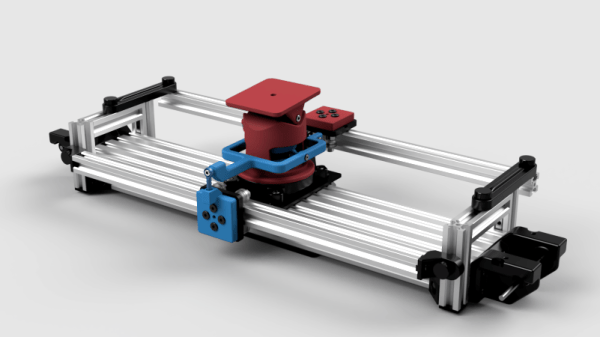
A camera slider is a popular and simple project — just a linear slide, a stepper, and some sort of controller. Adding tilt and pan axes ups the complexity until you’ve got three motors, a controller, and probably a pretty beefy battery pack to run everything. Why not simplify with an entirely mechanical pan-tilt camera slider and leave all that heavy stuff at home?

There’s more than one way to program motion control, and [Enza3D]’s design uses adjustable rails to move the gimballed pan-tilt head through two axes of motion. One rail adjusts vertically to control tilt, while the other adjusts in and out relative to the slider to control pan. Arms ride on each rail and connect to the gimbals to swivel the camera in both dimensions while it travels down the manually cranked slide. It’s pretty clever and results in some clean, dynamic shots as in the video below.

Our quibble is that the “program” is only linear since the control rails are straight lengths of aluminum extrusion; seems to us that some sort of flexible control rails might make for more interesting shots. [Enza3D] has amply documented the build and is looking for feedback, so comment away. And if you don’t have a 3D printer to make the parts, wood works for a slider too.

Continue reading “Camera Slide Pans And Tilts Camera Mechanically”