Classic IBM TR-2 Flip-Flop Reproduction

As useful as computers are, most of them have all the design charm of a rubber doorstop. Oh, for the heady early days of computing, when vacuum tubes ruled, hardware was assembled by hand, and engineers always wore a tie.

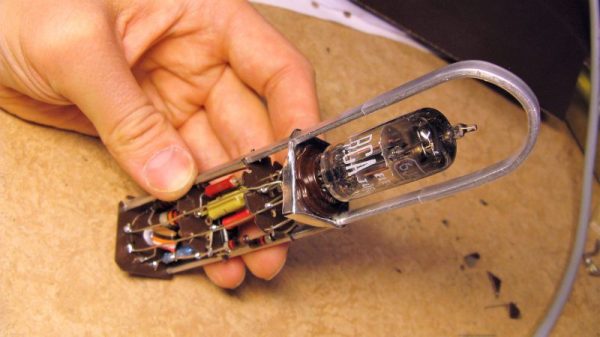
Looking to recreate an elegant bit of computing hardware from that more civilized age, [updatebjarni] built a reproduction of a 1948 IBM TR-2 flip-flop module — 1,250 of which once formed the memory of the IBM Model 604 Calculating Punch. Admittedly more of a high-speed adding machine than a computer, the 604 is still an important piece of computing history, and [updatebjarni]’s scrap-bin reproduction of the field-replaceable module served as part of a computer history exhibit.

With a single 6J6 double triode tube nestled inside a bent aluminum frame, the goal was to reproduce the appearance of the original TR-2 module, and so the passive components wired up point-to-point style below the tube socket were chosen for their vintage look. That’s not to say the flip-flop won’t function. Although [updatebjarni] hasn’t tested it, he’s built other functional flip-flops from vintage components before, so this one should work too. Only 1,249 left to build and he’ll have enough for a working 604.

If you like this kind of build, you should probably check out some of our Vintage Computer Festival coverage. VCF East in April was a huge success, and VCF West is coming up in August in Mountain View. Hackaday will be well represented there, so stop by.

[via r/geekporn]
Gecko Feet In Space

Space is a mess, and the sad truth is, we made it that way. Most satellites that have been lofted into Earth orbit didn’t have a plan for retiring them, and those dead hulks, along with the various bits of jetsam in the form of shrouds, fairings, and at least one astronaut’s glove, are becoming a problem.

A mission intended to clean up space junk would be fantastically expensive, but money isn’t the only problem. It turns out that it’s really hard to grab objects in space unless they were specifically designed to be grabbed. Suction cups won’t work in the vacuum of space, not everything up there is ferromagnetic, and mechanical grippers would have to deal with a huge variety of shapes, sizes, and textures.

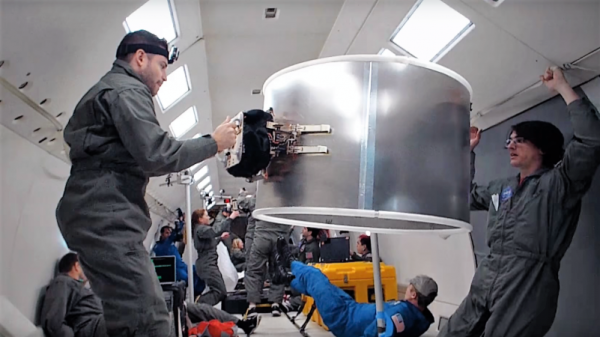
But now news comes from Stanford University of a dry adhesive based on the same principle a gecko uses to walk up a wall. Gecko feet have microscopic flaps that stick to surfaces because of Van der Waals forces. [Mark Cutkosky] and his team’s adhesive works similarly, adhering to surfaces only when applied in a certain direction. This is an advantage over traditional pressure-sensitive adhesives; the force needed to apply them would cause the object to float away in space. The Stanford grippers have been tested on the “vomit comet” and aboard the ISS.

We can think of tons of terrestrial applications for this adhesive, including the obvious wall-walking robots. The Stanford team also lists landing pads for drones that would let then perch in odd locations, which we find intriguing.

Need to get up to speed on more mundane adhesive? Check out our guide to sticky stuff for the shop.

Continue reading “Gecko Feet In Space”

Tiny Light Bulb Flasher Vies For World’s Record

We’re going to go out on a limb here and declare this minuscule incandescent light flasher the smallest such circuit in the world. After all, when you need a microscope to see it work, you’ve probably succeeded in making the world’s smallest something.

Even if it’s not record breaking, [Ben Krasnow]’s diminutive entry in the 2017 Flashing Light Contest, which we recently covered, is still pretty keen. For those not familiar with the contest, it’s an informal challenge to build something that electrically switches an incandescent light on and off in the most interesting way possible for the chance to win £200. [Ben] says he’ll donate the prize money to a STEM charity if he wins, and we’d say he has a good chance with this flea-sized entry.

The incandescent lamp he chose is a specialty item for model makers and scale railroad enthusiasts; we’d heard of “grain of wheat” bulbs before, but this thing is ridiculous. The bulb makes the 4.6 mm diameter SR416 hearing aid battery that powers the flasher look enormous. The driver is a clever Schmitt trigger inverter with a tiny RC network to flash the bulb at about 1 Hz. The video below shows the flasher working and details the development and the build, which featured spot welding to the battery. [Ben] has even spec’d precisely how many Joules of energy will rupture the thing steel cases on these cells — we suspect involuntarily through trial and error.

[Ben]’s entry in the contest is now our favorite, and not just because he’s been a great friend to Hackaday with such classic hacks as watching a phonograph needle with an electron microscope and a homebrew CT scanner. This circuit is genuinely fascinating, and we hope it inspires you to try to top it. There’s a little less than a month left in the contest, so get to it.

Continue reading “Tiny Light Bulb Flasher Vies For World’s Record”

Automate The Freight: Front Line Deliveries By Drone

Gen. Robert H. Barrow, USMC, once said that “Amateurs talk about tactics, but professionals study logistics.” That’s true in many enterprises, but in warfare, the side that neglects logistics is likely to be the loser. Keeping soldiers fed, clothed, and armed is the very essence of effectively prosecuting a war, and the long logistical chain from rear supply depots to forward action is what makes that possible.

Armies have had millennia to optimize logistics, and they have always maximized use of new technologies to position supplies where they’re needed. Strong backs of men and beasts sufficed for centuries, supplemented by trains in the 19th century and supplanted by motor vehicles in the 20th. Later, aircraft made an incalculable impact on supply chains, allowing rapid mobilization of supplies and supporting the industrial scale death and destruction of the 20th-century’s wars.

Continue reading “Automate The Freight: Front Line Deliveries By Drone”

3D-Printed Turbine Rotary Tool Tops 40,000 RPM

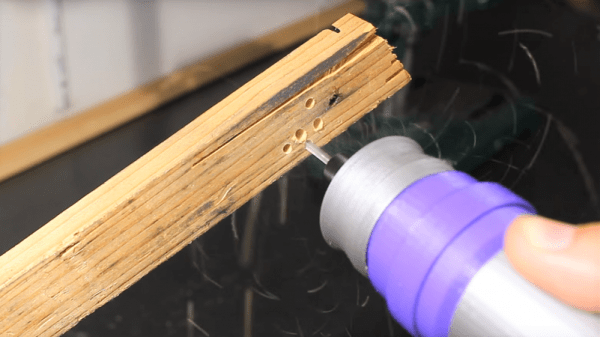
For your high speed, low torque needs, few things beat a rotary tool like a Dremel. The electric motor has its limits, though, they generally peak out at 35,000 rpm or so. Plus there’s the dust and the chips to deal with from whatever you’re Dremeling, so why not kill two birds with one stone and build a turbine-driven rotary tool attachment for your shop vac?

Another serious shortcoming of the electric Dremels that is addressed by [johnnyq90]’s 3D-printed turbine is the lack of that dentist’s office whine. His tool provides enough of that sound to trigger an attack of odontophobia as it tops out at 43,000 rpm. The turbine’s stator and rotors are 3D-printed, as is the body, inlet scoop, and adapter for the vacuum line. A shaft from an old rotary tool is reused, but a new one could be turned pretty easily. The video below shows the finished tool in action; there’ll no doubt be objections in the comments to ingesting dust, chips, and incandescent bits of metal, but our feeling is that the turbine will hold up to these challenges pretty well. Until it doesn’t, that is.

We like [johnnyq90]’s design style, which you may recall from his micro Tesla turbine or nitro-powered rotary tool. He sure likes things that spin fast.

Continue reading “3D-Printed Turbine Rotary Tool Tops 40,000 RPM”

“Alexa, What Plane Is That?”

We’ve all probably done it — gazed up at a passing jetliner and wondered where it was going and what adventures its passengers were embarked upon. While the latter is hard to answer, the former just got a bit easier: just ask Alexa what the plane is.

Granted, [Nick Sypteras]’s Echo Dot isn’t quite omniscient enough to know exactly what plane you’re looking at. His system benefits from the constraints offered by the window of his Boston apartment — from the video below, we’d guess somewhere in Beacon Hill or the West End — that offers a view of the approach to Logan Airport. An RTL-SDR dongle receives the ADS-B transmissions from all aircraft in the vicinity, and a Raspberry Pi does a lookup, picks the closest plane, and scrapes the departure and arrival airports from FlightRadar24. Alexa does the rest, but we have to confess that hearing “Boeing seven hundred eighty-seven” rather than “seven eighty-seven” would drive us nuts.

If you don’t have the limited view of an airport approach that makes [Nick]’s hack workable, maybe a plane-spotting robot camera would work better for you.

Continue reading ““Alexa, What Plane Is That?””

Custom Aluminum Wheels Teach A Thing Or Two About Casting

For some mobile projects like small carts or rolling cabinets, your standard casters from Harbor Freight will do just fine. But some projects need big, beefy wheels, and these custom cast aluminum wheels certainly make a statement. Mostly, “Watch your toes!”

To be honest, [Brian Oltrogge]’s wheels are an accessory in search of a project, and won’t be crushing feet anytime soon. He made them just to make them, but we have no beef with that. They’ve got a great look that hearkens back to a time when heavy metal meant something else entirely, and things were made to last. Of course, being cast from aluminum sort of works against that, but there are practical limits to what can be done in the home foundry. [Brian] started with a session of CAD witchcraft followed by machining the cores for his molds. Rather than doing this as lost foam or PLA, he milled the cores from poplar wood. His sand mix is a cut above what we usually see in home-brew sand casting — sodium silicate sand that can be cured with carbon dioxide. All his careful preparation meant the pour went off without a hitch, and the wheels look great.

We’ve featured quite a few metal casting projects recently, some that went well and some that didn’t. [Brian] looks like he knows what he’s doing, and we appreciate the workmanship that he puts on display here.

Continue reading “Custom Aluminum Wheels Teach A Thing Or Two About Casting”