A 3D Scanner That Archimedes Could Get Behind

3D-scanning seems like a straightforward process — put the subject inside a motion control gantry, bounce light off the surface, measure the reflections, and do some math to reconstruct the shape in three dimensions. But traditional 3D-scanning isn’t good for subjects with complex topologies and lots of nooks and crannies that light can’t get to. Which is why volumetric 3D-scanning could become an important tool someday.

As the name implies, volumetric scanning relies on measuring the change in volume of a medium as an object is moved through it. In the case of [Kfir Aberman] and [Oren Katzir]’s “dip scanning” method, the medium is a tank of water whose level is measured to a high precision with a float sensor. The object to be scanned is dipped slowly into the water by a robot as data is gathered. The robot removes the object, changes the orientation, and dips again. Dipping is repeated until enough data has been collected to run through a transformation algorithm that can reconstruct the shape of the object. Anywhere the water can reach can be scanned, and the video below shows how good the results can be with enough data. Full details are available in the PDF of their paper.

While optical 3D-scanning with the standard turntable and laser configuration will probably be around for a while, dip scanning seems like a powerful method for getting topological data using really simple equipment.

[wpvideo xx88I1SN]

Thanks to [bmsleight] for the tip.

World’s Worst Bitcoin Mining Rig

Even if we don’t quite understand what’s happening in a Bitcoin mine, we all pretty much know what’s needed to set one up. Racks of GPUs and specialized software will eventually find a few of these vanishingly rare virtual treasures, but if you have enough time, even a Xerox Alto from 1973 can be turned into a Bitcoin mine. As for how much time it’ll take [Ken Shirriff]’s rig to find a Bitcoin, let’s just say that his Alto would need to survive the heat death of the universe. About 5000 times. And it would take the electricity generated by a small country to do it.

Even though it’s not exactly a profit center, it gives [Ken] a chance to show off his lovingly restored Alto. The Xerox machine is the granddaddy of all modern PCs, having introduced almost every aspect of the GUI world we live in. But with a processor built from discrete TTL chips and an instruction set that doesn’t even have logical OR or XOR functions, the machine isn’t exactly optimized for SHA-256 hashing. The fact that [Ken] was able to implement a mining algorithm at all is impressive, and his explanation of how Bitcoin mining is done is quite clear and a great primer for cryptocurrency newbies.

[Ken] seems to enjoy sending old computer hardware to the Bitcoin mines — he made an old IBM mainframe perform the trick a while back. But if you don’t have a room-size computer around, perhaps reading up on alternate uses for the block chain would be a good idea.

[via Dangerous Prototypes]

Shed Pounds And Inches While Binge Watching Netflix

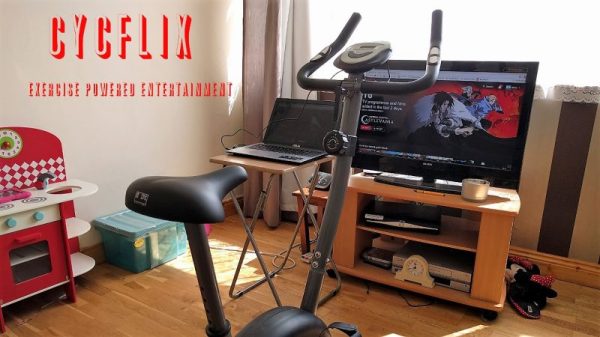
Feel like breaking out of your streaming-induced vegetative state but can’t seem to break the binge-watching cycle? Maybe you’re a candidate for this exercise bike that controls how much Netflix you watch.

The concept behind [Roboro]’s anti-couch potato build is simple — just keep pedaling and you get to keep watching. The details are pretty simple too and start with an Arduino monitoring the signal coming from a jack thoughtfully provided by the manufacturer of his exercise bike. The frequency of the square wave is translated into a speed which a Python script on a PC reads over USB. Once a Netflix stream is started, dropping below the user-defined speed pauses the movie. The video below shows it doing its thing.

Improvements readily spring to mind, like adding a speed buffer so that pedaling faster lets you bank some streaming time and earn a rest. Maybe it could somehow integrate with these Netflix-enabled socks, or even with the Netflix and Chill button. But those sort of defeat the purpose a bit.

Continue reading “Shed Pounds And Inches While Binge Watching Netflix”

Automate The Freight: The Robotic Garbage Man

When I started the Automate the Freight series, my argument was that long before the vaunted day when we’ll be able to kick back and read the news or play a video game while our fully autonomous car whisks us to work, economic forces will dictate that automation will have already penetrated the supply chain. There’s much more money to be saved by carriers like FedEx and UPS cutting humans out of the loop while delivering parcels to homes and businesses than there is for car companies to make by peddling the comfort and convenience of driverless commuting.

But the other end of the supply chain is ripe for automation, too. For every smile-adorned Amazon package delivered, a whole bunch of waste needs to be toted away. Bag after bag of garbage needs to go somewhere else, and at least in the USA, municipalities are usually on the hook for the often nasty job, sometimes maintaining fleets of purpose-built trucks and employing squads of workers to make weekly pickups, or perhaps farming the work out to local contractors.

Either way you slice it, the costs for trash removal fall on the taxpayers, and as cities and towns look for ways to stretch those levies even further, there’s little doubt that automation of the waste stream will start to become more and more attractive. But what will it take to fully automate the waste removal process? And how long before the “garbage man” becomes the “garbage ‘bot”?

Continue reading “Automate The Freight: The Robotic Garbage Man”

Flying Defibrillators

It’s a sad reality that, by and large, cardiopulmonary resuscitation (CPR) doesn’t save lives. Despite all the “you could save a life” marketing aimed at getting people certified in CPR, the instances where even the prompt application of the correct technique results in a save are vanishingly rare, and limited mostly to witnessed arrests in a hospital. Speaking from personal experience, few things are sadder than arriving on-scene as a first responder to see CPR being performed by a husband on his wife and knowing that no matter what we do, it’s not going to end well.

The problem is one of time. Hearts only rarely just stop beating outright; usually some kind of arrhythmia first causes the heart to beat ineffectively, leading to hypoxia and loss of consciousness. From there it’s about a four-minute trip to brain death, but in that brief window chances are pretty good that the heart can be restarted. That’s why witnessed cardiac arrests in a hospital have better survival rates — the needed electric reboot of the heart with a defibrillator is only as far away as the nearest crash cart.

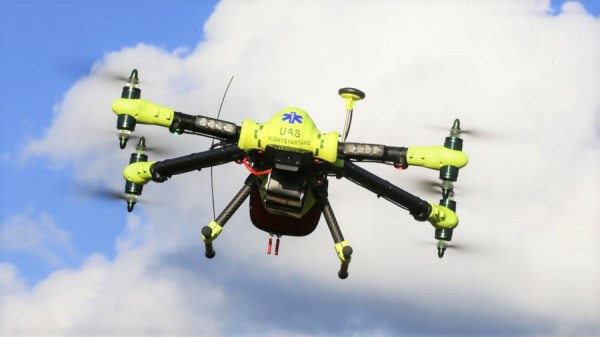
The advent of the automatic external defibrillator (AED) has increased the odds for survival of out-of-hospital cardiac arrest (OHCA), but the penetration of AEDs into public settings is far from complete enough to put one within a few minutes reach of everyone who might need one. So it’s only natural that thoughts would turn to delivering AEDs to cardiac incidents by drones. It seems like a great idea, but will it work? Continue reading “Flying Defibrillators”

Old Rabbit Ears Optimized For Weather Satellite Downlink

Communicating with a satellite seems like something that should take a lot of equipment. A fancy antenna and racks full of receivers, filters, and amplifiers would seem to be the entry-level suite of gear. But listening to a weather satellite with an old pair of rabbit ears and an SDR dongle? That’s a thing too.

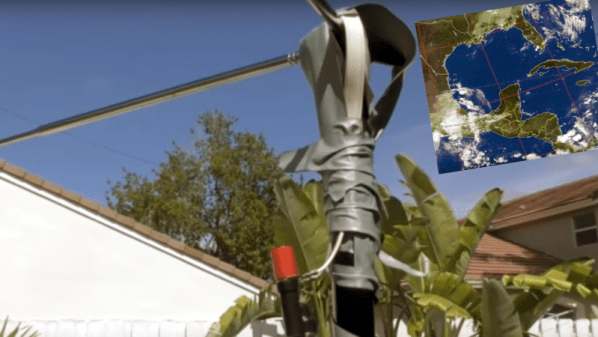
There was a time when a pair of rabbit ears accompanied every new TV. Those days are gone, but [Thomas Cholakov (N1SPY)] managed to find one of the old TV dipoles in his garage, complete with 300-ohm twinlead and spade connectors. He put it to work listening to a NOAA weather satellite on 137 MHz by configuring it in a horizontal V-dipole arrangement. The antenna legs are spread about 120° apart and adjusted to about 20.5 inches (52 cm) length each. The length makes the antenna resonant at the right frequency, the vee shape makes the radiation pattern nearly circular, and the horizontal polarization excludes signals from the nearby FM broadcast band and directs the pattern skyward. [Thomas] doesn’t mention how he matched the antenna’s impedance to the SDR, but there appears to be some sort of balun in the video below. The satellite signal is decoded and displayed in real time with surprisingly good results.

Itching to listen to satellites but don’t have any rabbit ears? No problem — just go find a cooking pot and get to it.

Continue reading “Old Rabbit Ears Optimized For Weather Satellite Downlink”

Horns Across America: The AT&T Long Lines Network

A bewildering amount of engineering was thrown at the various challenges presented to the United States by the end of World War II and the beginning of the Cold War. From the Interstate Highway System to the population shift from cities to suburbs, infrastructure of all types was being constructed at a rapid pace, fueled by reasonable assessments of extant and future threats seasoned with a dash of paranoia, and funded by bulging federal coffers due to post-war prosperity and booming populations. No project seemed too big, and each pushed the bleeding edge of technology at the time.

Some of these critical infrastructure projects have gone the way of the dodo, supplanted by newer technologies that rendered them obsolete. Relics of these projects still dot the American landscape today, and are easy to find if you know where to look. One that always fascinated me was the network of microwave radio relay stations that once stitched the country together. From mountaintop to mountaintop, they stand silent and largely unattended, but they once buzzed with the business of a nation. Here’s how they came to be, and how they eventually made themselves relics.

Continue reading “Horns Across America: The AT&T Long Lines Network”