
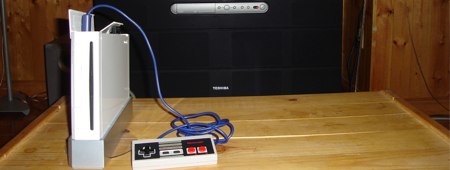
If you poke around [Raphaël]’s site, the creator of today’s featured hack, you’ll find a lot of interesting projects. X2Wii is an ongoing project to adapt controllers from earlier console generations so they work with the Wii’s GameCube ports. He adapted his Multiuse tiny1 which uses an ATmega8. The code is all assembly so the microcontroller can keep up with the protocol. Definitely check out [Raphaël]’s other project pages.
Author: Eliot1332 Articles
Exploit-Me Firefox XSS And SQL Scanning Addon
[youtube=http://www.youtube.com/watch?v=RbL2ptbjoSA&hl=en&rel=0&color1=0x3a3a3a&color2=0x999999]
One of the best tools we saw at LayerOne was the Exploit-Me series presented by [Dan Sinclair]. Security Compass created these tools to help developers easily identify cross site scripting (XSS) and SQL injection vulnerabilities.
Continue reading “Exploit-Me Firefox XSS And SQL Scanning Addon”
Ultraportable Laser Graffiti?
[Sittiphol Phanvilai]’s multitouch screen project was posted a couple different places today. It uses the Nokia N95 to track light pens and draws the resulting paths on the video output. We immediately saw the applications for this in laser tagging. Right now if you want to do laser tagging you need to haul a laptop with you in addition to the projector. With some modification to the NeuScreen software you could replace the laptop with just cellphone plugged directly into the projector.
Multiband Nixie VU Meter
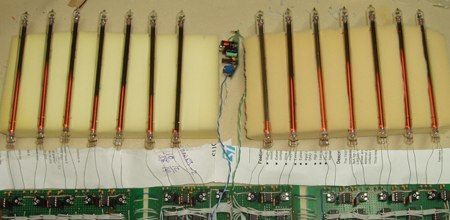
This VU meter project by [Daniel Naito] is a great piece of Russian electrocouture. It’s made up of 14 Nixie tubes that display seven frequency bands for the two audio channels. He found this similar project, but wanted to keep the cost low by avoiding such exotic ICs. First, the two input channels are amplified and then split using seven bandpass filters covering 60, 150, 400, 1000, 2500, 6000, and 15000Hz. Then, the AC audio is converted to DC. The final stage converts the logarithmic scale to a linear output. Besides the semirare Nixie tubes, the majority of the parts are just cheap opamps and comparators. The post is an excellent read and you can see it in action in the video below.
UPDATE: Yep, it’s a repost. I’m awesome like that. The True RMS Plasma Vu-meter seems to be new to us though.
Speed Testing The Latest Web Browsers

With the imminent release of Firefox 3 and Opera 9.5 being finalized this week, Lifehacker decided it was a good time to run the browsers head to head to see which was the fastest and least resource intensive. The testing system was a 2GHz 2GB Vista machine. The timing system used wasn’t directly hooked to the browser, so tests were repeated multiple times to improve accuracy. The cold start winner was Opera, but most browsers opened in about a second if they had been run recently. Safari did well loading content in multiple tabs at the same time, probably due to its short render times for JavaScript and CSS. The final test was memory usage; we’re sure many people will be happy to know that Firefox 3 RC3 only used 66% of the RAM required by the other three browsers.
Magnetically Actuated Microbots

The Carnegie Mellon NanoRobotics Lab uses external magnetic fields to precisely control their nanosoccer players. The micro robots are just 300×300 micron specs of neodymium-iron-boron permanent magnets that have been laser machined. The working volume is surrounded by five electromagnetic coils. Four coils are used for position while the fifth provides clamping force to the work surface. The bot can be operated almost anywhere as long as the surface isn’t magnetically active. Machine vision is used to watch the bot and provide feedback control. Embedded below is the robot moving across a glass slide next to a dime. It can travel at speeds up to 60 body lengths per second.
LAMP On Ubuntu
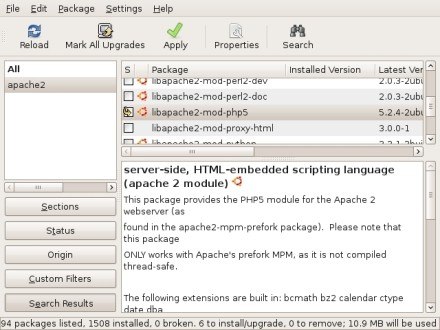
Download Squad’s [Kristin Shoemaker] has just published part 2 of their guide to web development using Linux. This time around they’re installing Apache, MySQL, and PHP on Ubuntu Hardy Heron. It’s a straight forward process under Ubuntu since you just need to select the few packages in Synaptic. Once installed, she shows you how to poke at Apache to verify that it’s running. They finish up by installing phpMyAdmin and the WordPress CMS.
Having a web server installed is useful for more than just development work. Many open source tools have a simple web based interface you’ll be able to access through your local web server.









