Maslow Brings The Wall Plotter Into The Woodshop

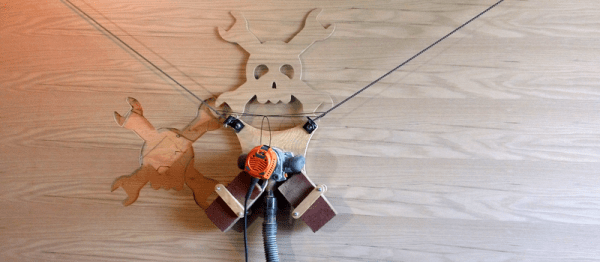
Hanging plotters, or two steppers controlling a dangling Sharpie marker on an XY plane, are nothing new to our community. But have you ever thought of trading out the Sharpie for a wood router bit and cutting through reasonably thick plywood sheets? That would give you a CNC machine capable of cutting out wood in essentially whatever dimensions you’d like, at reasonably low-cost. And that’s the idea behind [Bar]’s Maslow. It’s going to be a commercial product (we hope!), but it’s also entirely open source and indubitably DIYable.

[Bar] walks us through all of the design decisions in this video, which is a must-watch if you’re planning on building one of these yourself. Basically, [Bar] starts out like any of us would: waaaay over-engineering the thing. He starts out with a counterweight consisting of many bricks, heavy-duty roller chain, and the requisite ultra-beefy motors to haul that all around. At some point, he realized that there was actually very little sideways force placed on a sharp router bit turning very quickly. This freed up a lot of the design.

His current design only uses two bricks for counterweights, uses lighter chains, and seems to get the job done. There’s a bit of wobble in the pendulum, which he admits that he’s adjusted for in software. Motors with built-in encoders and gearing take care of positioning accurately. We haven’t dug deeply enough to see if there’s a mechanism to control the router’s plunge, which would be great to cut non-continuous lines, but first things first.

Taking the wall plotter into the woodshop is a brilliant idea, but we’re sure that there’s 99% perspiration in this design too. Thanks [Bar] for making it open! Best of luck with the Kickstarter. And thanks to [Darren] for the tip.
Running LISP On An ESP8266

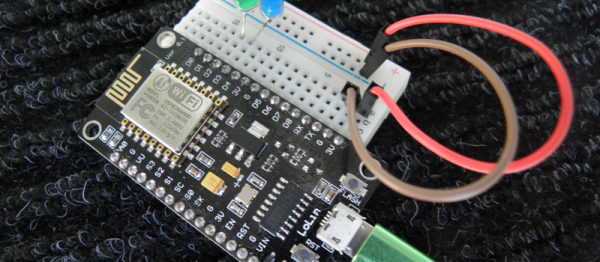
LISP is a polarizing language. Either you love it or you hate it. But we’ll put aside our personal preferences to bring you a good hack. In this case a LISP environment running on an ESP8266. [Dmitry] is on the “love it” side of the fence — he’s been waiting for an excuse to code up a LISP interpreter for a while, and he found one in the ESP8266.

there-is-always-a-way-2Actually, [Dmitry] is running LISP inside JavaScript, which is itself presumably coded up in C, before it’s assembled to run on an ESP8266. (It’s turtles all the way down!) This means that he can piggy-back on JavaScript’s garbage collection and console handling and so on. After picking a suitably small LISP implementation (actually a Scheme dialect for those of you who know the difference), he went to work.

One weekend bled into the next, but he got the system running, connected to the network, and had LEDs blinking! In the end, he even managed to squeeze in some optimization for memory’s sake. Pretty cool, and because it takes advantage of an already complete system, it can even be made pretty useful. Not bad for a few weekends’ work!

And finally, if Lots of Irritating Silly Parentheses is your idea of a good time, but the wealth of computing resources available on an ESP8266 seem overkill, have a look at Microlisp, running on an AVR. Or go to the opposite extreme, and run a LISP OS on a Raspberry Pi. Whatever you do, don’t forget to close your parentheses! (We’re told that’s a traditional LISPer farewell.)

Ask Hackaday: DIY Handwriting Recognition

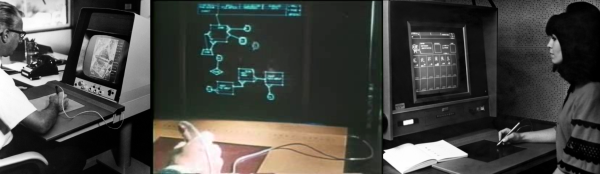
Computer handwriting recognition is very cool by itself, and it’s something that we’d like to incorporate into a project. So we went digging for hacker solutions, and along the way came up with an interesting bit of history and some great algorithms. We feel like we’ve got a good start on that front, but we’re stuck on the hardware tablet sensor itself. So in this Ask Hackaday, we’re going to make the case for why you could be using a tablet-like device for capturing user input or doing handwriting recognition, and then we’re going to ask if you know of any good DIY tablet designs to make it work.

Continue reading “Ask Hackaday: DIY Handwriting Recognition”

Hackaday Prize Entry: Hands|On Gloves Speaks Sign Language

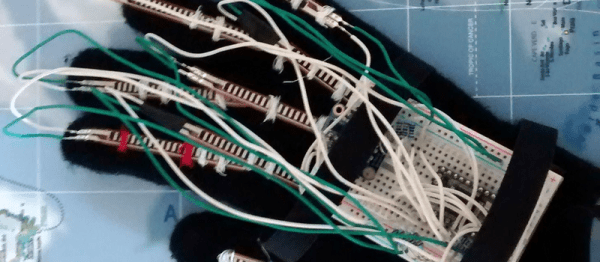
The Hands|On glove looks like it’s a PowerGlove replacement, but it’s a lot more and a lot better. (Which is not to say that the Power Glove wasn’t cool. It was bad.) And it has to be — the task that it’s tackling isn’t playing stripped-down video games, but instead reading out loud the user’s sign-language gestures so that people who don’t understand sign can understand those who do.

The glove needs a lot of sensor data to accurately interpret the user’s gestures, and the Hands|On doesn’t disappoint. Multiple flex sensors are attached to each finger, so that the glove can tell which joints are bent. Some fingers have capacitive touch pads on them so that the glove can know when two fingers are touching each other, which is important in the US sign alphabet. Finally, the glove has a nine degree-of-freedom inertial measurement unit (IMU) so that it can keep track of pitch, yaw, and roll as well as the hand’s orientation.

In short, the glove takes in a lot of data. This data is cleaned up and analyzed in a Teensy 3.2 board, and sent off over Bluetooth to its final destination. There’s a lot of work done (and some still to be done) on the software side as well. Have a read through the project’s report (PDF) if you’re interested in support vector machines for sign classification.

Sign language is most deaf folks’ native language, and it’s a shame that the hearing community can’t understand it directly. Breaking down that barrier is a great idea, and it makes a great entry in the Hackaday Prize!

Two Words That Don’t Mean What You Think They Do

sprites_enhanced_stripWhen you hear “gravity waves” or “sprites”, you’d think you would know what is being discussed. After all, those ripples in space-time that Einstein predicted would emanate from twin, colliding, black holes were recently observed to much fanfare. And who doesn’t love early 8-bit computer animations? So when we were browsing over at SpaceWeather we were shocked to find that we were wrong twice, in one photo (on the right). Continue reading “Two Words That Don’t Mean What You Think They Do”

Minimal Computer And Operating System: One Button, One LED

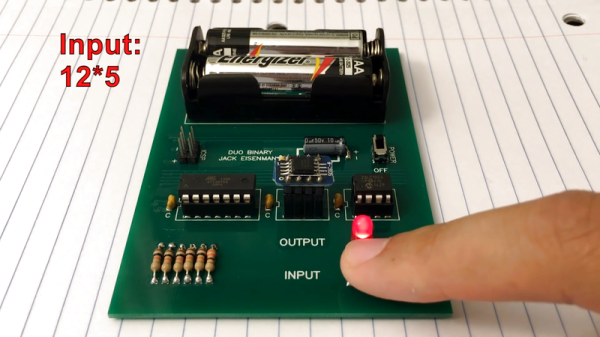
DUO BINARY is a very, very small computer system in every possible sense. It runs on an ATtiny84, which has even got “tiny” in its name. The user interface is a single button for data entry and a single LED for feedback, making this binary keyboard look frivolously over-complicated. It uses a devilish chimera of Morse code and a truncated ASCII to enter data, and the LED blinks the same back at you.

We’re guessing that [Jack Eisenmann] is the only person in the world who can control this thing, and you can watch him doing so in the video embedded below. Continue reading “Minimal Computer And Operating System: One Button, One LED”

NASA Knows Where The Meteors Are

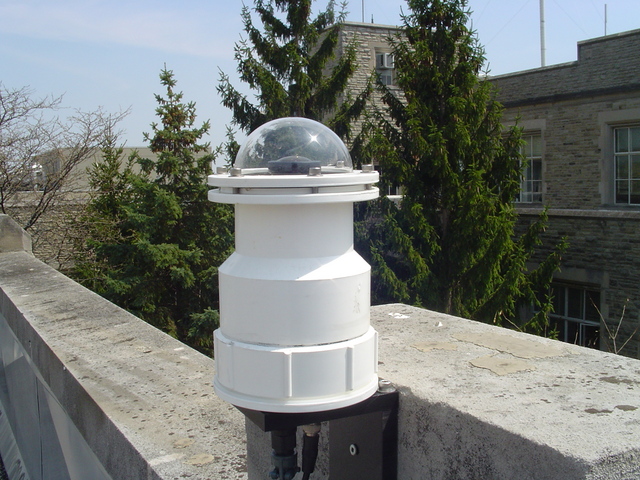
NASA has been tracking bright meteoroids (“fireballs”) using a distributed network of video cameras pointed upwards. And while we usually think of NASA in the context of multi-bazillion dollar rocket ships, but this operation is clearly shoe-string. This is a hack worthy of Hackaday.

droppedimage

The basic idea is that with many wide-angle video cameras capturing the night sky, and a little bit of image processing, identifying meteoroids in the night sky should be fairly easy. When enough cameras capture the same meteoroid, one can use triangulation to back out the path of the meteoroid in 3D, estimate its mass, and more. It’s surprising how many there are to see on any given night.

You can watch the videos of a meteoroid event from any camera, watch the cameras live, and even download the meteoroid’s orbital parameters. We’re bookmarking this website for the next big meteor shower.

cameraThe work is apparently based on [Rob Weryk]’s ASGARD system, for which the code is unfortunately unavailable. But it shouldn’t be all that hard to hack something together with a single-board computer, camera, and OpenCV. NASA’s project is limited to the US so far, but we wonder how much more data could be collected with a network of cameras all over the globe. So which ones of you are going to take up our challenge? Build your own version and let us know about it!

Between this project and the Radio Meteor Zoo, we’re surprised at how much public information there is out there about the rocky balls of fire that rain down on us every night, and will eventually be responsible for our extinction. At least we can be sure we’ll get it on film.