Blue LED Streetlights Keeping You Awake?

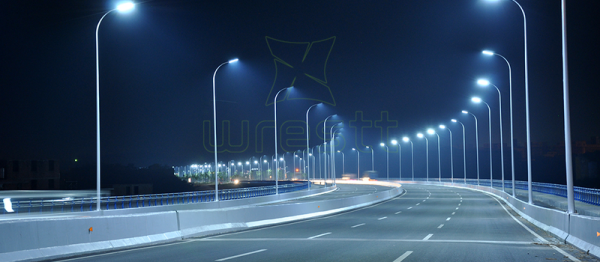
If you’ve played around with “white” LEDs, you already know that there’s no such thing. There’s warm white and cool white and any numbers of whites in-between. And when white LEDs were new, the bluer “cool white” variety were significantly more prevalent.

Enough US states have swapped out their old street lights with LEDs that it may be having a measurable effect on people and on the animals around us. This is the claim in a recent position paper by the American Medical Association’s Council on Science and Public Health. (Report as PDF.)

Science strongly suggests that heavy doses of light can keep people from falling asleep, and that brighter LED streetlamps may be making the problem worse. The AMA report goes a step further, and pins extra blame on the color of the light. Blue light apparently suppresses the production of melatonin which helps you sleep at night. And it’s not just humans whose circadian rhythms are getting messed up — the effects are seen throughout the animal kingdom.
Continue reading “Blue LED Streetlights Keeping You Awake?”

Tetris In 446 Bytes

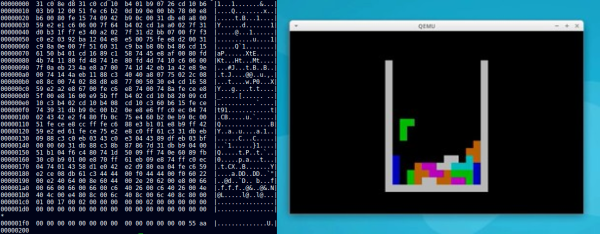
You want to play Tetris. You want to play Tetris on any operating system. You want to play on an old IBM PC, you want to play Tetris on a new MacBook. You want a Tetris that’ll fit inside the master boot record of a disk. You want Tetris as an operating system. You want TetrOS.

Or maybe you don’t, but it’s a fantastic piece of work, and we love tiny demos. Check it out below the break. Or read through the source code in the banner image.

Continue reading “Tetris In 446 Bytes”

Driving 16 WS2812B Strips With GPIOs And DMA

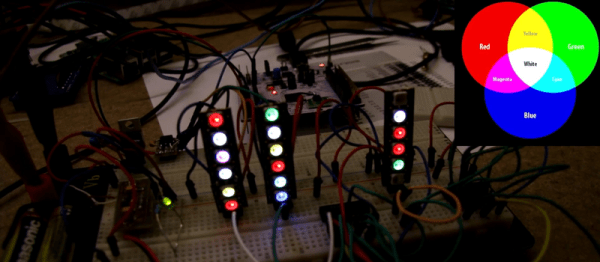
[Martin Hubáček] wrote in with his WS2812 LED library for the STM32F3 series processors. [Martin]’s library takes the same approach as [Paul Stoffregen]’s OctoWS2811 for the Teensy, and [Erich Styger]’s for the Freescale FRDM-K64F board. That is, it uses three DMA channels to get the signal out as fast as possible.

Continue reading “Driving 16 WS2812B Strips With GPIOs And DMA”

Transmitting Analog TV, Digitally

If you want to really understand a technology, and if you’re like us, you’ll need to re-build it yourself. It’s one thing to say that you understand (analog) broadcast TV by reading up on Wikipedia, or even by looking at scope traces. But when you’ve written a flow graph that successfully transmits a test image to a normal TV using just a software-defined radio, you can pretty easily say that you’ve mastered the topic.

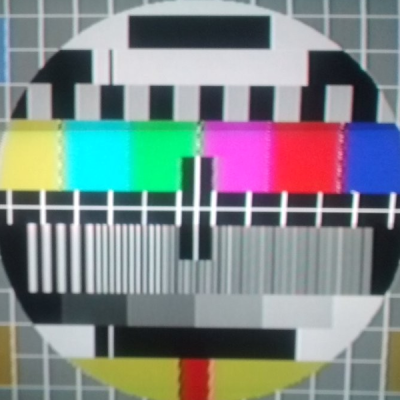
9944491474271463115_thumbnail[Marble] wrote his flow for PAL, but it should be fairly easy to modify it to work with NTSC if you’re living in the US or Japan. Sending black and white is “easy” but to transmit a full color image, you’ll need to read up on color spaces. Check out [marble]’s project log.
Hackaday has another hacker who’s interested in broadcasting to dinosaur TVs: [CNLohr]. Check out his virtuoso builds for the ATtiny and for the ESP8266.

(Yes, the headline image is one of his earlier trials with black and white from Wikipedia — we just like the look.)

Glitching USB Firmware For Fun

[Micah Elizabeth Scott], aka [scanlime], has been playing around with USB drawing tablets, and got to the point that she wanted with the firmware — to reverse engineer, see what’s going on, and who knows what else. Wacom didn’t design the devices to be user-updateable, so there aren’t copies of the ROMs floating around the web, and the tablet’s microcontroller seems to be locked down to boot.

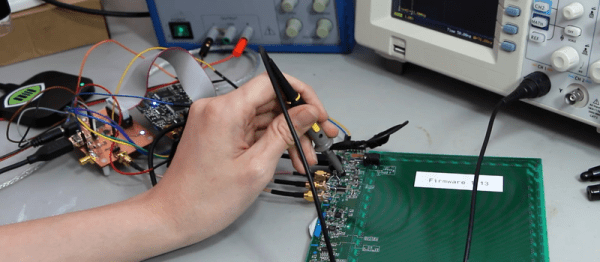
With the easy avenues turning up dead ends, that means building some custom hardware to get it done and making a very detailed video documenting the project (embedded below). If you’re interested in chip power glitching attacks, and if you don’t suffer from short attention span, watch it, it’s a phenomenal introduction.

Continue reading “Glitching USB Firmware For Fun”

How To Get Started With The ESP32

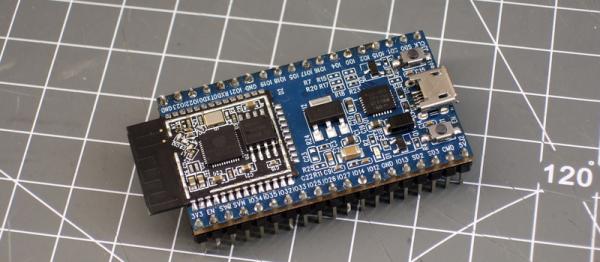
ESP32 is the hottest new wireless chip out there, offering both WiFi and Bluetooth Low Energy radios rolled up with a dual-core 32-bit processor and packed with peripherals of every kind. We got some review sample dev boards, Adafruit and Seeed Studio had them in stock for a while, and AI-Thinker — the company that makes the most popular ESP8266 modules — is starting up full-scale production on October 1st. This means that some of you have the new hotness in your hands right now, and the rest of you aren’t going to have to wait more than a few more weeks.

As we said in our first-look review of the new chip, many things are in a state of flux on the software side, but the basic process of writing, compiling, and flashing code to the chip is going to remain stable. It’s time to start up some tutorials!

Continue reading “How To Get Started With The ESP32”

Riding Rollercoasters With 3D Printed Kidneys, Passing Stones

Citizen science isn’t limited to the nerd community. When medical professionals get a crazy idea, their options include filling out endless paperwork for human consent forms and grant applications, or hacking something together themselves. When [David Wartinger] noticed that far too many of his patients passed kidney stones while on vacation, riding rollercoasters, he had to test it out.

Without the benefit of his own kidney stones, he did the next best thing: 3D printed a model kidney, collected some urine, and tossed a few stones that he’d collected from patients into the trap. Then he and a colleague rode Big Thunder Mountain Railroad sixty times, holding the model in a backpack at kidney height.

Continue reading “Riding Rollercoasters With 3D Printed Kidneys, Passing Stones”