Saving Lives With Open-Source Electrocardiography

A few months ago, MobilECG wowed us with a formidable electrocardiograph (ECG, also EKG) machine in the format of a business card, complete with an OLED display. We’ve seen business card hacks before, but that was the coolest. But that’s peanuts compared with the serious project that it supports: making an open-source ECG machine that can actually save lives by being affordable enough to be where it’s needed, when it’s needed.

The project, MobilECG, is an open-source, wearable device that supports all of the major ECG modes. In their talk, [Péter Isza] and [Róbert Csordás] taught us a lot about what that exactly entails and how the heart works. We learned a lot, and we’ll share some of that with you after the break.

Continue reading “Saving Lives With Open-Source Electrocardiography”
Connect All Your IoT Through Your Pi 3

If you’re playing Hackaday Buzzword Bingo, today is your lucky day! Because not only does this article contain “Pi 3” and “IoT”, but we’re just about to type “ESP8266” and “home automation”. Check to see if you haven’t filled a row or something…

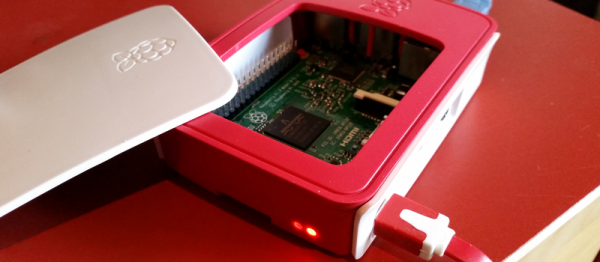
Seriously, though. If you’re running a home device network, and like us you’re running it totally insecurely, you might want to firewall that stuff off from the greater Interwebs at least, and probably any computers that you care about as well. The simplest way to do so is to keep your devices on their own WiFi network. That shiny Pi 3 you just bought has WiFi, and doesn’t use so much power that you’d mind leaving it on all the time.

Even if you’re not a Linux networking guru, [Phil Martin]’s tutorial on setting up the Raspberry Pi 3 as a WiFi access point should make it easy for you to use your Pi 3 as the hub of your IoT system’s WiFi. He even shows you how to configure it to forward your IoT network’s packets out to the real world over wired Ethernet, but if you can also use the Pi 3 as your central server, this may not even be necessary. Most of the IoT services that you’d want are available for the Pi.

Those who do want to open up to the world, you can easily set up a very strict firewall on the Pi that won’t interfere with your home’s normal WiFi. Here’s a quick guide to setting up iptables on the Pi, but using even friendlier software like Shorewall should also get the job done.

Still haven’t filled up your bingo card yet? “Arduino!”

Colin Furze Flies The Dangerous Skies

To quote our tipster: “Furze is my hero … You just need to know how to weld and have zero consideration for your personal well-being.” We’re not exactly sure that he has no consideration, but [Colin Furze] definitely pulls off some dangerous hacks. This time? Two-engine hoverbike. We don’t have to tell you to watch the video, do we? Continue reading “Colin Furze Flies The Dangerous Skies”

Robot Beats Piano Tiles

Machines running out of control are one of the staples of comedy. For the classic expression, see Chaplin’s “Modern Times”. So while it starts out merely impressive that [Denver Finn]’s robotic fingers can play an iPad piano video game, it ends up actually hilarious. Check out the linked video to see what we mean.

Continue reading “Robot Beats Piano Tiles”

Threadless Ballscrew For 3D Printer

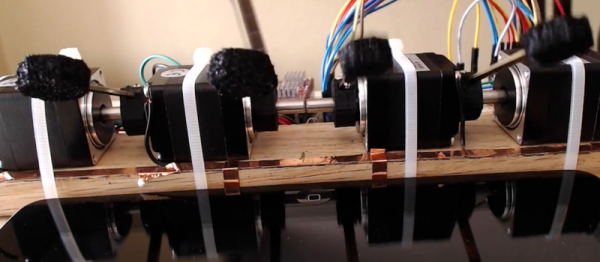
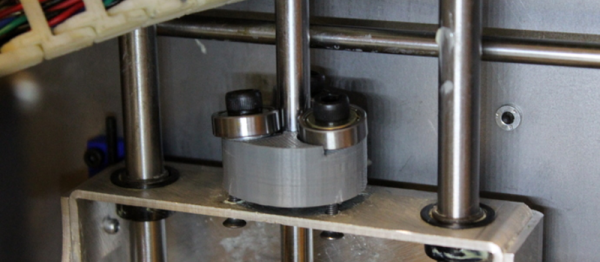
[2n2r5] posted up a mechanism that we’d never seen before — a threadless ballscrew that turns rotational into linear motion with no backlash. It works by pressing the edge of three bearings fairly hard up against a smooth rod, at an angle. The bearings actually squeeze the rod a little bit, making a temporary indentation in the surface that works just like a screw thread would. As the bearings roll on, the rod bounces back to its original shape. Watch it in action in the video below.

Continue reading “Threadless Ballscrew For 3D Printer”

Autonomous Electro-musical Devices

Circuit-bending is tons of fun. The basic idea is that you take parts of any old electronic device, say a cheap toy keyboard, and probe all around with wires and resistors, disturbing its normal functioning and hoping to get something cool. And then you make art or music or whatever out of it. But that’s a lot of work. What you really need is a circuit-bending robot!

Or at least that’s what [Gijs Gieskes] needed, when he took apart a horrible Casio SA-5 and grafted on enough automatic glitching circuitry to turn it into a self-playing musical sculpture. It’s random, but somehow it’s musical. It’s great stuff. Check out the video below to see what we mean.

We also love the way the autonomous glitching circuit is just laid over the top of the original circuitboard. It looks like some parasite out of Aliens. But with blinking LEDs.

Continue reading “Autonomous Electro-musical Devices”

DIY Thermal Imaging Smartphone

We wish we had [Karri Palovuori] for a professor! As an exciting project to get incoming freshmen stoked on electrical engineering, he designed a DIY thermal-imaging smartphone that they can build themselves. It’s all built to fit into a sleek wooden case that gives the project its name: KAPULA is Finnish for “a block of wood”.

It’s just incredible how far one can push easily-available modules these days. [Karri] mounts a FLIR Lepton thermal camera, an LPC1768 Cortex M3 ARM micro, a GSM phone module, and a whole bunch of other cool stuff on a DIY-friendly two-sided board. The design uses 10 mil (0.25mm) trace and space, which is totally achievable with home etching methods. Copper wire bits fill up the vias. Did we mention he’s making the students do all this themselves? How awesome is that?

[Karri] expects that the students will tweak the software side of things. With additional onboard goodies like an accelerometer, microphone, speaker, SIM card, and USB, it’s not likely that they’ll get bored with the platform. He has a stretch hope that someone will take the hardware and modify it. That’s ambitious for sure, but it’s so cool that someone could.

We’ve seen some sophisticated DIY cellphones before, but this one rises above by being easily DIYable and including awesome extra features. Order parts now, and start etching. You could be sending thermal-photo tweets inside of just a few days.