It’s A CoCo! No, It’s An Apple II!

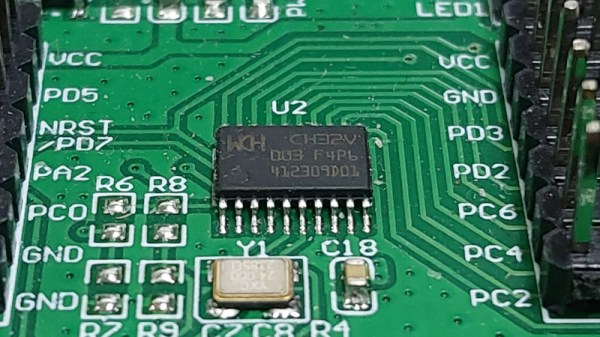
Original retrocomputing hardware is now decades old and showing its age, so the chances are it’s more common in 2024 to experience a machine from the 1970s or 1980s by way of an emulator on a modern machine than it is on the real hardware. There’s another more limited emulation scene as similar 8-bit machines emulate each other, for example when the very similar Dragon 32 and Tandy CoCo have a go at each other’s software. Rarest of them all though is when one classic machine emulates another with a different architecture, but that’s exactly what’s happened with [DragonBytes], who has persuaded a Tandy CoCo to emulate an Apple II.

The two machines have significant hardware differences, but we’re guessing that the project is helped a little by the Motorola 6809 in the CoCo and the MOS 6502 in the Apple having both in a sense been different visions of a successor to the Motorola 6800. Thus their architectures while different, are not diametrically opposed. The other hardware is certainly not so similar though, with Moto’s 6847 display chip in the Tandy being far more conventional than Steve Wozniak’s clever NTSC hacks to achieve a color display for minimal cost on the Apple.

The project is written in assembler, and doesn’t by any means claim to support all Apple modes, or be cycle accurate. But it’s a hugely impressive achievement nevertheless.

The CoCo has an enthusiastic following, and has appeared here a few times in the past. We particularly like this video player.

Designing A USB-C Upgrade PCB For The MX Ergo Mouse

As the world of electronic gadgetry made the switch from micro USB to USB-C as the charging port of choice, many of us kept both of the required cables handy. But it’s fair to say that these days a micro USB port has become a pretty rare sight, and the once ubiquitous cable can be a bit elusive in the event that you encounter an older device that requires it.

[Solderking] has a high-end Logitech cordless mouse with just this problem, and so he replaced its micro USB socket with a USB-C port. That makes the task sound deceptively simple, because in fact he had to reverse engineer one of the device’s PCBs in its entirety, making a new board with the same outline and components, but sporting the new connector.

Instead of attempting to replicate the complex shape with geometry he started with a scan of the board and had Fusion 360 trace its outline before 3D printing a version of it to check fit in the Logitech case. Then it was a case of tracing the circuit, designing the replacement, and hand transferring the parts from board to board.

The result is a USB-C chargeable mouse, and while all the design files don’t appear to be online, it’s possible to download the Gerbers from a PCBWay page. On top of that there’s a YouTube video of the process which we’ve placed below the break.

This isn’t the first time we’ve seen somebody spin up a new board to add USB-C to an older device — this drop-in replacement for Sony’s DualShock 4 comes to mind. If you’ve got enough free space inside your particular gadget, you might be able to pull of a USB-C conversion with nothing more exotic than a hacked up Adafruit breakout board.

Continue reading “Designing A USB-C Upgrade PCB For The MX Ergo Mouse”

If You Thought Sega Only Made Electronic Games, Think Again

Most of us associate the name Sega with their iconic console gaming systems from the 1980s and 1990s, and those of us who maintain an interest in arcade games will be familiar with their many cabinet-based commercial offerings. But the company’s history in its various entities stretches back as far as the 1950s in the world of slot machines and eventually electromechanical arcade games. [Arcade Archive] is starting to tell the take of how one of those games is being restored, it’s a mid-1960s version of Gun Fight, at the Retro Collective museum in Stroud, UK.

The game is a table-style end-to-end machine, with the two players facing each other with a pair of diminutive cowboys over a game field composed of Wild West scenery. The whole thing is very dirty indeed, so a substantial part of the video is devoted to their carefully dismantling and cleaning the various parts.

This is the first video in what will become a series, but it still gives a significant look into the electromechanical underpinnings of the machine. It’s beautifully designed and made, with all parts carefully labelled and laid out with color-coded wiring for easy servicing. For those of us who grew up with electronic versions of Sega Gun Fight, it’s a fascinating glimpse of a previous generation of gaming, which we’re looking forward to seeing more of.

This is a faithful restoration of an important Sega game, but it’s not the first time we’ve featured old Sega arcade hardware.

Continue reading “If You Thought Sega Only Made Electronic Games, Think Again”

For Today Only, Pi=3

In 1897 the state assembly of the American state of Indiana famously tried and failed to pass a bill which would have had the effect of denying the value of the mathematical constant Pi. It was an attempt to define a method to “square the circle”, or draw a square of the same area as a given circle through a series of compass and straight edge steps. It’s become something of a running joke and internet meme, and of course defining Pi exactly remains as elusive as ever.

Today and today alone though, you can in one sense claim that Pi is 3, because it’s twelve years since the launch of the original Raspberry Pi. The 29th of February 2012 was a leap day, and today being the third leap day since, could be claimed by a date pedant to be the third birthday of the little board from Cambridge. It’s all a bit of fun, but the Pi folks have marked the occasion by featuring an LED birthday cake.

Three leap days ago, your scribe was up at the crack of dawn to be one of the first to snag a board, only to witness the websites of the two distributors at the time, RS and Farnell, immediately go down under the denial of service formed by many thousands of other would-be Pi owners with the same idea. It would be lunchtime before the sites recovered enough to slowly buy a Pi, and it would be May before the computer arrived.

The Pi definitely arrived with a bang, but at tweleve years old is it still smoking? We think so, while it’s normalized the idea of an affordable little board to run Linux to the extent that it’s one of a crowd, the Pi folks have managed to stay relevant and remain the trend setter for their sector rather than Arduino-style becoming an unwilling collective term.

We’ve said this before here at Hackaday, that while the Pi boards are good, it’s not them alone which sets them apart from the clones but their support and software. Perhaps their greatest achievement is that a version of the latest Raspberry Pi OS can still run on that board ordered in February 2012, something unheard of elsewhere in single board computers. If you still have an original Pi don’t forget this, while it’s not the quickest any more there are still plenty of tasks at which they can excel. Meanwhile with their move into branded silicon and their PCIe architecture move we think things are looking exciting, and we look forward to another 12 years and three birthdays for them. Happy 3rd birthday, Raspberry Pi!

Washing Machine Motors Unlocked

There’s great potential in salvaging a motor from a broken appliance, but so often the part in question is very specific to its application, presenting a puzzle of wires to the experimenter. This was very much the case with older washing machines and other white goods, and while their modern equivalents may have switched to more understandable motors, there are still plenty of the older ones to be had. [Matthias random stuff] sheds a bit of light on how these motors worked, by means of a 1980s Maytag washing machine motor.

Many of us will be used to old-style induction motors, in which two windings were fed out of phase via a large capacitor. This one doesn’t have a capacitor, instead it has a primary winding and a secondary one with a higher resistance. We’re not quite sure the explanation of the resistance contributing to a phase shift holds water, however this winding is connected in for a short time at start-up by a centrifugal switch. Even better, reversing its polarity reverses the direction of the motor.

The result is a mess of wires demystified, and a mains powered motor with a bit of strength for your projects. We’ve let a few of these motors slip through our fingers in the past, perhaps we shouldn’t have been so hasty.

This is a subject that we’ve looked at in the past.

Continue reading “Washing Machine Motors Unlocked”

An Automotive Locksmith On The Flipper Zero And Car Theft

Here in the hacker community there’s nothing we love more than a clueless politician making a fool of themselves sounding off about a technology they know nothing about. A few days ago we were rewarded in spades by the Canadian Minister of Innovation, Science and Industry François-Philippe Champagne, who railed against the Flipper Zero, promising to ban it as a tool that could be used to gain keyless entry to a vehicle.

Of course our community has roundly debunked this assertion, as capable though the Flipper is, the car industry’s keyless entry security measures are many steps ahead of it. We’ve covered the story from a different angle before, but it’s worth returning to it for an automotive locksmith’s view on the matter from [Surlydirtbag].

He immediately debunks the idea of the Flipper being used for keyless entry systems, pointing out that thieves have been using RF relay based attacks which access the real key for that task for many years now. He goes on to address another concern, that the Flipper could be used to clone the RFID chip of a car key, and concludes that it can in the case of some very old vehicles whose immobilizers used simple versions of the technology, but not on anything recent enough to interest a car thief.

Of course, to many readers this will not exactly be news. But it’s still important, because perhaps some of us will have had to discuss this story with non-technical people who might be inclined to believe such scare stories. Being able to say “Don’t take it from me, take it from an automotive locksmith” might just help. Meanwhile there is still the concern of CAN bus attacks to contend with, something the manufacturers could have headed off had they only separated their on-board subsystems.

Continue reading “An Automotive Locksmith On The Flipper Zero And Car Theft”

The Photodiode You Never Knew You Had

Optoelectronics hold a range of possibilities for the hardware experimenter — indeed who among us hasn’t added LEDs aplenty to our work? What many of us may be unaware of though is that an LED is also a photodiode, and can even be persuaded to generate usable quantities of power. [Voltative] takes a look at this phenomenon with a series of experiments.

Lighting up an LED from a set of other LEDs is pretty cool, as is powering a calculator, or even the calculator powering itself from its on-board LED. But what caught our eye was using two LEDs as a data link, with both of them acting as transmitter and receiver (something on searching we find we’ve seen before). The possibilities there become interesting indeed.

Given that we are now surrounded by LEDs, from OLED screens to LED lighting, we can’t help wondering what the photodiode performance of some other types of part might be. Would the large area of a lighting LED give a better result for example, or would the phosphorescent coating of a white LED make it useless. We feel there’s more scope for experimentation here.

Continue reading “The Photodiode You Never Knew You Had”