Affordable Networking For Your Classic Mac

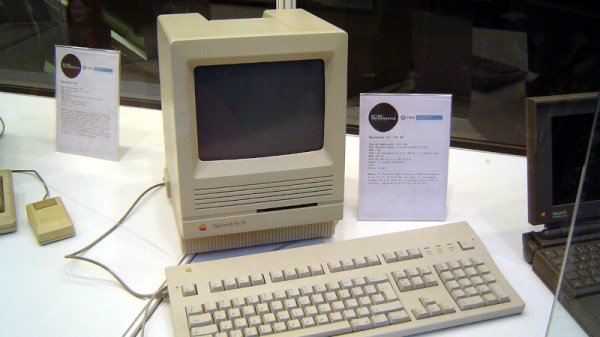
The Mac SE and in particular the Mac SE/30 number among the more sought-after of the classic all-in-one Apple computers, and consequently their peripherals including network cards are also hard to find and pricey. Even attempts at re-creating them can be expensive, usually because the chips used back in the day are now nearly unobtainable. But if the search is widened to other silicon it becomes possible to create substitutes, as [Richard Halkyard] is doing with a modern version of the SE Ethernet card.

The chip which makes this possible is the Microchip ENC624J600, an embedded 10/100 Ethernet controller with an impressively configurable interface that can be easily mated to the 68k bus. For The SE it’s mapped to a memory area, while for the /30 there can be a declaration ROM which informs the machine where it is.

This is an as yet unfinished project, a work in progress. But it deserves to succeed, and if we can provide encouragement by featuring it here then it’s definitely worth a look. Or course, this is by no means the only replacement for an original board.

SE/30 picture: Cornellanense, CC BY-SA 4.0.

Retrotechtacular: The Gunsmith Of Williamsburg

A modern firearm is likely to be mass-produced using high-precision machine tools, and with a uniformity to the extent that parts from one can be interchanged with those from another. This marks a progression of centuries of innovation, in gunsmithing, in machine tooling, and in metallurgy. In the 18th century there was little of the innovations found in a modern weapon, and a rifle would have been made entirely by hand through the work of a master gunsmith. The video below the break is a fascinating 1969 film following Wallace Gusler, the gunsmith at the museum town of Williamsburg, Virginia, as he makes an 18th-century muzzle-loading flintlock rifle from raw materials. It’s a long video, but it leaves nothing out and has a really informative commentary we’re told from the gunsmith himself.

The film opens with a piece of wrought iron being forged into a long strip. We’ve talked about wrought iron as a difficult-to-find blacksmith’s material before here, so this immediately makes us curious as to what material the current Williamsburg gunsmiths use. The strip is formed round a mandrel and laboriously forge-welded to form a rough tube, before being bored with a series of drills and then rifled with a toothed slug. The finishing is done by had with a file, with the rough tube being filed to an octagonal shape. Continue reading “Retrotechtacular: The Gunsmith Of Williamsburg”

A Single Board Computer, With Vacuum Tubes

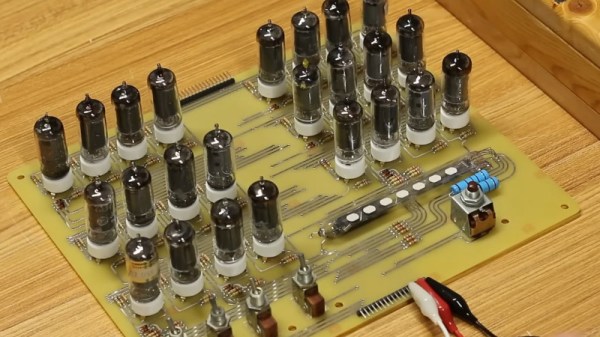
We have occasionally featured vacuum tube computers here at Hackaday and we’ve brought you many single board computers, but until now it’s probable we haven’t brought you a machine that combined both of these things. Now thanks to [Usagi Electric] we can see just such a board, in the form of his UE-0.1, a roughly 260 by 210 mm PCB with 24 6AU6 pentodes on board that implements a simple one-bit CPU.

The architecture starts with the MC14500B 1-bit microcontroller, which was the subject of a previous vacuum tube computer. People found the unusual architecture difficult to understand, so this board is an even simpler take. It doesn’t have all the features of the Motorola original but it is (just) enough to be a CPU.

The tubes are arranged in groups of four with heaters in series from a 24 V supply, while the inputs and clock come in the form of on-board suitably retro-looking switches. The final touch is a VFD of the type used in bar graphs, were used to show the state of the various bits. It’s a fully working computer in the simplest sense, and definitely worth a look in the video below the break.

It would be interesting to see whether the tube count could be reduced further, or is this a record. The number of physical devices could be cut by using tubes with more than one device in them such as double-triodes, but perhaps that would be cheating.

Meanwhile, if you think vacuum computing is all about the old stuff, perhaps you should look at the state of the art.

Continue reading “A Single Board Computer, With Vacuum Tubes”

Finally! A Typeface For Hardware People

When it comes to novelty typefaces there is no shortage of weird and wonderful fonts to be found when you have finally tired of Comic Sans. Everything from bananas forming letters to Wild West saloon lettering can be yours, plus of course our favourite, the embossed Dymo label. But there’s a new kid on the novelty typeface block, and for us it sweeps all before it.

Scopin’ Sans is as its creator [Guy Dupont] calls it “A typeface for hardware people”, and its party trick is that it doesn’t produce letters. Instead it forms an oscilloscope trace that displays what it would look like as serial data. Instantly your text jumps straight to 1337, and you win the internet.

We have shamefacedly to admit that we don’t know binary ASCII by sight, so we’ll have to take his word for it. But for the curious there’s a demo from which you can amuse yourself creating traces, and if you can’t recognize serial ASCII then the chances are few of the people around you can either. We take our hats off to [Guy], and it’s something we’re sure we’ll use at some point to delight and confuse our friends. It’s not the first font we’ve brought you, here are some more if you come from the bitmap era.

Powering A Cavity Magnetron, From A Battery

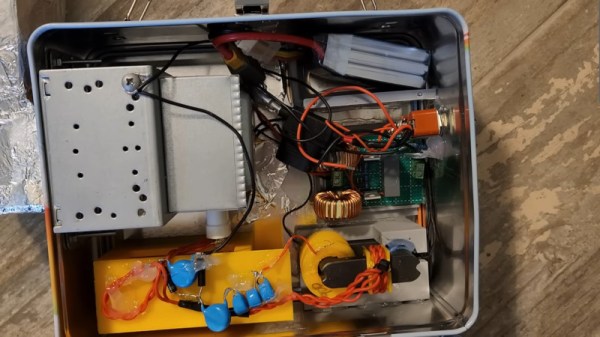
While vacuum electronic devices have largely been superseded over much of consumer electronics, there’s one place where they can still be found for now. The cavity magnetron is a power RF oscillator device in which electrons are induced to move in a circular path through a tuned cavity, inducing a high-power RF field, and it lies at the heart of a domestic microwave oven. They usually need a high-voltage mains transformer and a rectifier to work, but [Hyperspace Pirate] has managed to make a solid-state power supply to power one from a 12 volt battery. Better still, he’s put the resulting combo in a Care Bears lunchbox. Take a look at the video below the break.

The video starts with a potted history of the magnetron before looking at the circuit of a typical oven, which uses a single diode and a capacitor in a simple voltage multiplier. The capacitor value is adjusted to lower the power output, and a pretty thorough job is done of characterising the circuit.

The low-voltage supply starts with an XVS inverter to make the high voltage via another multiplier, but the interesting part comes with the magnetron’s heater. It’s designed for 50 or 60Hz household electricity, but there it’s receiving 40 kHz and has an appreciable impedance. The addition of a capacitor soon restores it to a reasonable performance.

In case you noticed that the ZVS converter might be improved upon, take a look at a flyback converter. Meanwhile, we should probably echo the safety message in the video that playing with magnetrons and their associated transformers can be a nasty way to die. Please take care out there!

Continue reading “Powering A Cavity Magnetron, From A Battery”

A Handheld Hackintosh, But So Much More

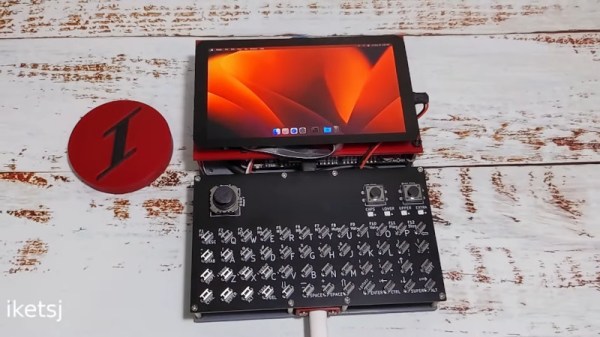
As handheld computing has solidified alongside everything else into the mobile phone, it’s sad that the once promising idea of a general purpose machine in the palm of the hand has taken a turn into the dumbed-down walled-garden offered by smartphone vendors. There was a time when it seemed that a real computer might be a common miniaturized accessory, but while it’s not really come to pass, at least [iketsj] has taken a stab at it. His handheld Hackintosh runs MacOS on a miniature scale, and looks rather nice.

At its heart is the LattePanda Alpha x86 single board computer, with a small custom expansion board  for a couple of buttons, a USB hub, a small keyboard, and a display. These parts are all mounted to a baseboard with metal stand-offs, and the power is sourced from a single USB-C socket at the bottom edge. What makes it more extraordinary is that it’s not the first handheld Hackintosh from this maker, the previous one being significantly bigger.

On one hand then, this is home-built PC like any other, assembled from off-the-shelf-parts. But on the other it’s far from normal, for despite its simplicity it forms a very usable small form factor device. The Akruvia Una keyboard uses tactile switches so maybe it’s not the machine to type your thesis on, but other than that it makes a great little machine for MacOS, Linux, or Windows. We like it, and we think you will too when you see the video below the break.

Continue reading “A Handheld Hackintosh, But So Much More”

Honey, I Ate The Camera

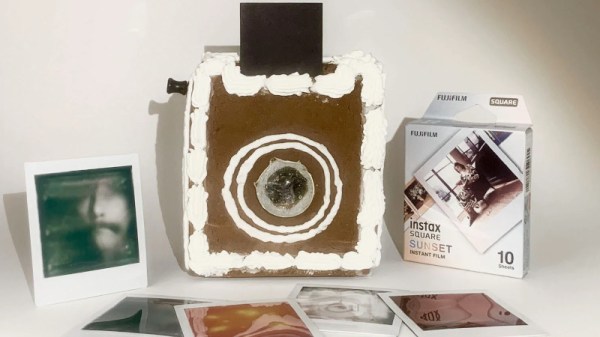
We like cameras here at Hackaday. We like them a lot. But until now that liking has never extended to liking their taste. A build from [Dmitri Tcherbadji] could change all that though, and he’s created a working Fuji Instax Square camera made from gingerbread.

To look at, it’s a straightforward box camera, albeit one made from sheets of gingerbread stuck together with what looks like icing. The film rests in an off-the-shelf development unit but the rest is edible, including unexpectedly the lens which is made of sugar glass. The photos it returns are definitely somewhat cloudy, but that it works at all is a significant feat.

While it’s an unconventional choice it’s clear that gingerbread, or at least a baked material similar to it, could become a useful tool in a maker’s arsenal. In this case it’s light-proof, but were instantly curious about how well a moulded piece of dough might hold its shape when baked. He reports the gingerbread expanding in the oven, however we’re guessing that tuning the quantity of raising agent could help.

Home-made cameras have featured here many times, but Instax seems to pop up most often as a hacked in replacement for obsolete Polaroid packs.