The Case For A Technology Aware Lobby Correspondent

We cover all manner of stories here at Hackaday, including awesome hardware hacks, the latest trends and inventions, and in-depth guides to fascinating technologies. We also cover a few news stories from the wider world outside our community, usually when they have some knock-on effect that has an impact on us. Recently this last category of stories has included laws which present a threat to online encryption and privacy in the UK and in the European Union, for example. They’re not the most joyful of news, but it’s vital for everyone with an interest in online matters to be informed about them.

A Long And Inglorious History

A quad flat-pack computer chip, made by VLSI
The infamous Clipper chip. Travis Goodspeed, CC BY 2.0

Those of us who have followed the world of technology will know that badly thought out laws with a negative impact on technology have a long and inglorious history. Some like the infamous backdoored Clipper chip encryption device die an inglorious death as industry or the public succeed in making them irrelevant, but others such as the Digital Millennium Copyright Act or DMCA live on for decades and present an ongoing malign influence. Most recently our ongoing coverage of dubious drone stories included a hefty dose of equally dubious action from lawmakers.

When considering these pieces of legislation it’s easy to characterise the politicians who advance them as gullible idiots easily swayed by any commercial lobbyist with a fistful of cash. But the reality is far more nuanced, while some of them may well be tempted by those lobbyists  they are in most cases neither gullible nor foolish. Instead they are better characterised as clueless on technical issues, and thus easily swayed by received opinion rather than by technological reality. If there’s a fault in the system it’s that the essential feedback which provides the checks and balances is missing, and oddly while sitting here writing this story, the responsibility for this comes close to home. The solution doesn’t lie in changing the politicians, but in changing how they are treated by journalists. Continue reading “The Case For A Technology Aware Lobby Correspondent”
Apple Archeology: The Future Once Had Server Side Computing In It

To read the IT press in the early 1990s, those far-off days just before the Web was the go-to source of information, was to be fed a rosy vision of a future in which desktop and server computing would be a unified and powerful experience. IBM and Apple would unite behind a new OS called Taligent that would run Apple, OS/2, and 16-bit Windows code, and coupled with UNIX-based servers, this would revolutionise computing.

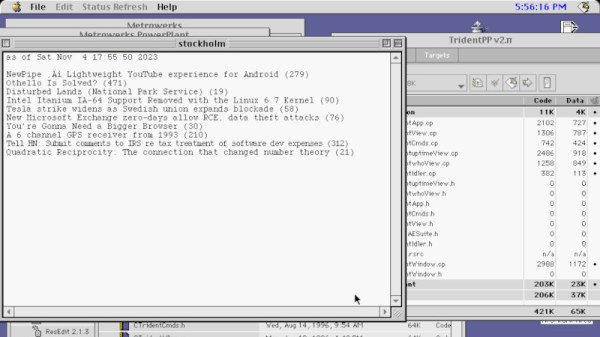
We know that this never quite happened as prophesied, but along the way, it did deliver a few forgotten but interesting technologies. [Old VCR] has a look at one of these, a feature of the IBM AIX, which shipped with mid-90s Apple servers as a result of this partnership, in which Mac client applications could have server-side components, allowing them to offload computing power to the more powerful machine.

The full article is very long but full of interesting nuggets of forgotten 1990s computing history, but it’s a reminder that DOS/Windows and Novell Netware weren’t the only games in town. The Taligent/AIX combo never happened, but its legacy found its way into the subsequent products of both companies. By the middle of the decade, even Microsoft had famously been caught out by the rapid rise of the Web. He finishes off by creating a simple sample application using the server-side computing feature, a native Mac OS application that calls a server component to grab the latest Hacker News stories. Unexpectedly, this wasn’t the only 1990s venture from Apple involving another company’s operating system. Sometimes, you just want to run Doom.

No TP? No Problem!

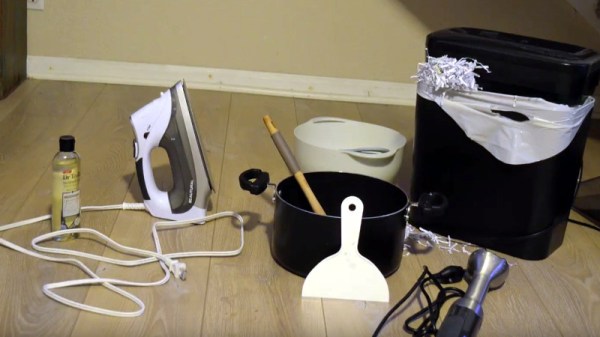
Among First World Problems, there can be few worse than running out of toilet paper. The horror! If you’re not able to do as we did yesterday and borrow a pack until more can be bought, then you’re not without options. A handy copy of the Daily Mail could be cut into squares and hung up in your Smallest Room, or you can even make your own with the help of this handy instructional video from [whoisandrewfahmy]. It appears from a casual search to be one of many such guides that appeared during the pandemic when the bog roll supply was seen as endangered, but it’s still interesting simply as a diversion into how something is made.

The process is surprisingly straightforward, starting with scrap paper, which is shredded and soaked before being boiled to break down to pulp. The pulp is then emulsified, and some body oil is added to remove the sandpaper-on-the-butt experience before being spread between a sheet and a piece of window screen to be ironed dry. It’s an energy-intensive process, so the Daily Mail is likely to be an easier stopgap if no friends can lend you a few rolls, but it’s left us here curious about papermaking. The butts of Hackaday may be safe from homemade TP, but that’s not to say that it wouldn’t be interesting to make other paper products. Check out the video below.

Of course, back in April 2020 we had our own solution to the pandemic toilet paper shortage. After you make your bespoke dunny roll, how can you wind it into a nice roll? Don’t worry. We got you.

Continue reading “No TP? No Problem!”

Probably The Largest Selfie Camera In The World

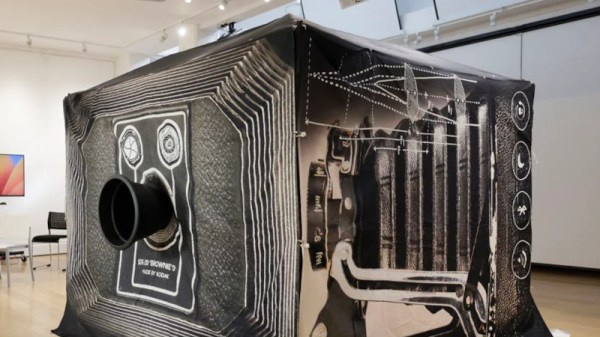
Most readers will have some idea of how a camera works, with a lens placed in front of a piece of film or an electronic sensor, and the distance between the two adjusted until the images is in focus. The word “camera” is a shortening of “camera obscura”, the Latin for “dark room”, as some early such devices were darkened rooms in which the image was projected onto a rear wall. [David White], a lecturer at Falmouth University in the UK has created a modern-day portable camera obscura using a garden gazebo frame, and uniquely for a camera obscura, it can be used to take selfies.

As might be expected the gazebo frame covered with a dark fabric forms the “room”, and the surface on which the image is formed comes from a projection screen. The lens is a custom-made 790 mm f/5.4, not exactly the type of lens found off-the-shelf. The selfie part comes from a Canon digital camera inside the gazebo focused on the frame, using its Wi-Fi control app a subject can sit at the appropriate point in front of the lens and take the selfie as they see fit.

The resulting images have a pleasing ethereal feel to them, and while it’s definitely not the most practical taker of snaps it’s still very much a camera to be impressed by. We’d be curious to see how it would perform as a pinhole camera, and even though it’s nowhere near the 2006 record pinhole image taken using an abandoned US Marine Corps aircraft hangar we think it would still deliver when given enough light. Meanwhile this isn’t the first time we’ve shown you a camera obscura, here’s one using the back of a U-Haul truck.

There’s No AI In A Markov Chain, But They’re Fun To Play With

Amid all the hype about AI it sometimes seems as though the world has lost sight of the fact that software such as ChatGPT contains no intelligence. Instead it’s an extremely sophisticated system for extracting plausible machine generated content from the corpus on which it is trained. There’s a long history behind machine generated text, and perhaps the simplest example comes in the form of a Markov chain. [Ben Hoyt] takes us through how these work, and provides some Python code so that you can roll your own.

If you’re uncertain what a Markov chain is, consider the predictive text on your phone. It works by offering the statistically most likely next word in your sentence, and should you accept all of its choices it will deliver sentences which are superficially readable but otherwise complete nonsense. He demonstrates with very simple short source texts how a collocate probability map is generated for two-word phrases, and how from that a likely next word can be extracted. It’s not AI, but it can be a lot of fun to play with and it opens the door to the entire field of computational linguistics. We haven’t set one loose on Hackaday’s archive yet but we suspect it would talk a lot about the Arduino.

We’re talking about Markov chains here with respect to language, but it’s also worth remembering that they work for music too.

Header: Bad AI image with Dall-E prompt, “Ten thousand monkeys with typewriters”.

Stream Vinyl To Your Sonos Without The Financial Penalty

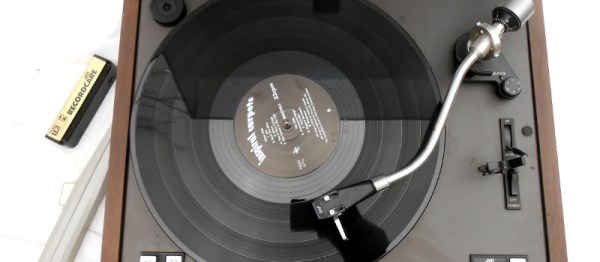
One of the unexpected success stories in the world of hi-fi over the past decade has been the resurgence of the vinyl LP as a musical format. What was once old hat is now cool again, but for freshy minted vinyl fans there’s a snag. Hi-fi itself has moved on from the analogue into the digital, so what can be done if your listening comes through a Sonos system. Sonos will sell you a box to do that of course, but it’s as overpriced as 2023-pressing vinyl. [Max Fischer] has a far better solution, in the form of a Raspberry Pi loaded with open source software.

At the vinyl end is a Behringer audio interface containing a pre-amp with the required RIAA response curve. This acts as the source for the DarkIce audio streamer and the IceCast2 media serer, all of which even with the cost of a Pi and the interface, is considerably less than the commercial device.

We’re guessing that a more humble interface coupled to an older RIAA pre-amp could cut the cost further, and we’d be hugely curious as to whether a simple mic pre-amp could be used alongside some DSP from the likes of Gnu Radio to give the RIAA response.

Either way, he’s made a handy device for any 21st-century vinyl fan. Meanwhile if you’re one of the streaming generation seduced by round plastic discs, we’ve gone into some detail about their audiophile credentials in the past. And if you have found yourself a turntable, of course you’ll need to know how to set it up properly.

A Small-Packing Antenna For 2 Metre Portable Work

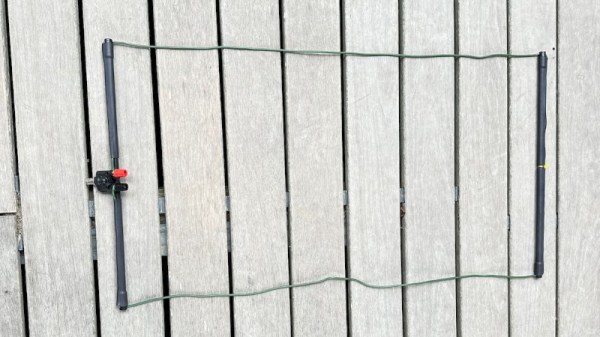
One of amateur radio’s many interests comes in portable operation, taking your radio to an out of the way place, usually a summit, and working the world using only what can be carried in. Often this means using the HF or shortwave bands, but the higher frequencies get a look-in as well. A smaller antenna is no less the challenge when it comes to designing one that can be carried though, and [Thomas Witherspoon] demonstrates this with a foldable loop antenna for the 2 metre band.

The antenna provides a reminder that the higher bands are nothing to be scared of in construction terms, it uses a BNC-to-4 mm socket adapter as its feedpoint, and makes the rectangular shape of the loop with pieces of fiberglass tube. The wire itself is flexible antenna wire, though we’re guessing almost any conductor could be used. The result is a basic but useful antenna that certainly packs down to a very small size, and we can see it would be a useful addition to any portable operator’s arsenal.

If you’re a 2 metre band user, this certainly isn’t the first time we’ve visited lightweight antennas for this band.