Why Didn’t We Think Of Making A Remote Trigger Button?

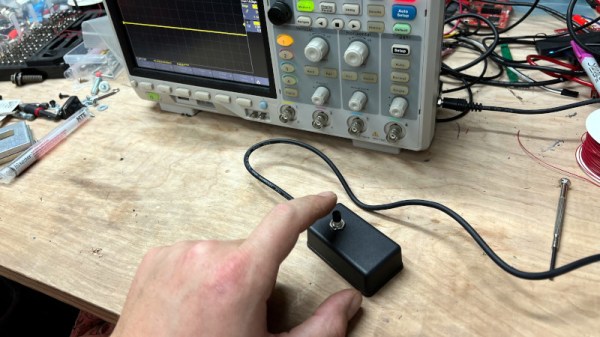
One of the many functions a digital oscilloscope offers over its analog ancestors is a trigger button. Alongside the usual electronic means of triggering the instrument, you can reach over and press a button to “freeze-frame” the action and preserve the trace. Sometimes doing it repeatedly it can become a chore to reach for the ‘scope. That’s where [Kevin Santo Cappuccio]’s remote trigger button comes in.

The button itself is about as simple a hack as it gets. The ‘scope was carefully dissected and some fine wires laid from the contacts within the front panel to a connector on the case. From there a cable goes to a box with a momentary action button switch. Plug in the box, and you can trigger the ‘scope from a distance!

We have to admit to rather admiring this hack, as needing to trigger the ‘scope is a well-known problem here. It’s easy to stab the wrong button and lose what you are looking for, so we’re rather surprised we didn’t think of this one ourselves. But then again from another viewpoint, it involves dissecting an expensive instrument which is best left unmolested. Perhaps manufacturers should consider adding this functionality.

This may be the most straightforward oscilloscope hack we’ve shown you, but it’s certainly not the first.


PicoStepSeq Is Small But Perfectly Formed

The Raspberry Pi Pico is what you might call the board of the moment, thanks to its combination of affordability, features, and continued availability during the component shortage. We have seen plenty of great projects using it, and the latest to float past is [todbot]’s PicoStepSeq, an extremely compact MIDI sequencer.

All the components are mounted on a PCB, with the sequencer’s eight steps selected by a row of buttons with integrated LEDs. The interface is via an SSD1306 OLED, and there is also a rotary encoder. Software comes courtesy of CircuitPython, and the output is delivered via a 3.5 mm TRS jack. Finally the whole is wrapped in a 3D printed enclosure.

The result is a sequencer that could almost be a product in its own right, and we think anyone whose interests lie in electronic music should find straightforward enough to build. All the files and information required to build your own can be found in the linked repository, and he’s placed a Tweet with a video online which we’ve embedded below the break.

Continue reading “PicoStepSeq Is Small But Perfectly Formed”

Deepdeck: Going Beyond The Macro Pad

We’re used to the idea of a macropad, a small extension keyboard for your computer whose keys can be programmed to the functions of your choice. They can be made in many ways, but they all follow a similar functionality. Deepdeck from [Nick Velasquez] is another matter, an attempt to make a macropad with functionality that goes way beyond simply pressing keys.

At its heart is an ESP32 module, and it makes full use of both Bluetooth and wireless networking capabilities. It can use Bluetooth when connecting to the host computer, and the wireless connection hosts both the configuration interface via a web server and an Internet connection from which it derives those special powers.  This is a macropad with programmable keys just like all the others, but it also has the ability to connect to online APIs programmed by the user. This allows it to automate complex queries involving other sources into a keypress, which gives it many more possibilities.

A tool such as this one is one of those things which requires a bit of thought as to exactly how it might be used. A normal API connected device might display the weather on a screen for instance, but how often does one need to type the weather forecast? However we can see that this extra online dimension will find as yet unseen applications, and we look forward to the idea being taken up with other macropads.

Fridge Compressor Teardown Reveals Engineering Compromises

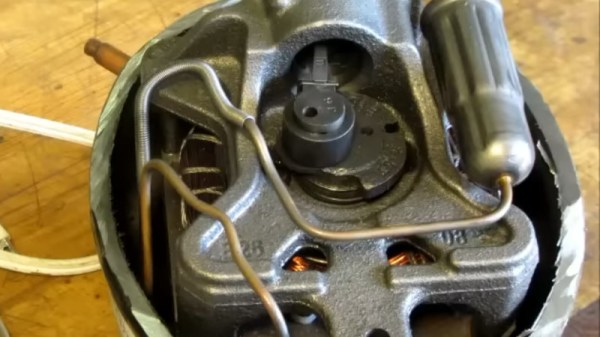
Probably one of the most reliable devices you will have in your house is the refrigerator, as its compressor has the minimum of moving parts and carries its own lubrication. It’s not uncommon to find fridges many decades old still in use, and fridges are far more likely to be discarded due to broken fittings rather than a failed compressor. An interesting teardown of a failed fridge compressor comes from [turbokinetic], who gives us a professional analysis of how shortcomings in its construction caused it to fail. It’s both an opportunity for a look at the inside of a fridge compressor, and a commentary on the quality of consumer grade hardware.

Electrically the unit seemed unhurt, but the motor wouldn’t pump anything. Cutting the lid off revealed the motor, and it was soon established that the bearing had failed. As the teardown proceeded the conclusion was that the fault lay in the oil being too low viscosity. The designer had picked a very light oil in pursuit of low friction for lower energy consumption, but had ended up with one too light to provide adequate coverage within the bearing. The compressor has a lifetime of around ten years baked into it from manufacture, whether the designer intended it to or not.

You can see the full video below the break, but meanwhile this isn’t the first fridge compressor we’ve seen.

Continue reading “Fridge Compressor Teardown Reveals Engineering Compromises”

Put 3D Metal Printing Services To The Test, By Making A Watch

Have you ever been tempted by those metal 3D printing services? [Carter Hurd] has, and puts them to the test with a wristwatch. (Video, embedded below.)

It’s fair to say that among Hackaday readers you will find a very high percentage of 3D printer ownership compared to the general population, but for most of us that means an FDM or perhaps even an SLA printer. These two technologies have both effectively delivered polymer printing at the affordable end of the market, but as readers will also be aware they are only the tip of the 3D printing iceberg. We know the awesomeness of your industrial 3D printer is defined by the size of your wallet, and while our wallets are small, we are offered a chance at the big time through the services of rapid prototyping companies that will print our models on these high-end machines. Thus [Carter]’s project video is as much about using these services as it is about making a wristwatch.

Continue reading “Put 3D Metal Printing Services To The Test, By Making A Watch”

An EMMC Gives Up Its Secrets

An increasing phenomenon over the years since mobile phones morphed from simply telephones into general purpose pocket computers has been that of the dead device taking with it some treasured digital resource. In most cases this means the device has died, but doesn’t necessarily mean that that the data has completely gone. Inside the device will be an eMMC flash chip, and if that can be read then the data is safe. This applies to some single board computers too, and thus [Jeffmakes]’ adventures in recovering an eMMC from a dead Raspberry Pi CM4 are particularly interesting.

The whole thing relies on the eMMC presenting the same interface as an SD card, so while it comes in a multi-pin BGA package it can be addressed with surprisingly few wires. Using the PCB from another dead CM4 he traced the relevant connections from eMMC to SoC pads, and was thus able with some very fine soldering to construct an interface for an SD card reader. The disk could then be imaged in its entirety.

This work will be of huge use to experimenters who’ve fried their Compute Modules, but of course the information it contains will also be of use to retrieve those photos from the phone that fell in the bath. It’s not the first time we’ve taken a look at someone’s efforts in this area.

Did You See A John Deere Tractor Cracked At DEF CON?

The Internet, or at least our corner of it,  has been abuzz over the last few days with the news of a DEF CON talk by [Sick.Codes] in which he demonstrated the jailbreaking of the console computer from a John Deere tractor. Sadly we are left to wait the lengthy time until the talk is made public, and for now the most substantive information we have comes from a couple of Tweets. The first comes from [Sick.Codes] himself and shows a game of DOOM with a suitably agricultural theme, while the second is by [Kyle Wiens] and reveals the tractor underpinnings relying on outdated and un-patched operating systems.

You might ask why this is important and more than just another “Will it run DOOM” moment. The answer will probably be clear to long-term readers, and is that Deere have become the poster child for improper use of DRM to lock owners into their servicing and deny farmers the right to repair. Thus any breaches in their armor are of great interest, because they have the potential to free farmers world-wide from this unjust situation. As we’ve reported before the efforts to circumvent this have relied on cracked versions of the programming software, so this potential jailbreak of the tractor itself could represent a new avenue.

As far as we’re aware, this has so far taken place on the console modules in the lab and not in the field on a real tractor. So we’re unsure as to whether the door has been opened into the tractor’s brain, or merely into its interface. But the knowledge of which outdated software can be found on the devices will we hope lead further to what known vulnerabilities may be present, and in turn to greater insights into the machinery.

Were you in the audience at DEF CON for this talk? We’d be curious to know more. Meanwhile the Tweet is embedded below the break, for a little bit of agricultural DOOM action.

Continue reading “Did You See A John Deere Tractor Cracked At DEF CON?”