It’s MacOS. On An Unmodified Wii!

We’re used to the so-called “Hackintoshes”, non-Apple hardware running MacOS. One we featured recently was even built into the case of a Nintendo Wii. But [Dandu] has gone one better than that, by running MacOS on an unmodified Wii, original Nintendo hardware (French, Google Translate link).

How has this seemingly impossible task been achieved? Seasoned Mac enthusiasts will remember the days when Apple machines used PowerPC processors, and the Wii uses a PowerPC chip that’s a close cousin of those used in the Mac G3 series of computers. Since the Wii can run a Linux-based OS, it can therefore run Mac-on-Linux, providing in theory an environment in which it can host one of the PowerPC versions of MacOS.

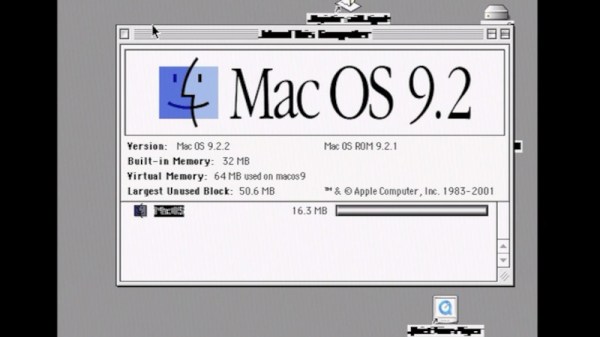
The installation sequence has more than its share of difficulties, but eventually he was able to get the Wii running MacOS 9, the last classic MacOS. It runs DOOM, Internet Explorer 5, and iTunes even on these limited resources, though the last package had display and sound issues. He then tries a MacOS X build, but without success.

It’s fair to say that this is not exactly a way to get your hands on a cheap Mac, and remains more of an exercise in pushing a console beyond its original function. But it’s still an interesting diversion, and maybe someone will in time make a MacOS X version work on the Wii too. If you’re curious about the Mac-in-a-Wii that inspired this work, you can see it here.
If Your Drone Flies, Eat It!

Over the years we’ve featured countless drone projects here at Hackaday, fixed wing, rotary wing, multi-rotor, and more. Among them all we think there may be a type that we’ve never seen, but that is about to change as it’s the first time we’ve brought you an edible drone.

Why might you need an edible drone, you ask? It’s not to conceal the evidence after closing an airport — instead it’s a research project from the Swiss Federal Institute of Technology to produce an efficient means of bringing sustenance to stranded climbers. The St. Bernard dogs are out of a job, it’s now done the modern way!

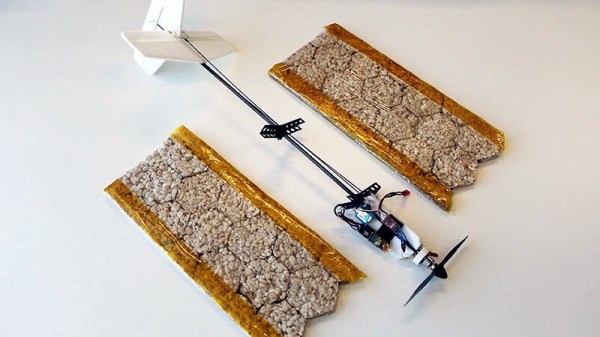
Jokes aside, this is clearly an experimental craft, a fixed-wing monoplane whose wings are made from rice cakes and gelatin. A stranded climber could certainly munch away at those airofoils, but we’re guessing a real device would need something a little more nutritious while retaining the light cellular structure.

This may be our first edible drone, but it’s not the first piece of edible technology we’ve brought you.

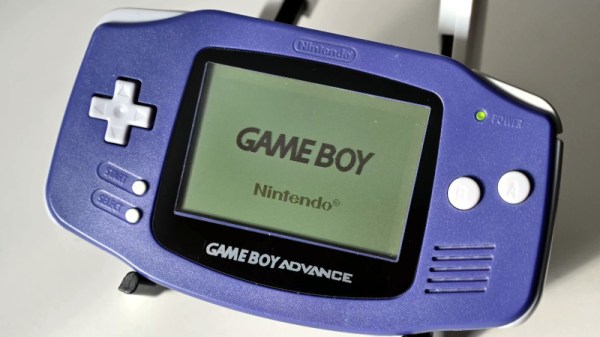
A Game Boy Advance – Downgraded!

We feature a large number of game console mods here, because enhancing the experience of using a classic machine often involves some really clever work. But here’s one that’s a bit different, instead of upgrading his Game Boy Advance, [Wenting Zhang] has downgraded it from a colour screen to a monochrome LCD. Take a look at the video below the break.

One might ask why this would be necessary, given that there are plenty of backlit colour LCD upgrades already for the GBA, but perhaps people who played the original might understand that it’s about improving the viewability over the rather poor-quality colour LCD original.

Interesting too is the choice of display controller. Where it might be expected to find an FPGA, instead there’s an PR2040. He goes into detail about its programming, and we hope it might inspire any others looking at screen transplants. Meanwhile if the name [Wenting Zhang] means anything to you, it should be for his other work with mono LCDs.

Continue reading “A Game Boy Advance – Downgraded!”

Portable ESP32 RGB Lasershow Has All The Trimmings

Perhaps there was a time when fancy laser effects were beyond those without the largest of bank accounts, but today they can be created surprisingly easily. [Corebb] shows us how with a neat unit using an off the shelf RGB laser module and mirror module, driven by a ESP32 with software designed to make it as easy as possible to use.

The video below the break is in Chinese so you’ll have to turn on the subtitles if you’re an Anglophone, and it takes us through the whole process. It’s mounted in an SLA 3D printed enclosure which neatly holds all the parts. The ESP32 module drives a couple of DACs which in turn drive the galvanometer motors through a pair of amplifiers.

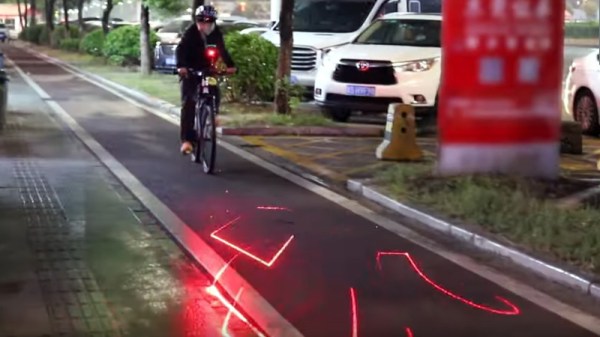
Then the software allows all sorts of custom displays for your creative expression, including uploading quick sketches over WiFi. Beyond pretty patterns we see it mounted on a bicycle for a head-up display of speed and navigation info. Even if it does fall off and break at one point we can see that could be an extremely useful accessory.

All the code can be found in a GitHub repository should you wish to try for yourself. Meanwhile we’ve covered a lot of laser projector projects here in the past, including most recently this one using stepper motors in place of galvanometers.

Continue reading “Portable ESP32 RGB Lasershow Has All The Trimmings”

New Part Day: Exotic Filament For RF Dielectric Structures

The world of microwave RF design appears to the uninitiated to be full of unimaginably exotic devices, as engineers harness the laws of physics to tame radio signals to their will. Among the weapons in their arsenal are materials of known dielectric properties, from which can be made structures with the desired effects on RF that encounters them. This has traditionally been a difficult and expensive process, but it’s one now made much easier by the availability of 3D printer filaments with a range of known dielectric values.

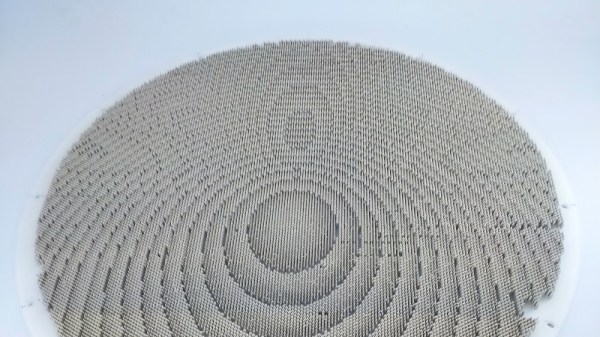
It’s best to think of the structures which can be designed using these materials as analagous to Fresnel lenses we’re all used to in the light domain. The example piece given by Microwave Journal is a metasurface for use in a steerable antenna, something that would be a much more difficult piece of work by more traditional means.

Normally when we inform you of a new special filament we’d expect it to be more costly than standard PLA, but this filament is in a class of its own at 275 euros per kilogram. So the interest for most readers will probably be more in the technology than the expectation of use, but even then we can see that there will still be microwave experimenters in our range who might be tempted by its unique properties. We look forward to what is developed using it.

Via Microwave Journal. Thanks to [Eric Mockler] for the tip!

Pop Your Way To A Fresh Roast Coffee

The preparation and consumption of coffee has become something of an art from in our community, with many people going to extravagant lengths to achieve the perfect cup. [Eric Sorensen] was keen to roast his own beans, but given the price of a dedicated roaster, instead made his own using a hot air popcorn popper.

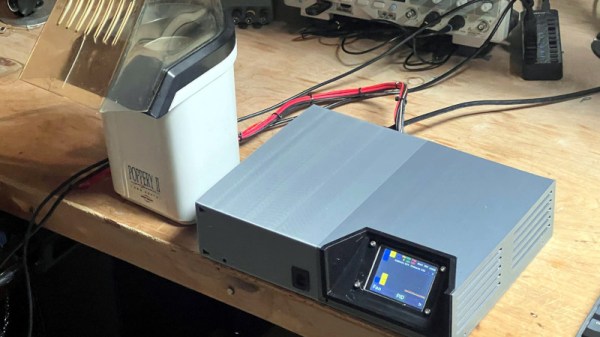
The story unfolds in several parts, and starts with disabling the thermal cutout on the popper to be replaced with thermal sensors. An Arduino controls both the fan and the heating coil to regulate and vary the roasting temperature over time. Perhaps it’s the software and user interface that most makes this project shine, with a graphical interface on a 320 by 240 pixel touch screen, and a graphing profile interface more reminiscent of a reflow oven than a kitchen appliance. The whole thing is neatly packed away with its power supply in a slimline case, and while we’re no bean experts, we appreciate the uniform brown of the finished product.

Coffee roasters have appeared here numerous times over the years. One of the more recent was this wobble disk design.

Is This The Smallest CP/M Machine Ever?

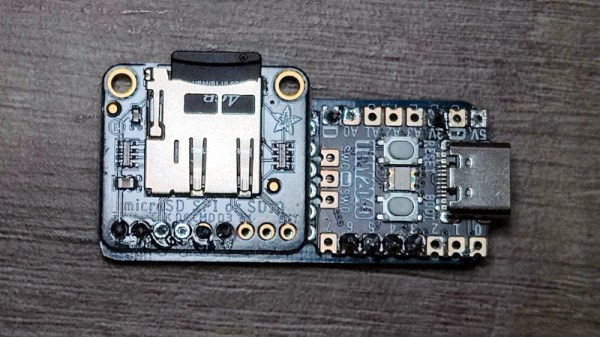
If you had an office word processor in the late 1970s, the chances are it ran Digital Research’s CP/M operating system. IBM went for Microsoft in the 1980s and the once-dominant player fell on hard times, but it survives today as a popular choice on retrocomputer platforms. Even the more compact Z80 systems are a little large for 2022, so when [Kian Ryan] needed the ultimate in CP/M portability it fell on a more modern piece of silicon. Hence he’s put it on a tiny RP2040-based board from Pimoroni alongside an Adafruit micro SD card breakout.

The tiny hardware is neat of course, but the real star of the show is the software. Non-CP/M aficionados will be interested to learn about RunCPM, and for this project, RunCPM 2040. This provides an emulated environment on a host microcontroller to run CP/M, allowing the operating system to be hosted on easier hardware than some of the original machines.

All this makes for a tiny development machine, but perhaps of more interest would be a machine that’s all-in-one with a display and perhaps a keyboard. The RP2040 is interesting in this case because of those programmable state machines. Could it be made to run a video display alongside RunCPM? We hope someone has a go at writing it.