Build A TPM Module For Your Server

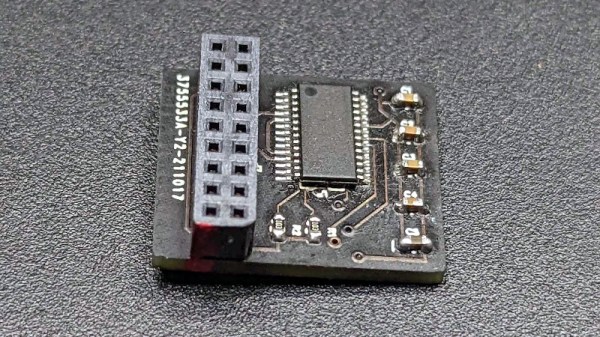
One of the big stories surrounding the announcement of Windows 11 was that it would require support for TPM 2.0, or Trusted Platform Module, to run. This takes the form of an on-board cryptographic processor, which Microsoft claims will help against malware, but which perhaps more importantly for Redmond, can be used to enforce DRM.  Part of the standard involves a hardware module, and [Zane] has built a couple of them for ASrock server motherboards.

The chip in question is the Infineon SLB9965, which with a bit of research was found to map more or less directly to the pins of the TPM socket on the motherboard. The interesting thing here lies in the background research it gives into TPMs, and furthermore the links to other resources dealing with the topic. The chances are that most readers needing a TPM will simply buy one, but all knowledge is useful when it comes to these things.

Our weekly security roundup has been keeping an eye on the use of TPMs for a while, and has even shown us some ways that people have used to bypass the modules.
Fix Every Broken Via To Return This Game To Life

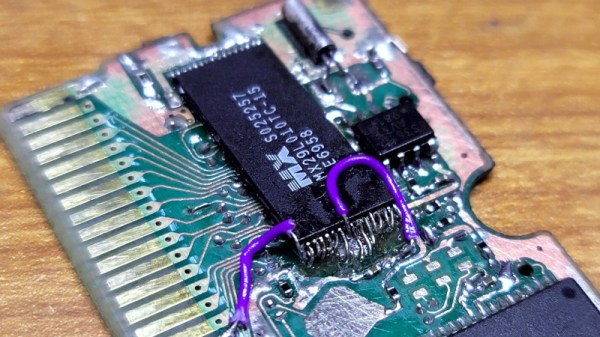
We all know the havoc that water in the wrong place can do to a piece of electronics, and thus we’ve probably all had devices damaged beyond repair. Should [Solderking] have thrown away the water-damaged PCB from a Nintendo Pokemon Ruby cartridge? Of course he should, but when faced with a board on which all vias had succumbed to corrosion he took the less obvious path and repaired them.

Aside from some very fine soldering in the video below the break there’s little unexpected. He removes the parts and tries a spot of reworking, but the reassembled board doesn’t boot. So he removes them again and this time sands it back to copper. There follows a repair of every single vial on the board, sticking fine wires through the holes into a sponge and soldering the top, before turning it over and fixing the forest of wires on the other side. Fixing the ROM results in a rather challenging fitment involving the chip being mounted at an angle and extra wires going to its pads, which demonstrates the value in this story. It’s not one of monetary value but of persevering with some epic rework to achieve a PCB which eventually boots. Of course a replacement board would make more sense. But that’s not the point, is it?

Continue reading “Fix Every Broken Via To Return This Game To Life”

A 3D Printed 35mm Movie Camera

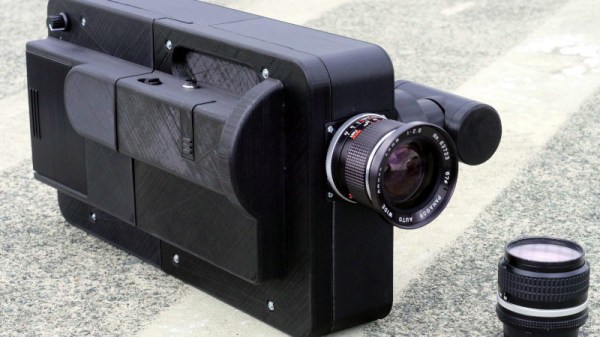
Making a camera can be as easy as taking a cardboard box with a bit of film and a pin hole, but making a more accomplished camera requires some more work. A movie camera has all the engineering challenges as a regular camera with the added complication of a continuous film transport mechanism and shutter. Too much work? Not if you are [Yuta Ikeya], whose 3D printed movie camera uses commonly-available 35 mm film stock rather than the 8 mm or 16 mm film you might expect.

3D printing might not seem to lend itself to the complex mechanism of a movie camera, however with the tech of the 2020s in hand he’s eschewed a complex mechanism in favour of an Arduino and a pair of motors. The camera is hardly petite, but is still within the size to comfortably carry on a shoulder. The film must be loaded into a pair of cassettes, which are pleasingly designed to be reversible, with either able to function as both take-up and dispensing spool.

The resulting images have an extreme wide-screen format and a pleasing artistic feel. Looking at them we’re guessing there may be a light leak or two, but it’s fair to say that they enhance the quality rather than detract from it. Those of us who dabble in movie cameras can be forgiven for feeling rather envious.

We’ve reached out to him asking whether the files might one day be made available, meanwhile you can see it in action in the video below the break.

Continue reading “A 3D Printed 35mm Movie Camera”

A Simple Linear Power Supply, Done Well

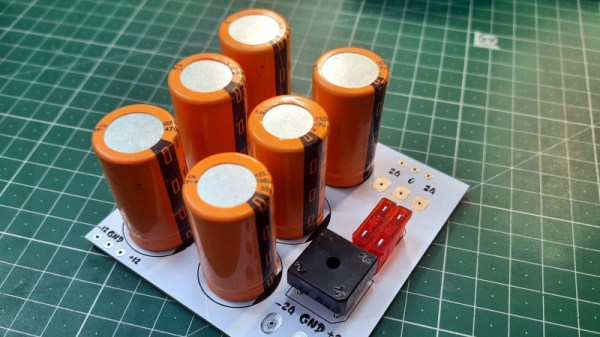
When reaching for a power supply design it’s normal here in 2022 to reach for a switching design. They’re lightweight, very efficient, and often available off-the-shelf at reasonable prices. Their benefits are such that it’s become surprisingly rare to see a traditional linear power supply with a mains-frequency transformer and rectifier circuit, so [ElectroBoy]’s dual voltage PSU board for audio amplifiers is worth a second look.

This type of linear power supply has an extremely simple circuit consisting of a transformer, bridge rectifier, and capacitors. The transformer isolates and steps down the AC voltage, the rectifier turns it into a rough DC, and the capacitors filter the DC to remove as much AC ripple as possible. In an audio power supply the capacitors have the dual role of filtering and providing an impulse reservoir for the supply in the event of a peak in demand imposed by the music being played. Careful selection is vital, with in this case a toroidal mains transformer and good quality capacitors being chosen.

The choice between a linear power supply such as this one and a switching design for high quality audio is by no means clear-cut, and may be something we’ll consider in our Know Audio series. The desirable properties are low noise and that impulse reservoir we mentioned, and it’s probably fair to say that while both types of power supply can satisfy them. With the extra expense of a toroidal transformer a linear supply is unlikely to be the cheaper of the two, but we suspect the balance tips in its favour due to a good linear supply being the easier to design.

How Did Dolby Digital Sound Work On Film?

When we go to the cinema and see a film in 2022, it’s very unlikely that what we’re seeing will in fact be a film. Instead of large reels of transparent film fed through a projector, we’ll be watching the output of a high-quality digital projector. The advantages for the cinema industry in terms of easier distribution and consistent quality are obvious. There was a period in the 1990s though when theatres still had film projectors, but digital technology was starting to edge in for the sound. [Nava Whiteford] has found some 35mm trailer film from the 1990s, and analysed the Dolby Digital sound information from it.

The film is an interesting exercise in backward compatibility, with every part of it outside the picture used to encode information. There is the analogue sound track and two digital formats, but what we’re interested in are the Dolby Digital packets. These are encoded as patterns superficially similar to a QR code in the space between the sprocket holes.

Looking at the patent he found that they were using Reed-Solomon error correction, making it relatively easy to decode. The patent makes for fascinating reading, as it details how the data was read using early-1990s technology with each line being scanned by a linear CCD, before detailing the signal processing steps followed to retrieve the audio data. If you remember your first experience of Dolby cinema sound three decades ago, now you know how the system worked.

The film featured also had an analogue soundtrack, and if you’d like to know how they worked, we’ve got you covered!

Monitor Space Weather And The Atmosphere With Your Cellphone!

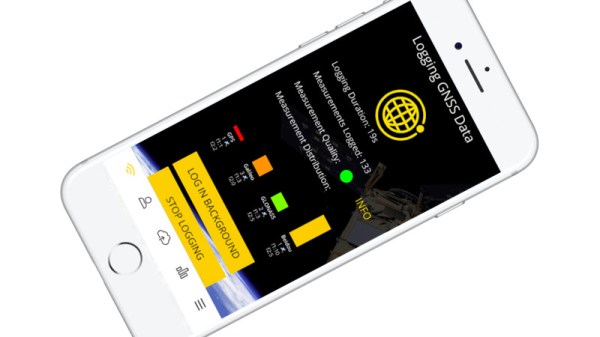
Above our heads, the atmosphere is a complex and unpredictable soup of gasses and charged particles subject to the influence of whatever the Sun throws at it. Attempting to understand it is not for the faint-hearted, so it has for centuries been the object of considerable research. A new project from the European Space Agency and ETH Zurich gives the general public the chance to participate in that research in a small way, by crowdsourcing atmospheric data gathering to a mobile phone app. How might a mobile phone observe the atmosphere? The answer lies in their global positioning receivers, which can track minute differences in the received signals caused by atmospheric conditions. By gathering as much of this data as possible, the ESA scientists will gain valuable insights into atmospheric conditions as they change across the globe.

The app requires an Android phone equipped with a dual frequency satnav receiver, and having been duly installed on the trusty Hackaday Motorola it in turn started picking up all the different constellations of satellites. The instructions are to leave it somewhere such as a windowsill with an unobstructed view of the sky and move it as little as possible, to which we’d add clicking the “Log in background” button and connectign a charger. There’s a promise that uploaders can win prizes, so aside from contributing to scientific discovery there might be an unexpected benefit. More details on the app can be found here, meanwhile many readers will know that this isn’t the only crowdsourced atmospheric data gathering effort.

Levitate The NE555 Way

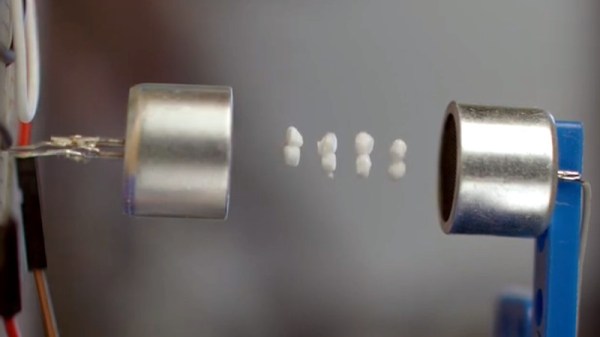
Ultrasonic levitation — the practice of creating a standing wave between two ultrasonic sources and positioning lightweight objects such that they can float in the pressure minimums between them — has been a source of fascination to more than one experimenter. [Peter Lin] demonstrated this in the video below the break, by creating an ultrasonic levitation system using only the trusted chip of all true experimenters, the NE555. (Video, embedded below.)

The circuit is simplicity itself, just an astable of the type that has made a billion beepers and flashing LEDs. It drives two ultrasonic transducers in parallel, and with them pointing towards each other and a bit of gap adjustment work it can successfully levitate pieces of polystyrene. There was some work in adjusting the frequency to the transducer resonance, but that’s not a huge challenge given the right instrumentation. We can see that it would make a great demonstration of standing waves, and also a fantastic desk toy for not a lot.

We celebrate everyone’s favourite timer chip here at Hackaday, so much so that we recently ran a contest to find the best creations using it.

Continue reading “Levitate The NE555 Way”