A Tidy Cyberdeck That You Could Take Anywhere.

The cyberdeck trend has evolved to a relatively straightforward formula: take a desktop computer and strip it to its barest essentials of screen, PCB, and input device, before clothing it in a suitably post-apocalyptic or industrial exterior. Sometimes these can result in a stylish prop straight from a movie set, and happily for [Patrick De Angelis] his Raspberry Pi based cyberdeck (Italian, Google Translate link) fits this description, taking the well-worn path of putting a Raspberry Pi and screen into a ruggedised flight case. Its very unremarkability is the key to its success, using a carefully-selected wired keyboard and trackpad combo neatly dodges the usual slightly messy arrangements of microcontroller boards.

If this cyberdeck has a special feature it’s in the extra wireless interfaces and the stack of antennas on its right-hand side. The Pi touchscreen is a little small for the case and perhaps we’d have mounted it centrally, but otherwise this is a box we could imagine opening somewhere in the abandoned ruins of a once-proud Radio Shack store for a little post-apocalyptic Hackaday editing. After all, your favourite online tech news resource doesn’t stop because the power’s gone out!

The No-MCU Fan Controller

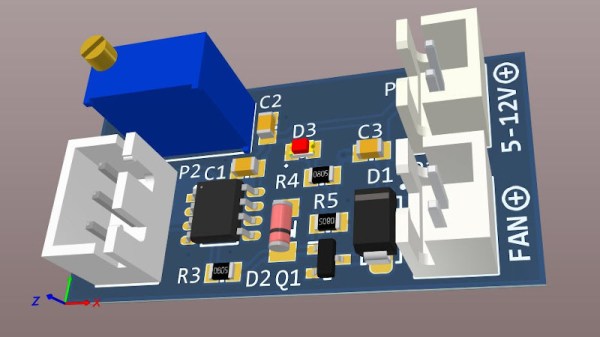
The default for any control project here in 2019 was to reach for a microcontroller. Such are their low cost and ubiquity that they can be used to replicate what might once have needed some extra circuitry, with the minimum of parts. But here we are at the end of 2021, and of course microcontrollers are hard to come by in a semiconductor shortage. [Hesam Moshiri] has a project that takes us back to a simpler time, a temperature controlled fan the way they used to be made, without a microcontroller in sight.

Old hands will no doubt guess where this design is heading, there is an LM35 temperature sensor producing a voltage proportional to its temperature, and half of an LM358 which forms a comparator against a static voltage from a divider. The LM358’s output drives a MOSFET which in turn switches on or off the fan motor. This type of circuit used to be the daily fare of simple control electronics in the days when a microcontroller represented a significant expense, and it’s still a handy circuit to be reminded of.

Have you forgotten sensors such as the LM35 in a world of on-board sensors? Time to refresh your sensing memory.

When A Ball Robot Becomes Two Wheels

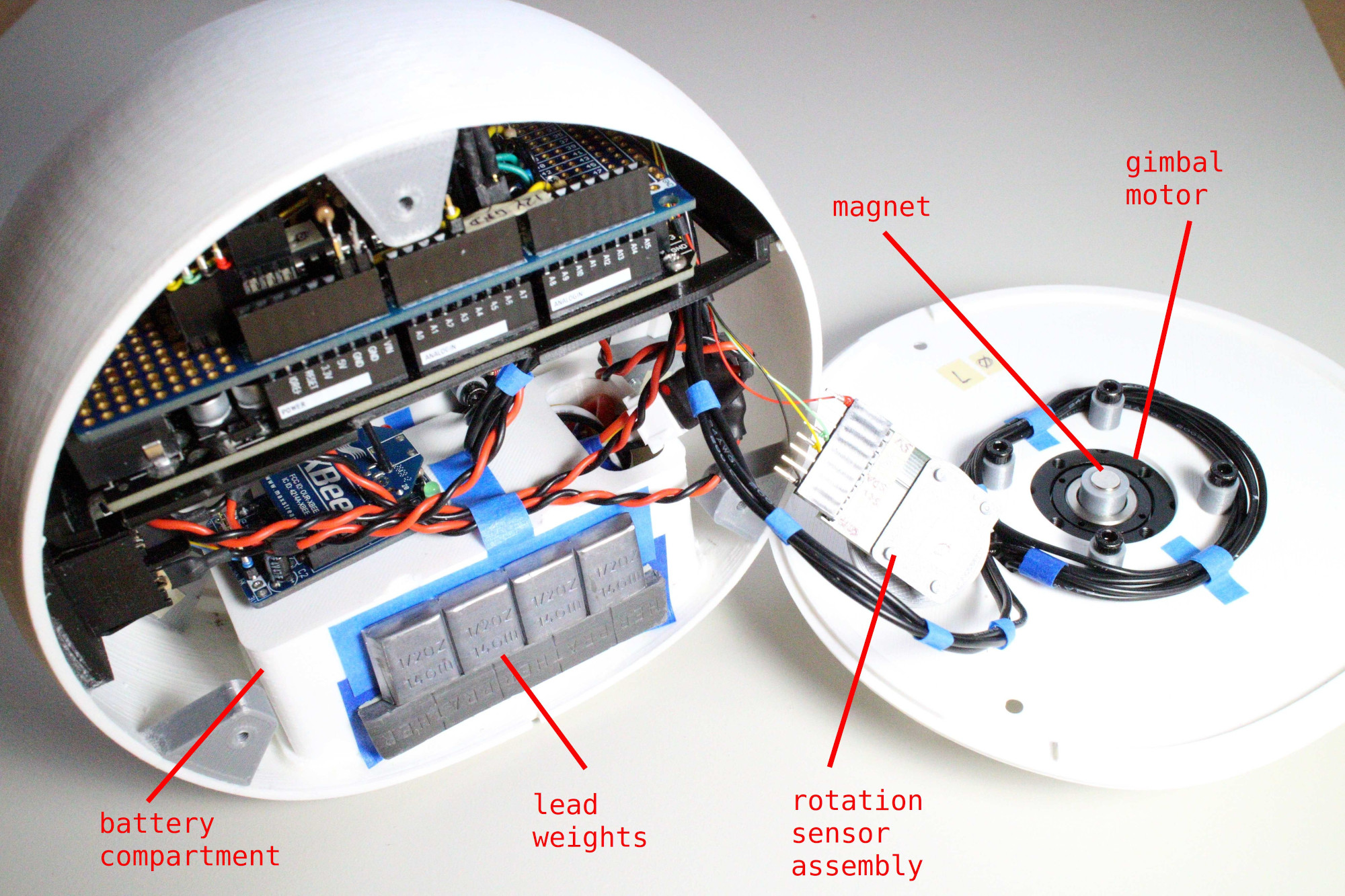
It’s now about six years since Star Wars: The Force Awakens first showed us the little spherical robot BB-8, but it’s fair to say that along the way we’ve not lost our collective fascination for rolling-ball robots. There have been plenty of attempts to make a fully-rolling device, but perhaps [Derek Lieber] has a better take on it by turning a spherical robot into a two-wheeled roller by the addition of a pair of tyres. Inspired by a Samsung prototype that never made it to market, it works by the wheels working against the machine’s low centre of gravity, and using a tilt sensor to control speed.

The ball chassis is a 3D printed shell, into which after much experimentation with motors, the final version put a pair of gimbal motors with a set of magnetic position sensors. Inside is an Arduino Mega and a custom motor driver board sporting an LM6234, with an XBee radio for remote control.  Meanwhile the power comes from a set of three LiPo cells, and there is some extra lead ballast in the bottom to keep the whole thing balanced.

We’ve seen more conventional takes on a spherical robot in the past, but we’re particularly keen on this one, and excited to see where the future takes it.

Continue reading “When A Ball Robot Becomes Two Wheels”

The Three Cent Motor Controller

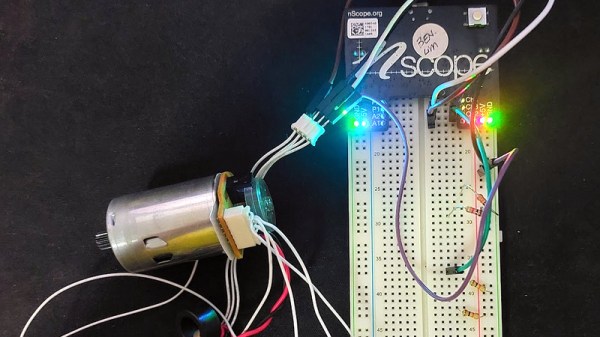
If you follow the world of small microcontrollers you will certainly be familiar with the usual fare of Atmel, ARM Cortex, PIC, and others. But these aren’t the smallest or cheapest devices, below them is an entire category of grain-of-dust microcontrollers with minimal capabilities and at rock bottom prices. Maybe the most well known are the Padauk series of chips, whose PIC12-like architecture can be had for literal pennies. These are the famous 3 cent microcontrollers, but despite their fame they have a bit of a reputation in our community for being difficult to work with. [Ben Lim] dispels some of those ideas, by Padauk-enabling a motor and encoder from a printer to make a three cent motor controller.

The Padauk doesn’t have on-chip peripherals such as SPI, instead its IDE provides bit-banging code to do the job. This and some PID motor controller code makes for a straightforward task on the little chip, and with the help of a probably considerably more expensive MAX14870 it can drive the motor. For the curious, the code can be found in a Git Hub repository. There may be more accomplished motor controllers to be found, but we doubt you’ll find one with a cheaper microcontroller.

Want to know what the fuss is about with the Padauk? Our colleague [Maya Posch] has you covered.

First Hacks: The Brand New Nokia 5G Gateway Router

Aside from being the focus of a series of bizarre conspiracy theories, 5G cellular networks offer the promise of ultra-fast Internet access anywhere within their range. To that end there are a new breed of devices designed to provide home broadband using 5G as a backhaul. It’s one of these, a Nokia Fastmile, that [Eddie Zhang] received, and he’s found it to be an interesting teardown and investigation. Spoiler: it runs Android and has exploitable bugs.

A privilege escalation bug in the web administration tool led to gaining the ability to export and modify configuration files, but sadly though a telnet prompt can be opened it’s not much use without the password. Uncovering some blocked-off ports on the base of the unit revealed a USB-C port, which was found to connect to an Android device. Via ADB a shell could be opened on Android, but on further  investigation it was found that the Fastmile is not a single device but two separate ones. Inside is a PCB with an Android 5G phone to handle the connection, and another with a completely separate home router.

With access to the Android side and a login prompt on the router side that was as far as he was prepared to go without risking bricking his Fastmile. It only remained to do a teardown, which reveals the separate PCBs with their own heatsinks, and an impressive antenna array. Perhaps these devices will in time become as ubiquitous as old routers, and we’ll see them fully laid bare.

It’s a shame that we’ve had to write more about the conspiracy theories surrounding 5G than real 5G devices, but maybe we’ll see more teardowns like this one to make up for it.

Belgian Railway Time For Your Home

Some of the 20th century’s most iconic design and typography came to us through public signage in the various national railways of Europe. Were you to think of a Modernist clock face for example, the chances are that the prototype for your image hangs somewhere in one of the continent’s great railway terminals. If you don’t fancy getting on a train to see your favourite public timepiece, then maybe [EBP Controller] has a treat for you, with a 3D-printed double-faced Belgian railway station clock.

Behind the scenes the mechanism is simpler than appearances might lead the observer to believe, with each set of hands driven through a single gear to a motor. Controlling it all is an ESP8266, which is able to synchronise the clock exactly to an NTP server. It appears at first sight to have an unnecessarily large quantity of motors, but considering that there are two faces each with three hands the six motors each have a use. So while the real thing might require a heist from the SNCB, at least modernist clock fans can now have their own.

Mini Linear Actuators From DVD Drive Parts

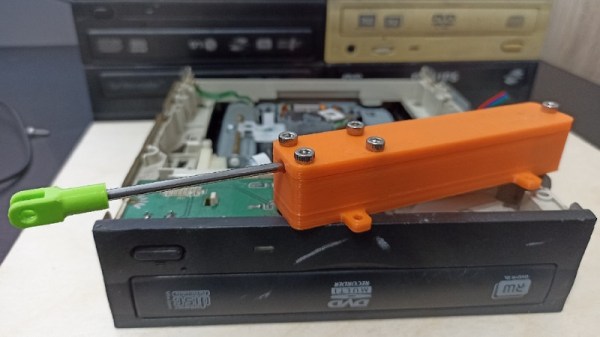
For many years now a source for some of the smallest and cheapest home made CNC mechanisms has been the seemingly never-ending supply of surplus CD and DVD-ROM drives. The linear actuator that moves the laser may not be the longest or the strongest, but it’s free, and we’ve seen plenty of little X-Y tables using CD drives. It’s these mechanisms that [Nemo404] has taken a little further, freeing the lead screw and motor from the drive chassis and placing them in a 3D-printed enclosure for a complete linear actuator that can be used in other projects. (Video, embedded below.)

There seems to be no positional feedback, not even the limit switch that would grace a typical CD drive, but aside from that it makes for a compact unit. There are two versions, one for a linear bearing and the other for the brass bushes found in CD drives. It’s unclear how strong the result is, but it appears to be strong enough to demonstrate lifting a small container of screws.

Should you need to make your own actuator then aside from the easy-to-obtain old CD drive the files can be found on Thingiverse. And introduce yourself to the world of CD drives for CNC machines by taking a look at this mill.

Thanks [BaldPower] for the tip!

Continue reading “Mini Linear Actuators From DVD Drive Parts”