Nintendo Switch Built Completely From Replacement Parts

It seems that everybody around us is playing Animal Crossing New Horizons, and we’re not alone in this. But a new Nintendo Switch can’t be had for love nor money, and second hand ones have fallen victim to price gouging. It seems if you’re not playing the game, you’re out of luck, or are you?

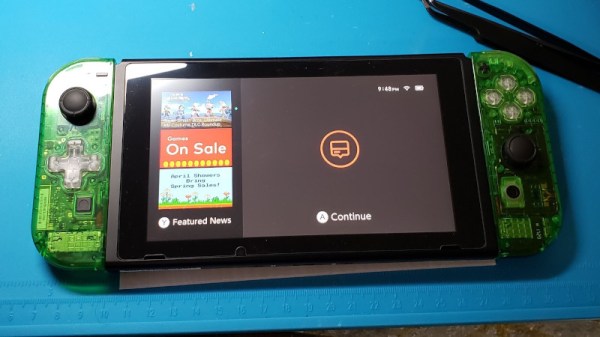
What’s to be done? [Sarbaaz37] found the hardware hacker’s solution to that question: Build a Nintendo Switch entirely from spare parts, of course! It took a month to source the parts and it’s not a project for the fainthearted, but it provides us with a look at all the parts they pack into the handheld. All told, there’s about 22 part numbers in the bill of materials.
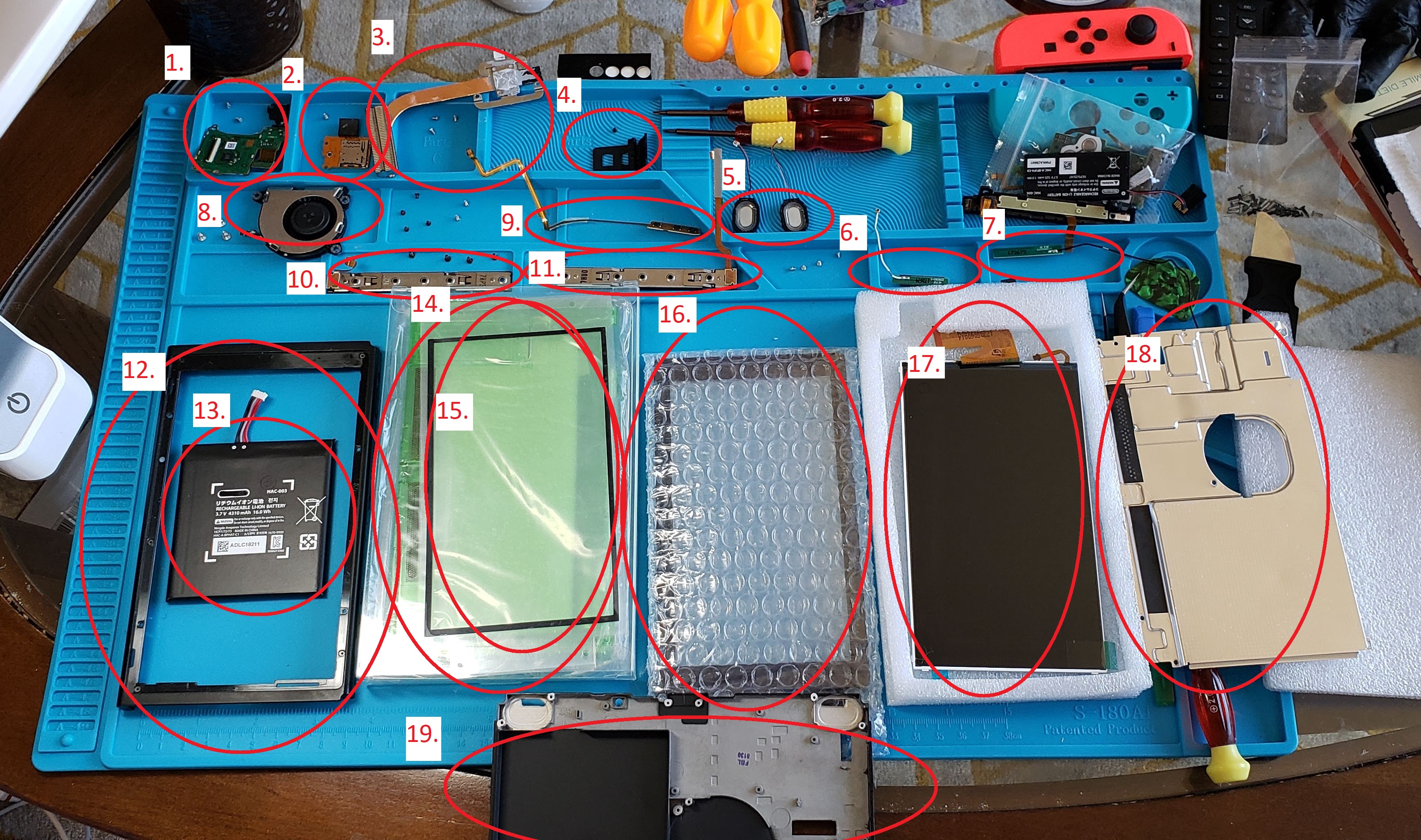
Anyone who has peeked inside a laptop recently will be familiar with the arrangement of this type of device. An array of extremely snug-fitting and fragile electronics laid out like a TV dinner has to be carefully assembled in a specific order and this is no different. Along the way [Sarbaaz37] has some pro tips, like cleaning off the stock thermal compound and using a higher quality. The eventual result is a working Switch, which for $200 is not a bad deal, though they do note that the pandemic has since led to a price rise in Nintendo parts as well as consoles.

This is, we think, the first home-made Switch we’ve seen, but it’s not the first desirable piece of consumer electronics made from grey market parts we’ve seen. Who could forget the Shenzhen electronics markets adventure of sourcing all the parts that go into an iPhone?

Thanks [Roel] for the tip.
A Tidy Little OBD Display For Your Car

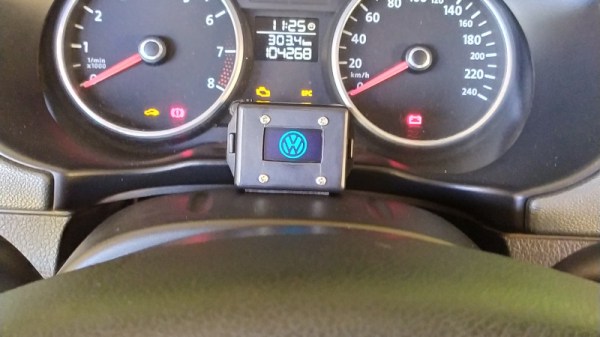
It’s likely that many readers will have an OBD dongle through which they can peer into the inner workings of their car, but the chances are that most of us will have restricted our curiosity to the Bluetooth or USB interface it was supplied with. Not [Frederico Souza Sant’ana] though, because he’s modified his OBD dongle to expose the serial lines between its ELM327 OBD chip and its Bluetooth chip. These go to an Arduino, which powers a small information display to supplement the car’s dashboard. This can display a range of readings as can be seen in the video below the break, he has it monitoring the battery, the various temperatures in the engine bay, and the ignition parameters.

All the software and hardware details can be found in a GitHub repository. In hardware terms it’s a surprisingly simple unit, but it serves to remind us that OBD sniffer dongles are more versatile than we might at first imagine, and good for a bit more than hooking up our smartphones via Bluetooth. If OBD is something you’d like to visit in more depth, in the past we’ve featured an open-source OBD interface, and a retrospective look at the protocol.

Continue reading “A Tidy Little OBD Display For Your Car”

Yeast Is A Hot Commodity; Brewing And Breadmaking During Lockdown

In the recent frenzy of stocking up with provisions as the populace prepare for their COVID-19 lockdown, there have been some widely-publicised examples of products that have become scarce commodities. Toilet paper, pasta, rice, tinned vegetables, and long-life milk are the ones that come to mind, but there’s another one that’s a little unexpected.

As everyone dusts off the breadmaker that’s lain unused for years since that time a loaf came out like a housebrick, or contemplates three months without beer and rediscovers their inner home brewer, it seems yeast can’t be had for love nor money. No matter, because the world is full of yeasts and thus social media is full of guides for capturing your own from dried fruit, or from the natural environment. A few days tending a pot of flour and water, taking away bacterial cultures and nurturing the one you want, and you can defy the shortage and have as much yeast as you need.

Continue reading “Yeast Is A Hot Commodity; Brewing And Breadmaking During Lockdown”

The Key To This City Opens A Real Lock

There are few more satisfying moments than the first time you pick a lock. No matter that it’s a dollar-store padlock that you opened with a pick from a $10 eBay kit, the magic of something that should be secure clicking open in the palm of your hand is hard to beat. Pin tumbler locks are surprisingly simple devices, and to demonstrate this [Farmcraft 101] has produced one at 10x scale to demonstrate their operation on the bench.

The video is a delightful exercise in wood-shop voyerism, as we see him construct the various parts of the lock using his lathe and other workshop tools. A key of the size usually reserved for Freedom Of The City is made, but this one really does slide into the keyway and operate those pins. At the back is a latch mechanism, and the result is a fully-functional model that anyone should be able to use to figure out how the lock works.

Thelock itself isn’t the whole story though, because given the date he’s used it as the basis for a cracking April Fool in which he sends up the [Lock Picking Lawyer] and proceeds to demonstrate the glaring insecurities in his creation. Both videos are there for your enjoyment, below the break. And if you can’t wait to have a go at a lock or two, don’t forget you can always make your own tools using paperclips.

[Ed note: streetcleaner bristles. Thank me later.]

Continue reading “The Key To This City Opens A Real Lock”

Iceland Is Doing Its COVID-19 Proximity Tracing The Open Source Way

As governments around the world grapple with the problem of tracing those who have had contact with a person known to have been infected with the COVID-19 virus, attention has turned to the idea of mobile apps that can divulge who a person has been near so that they can be alerted of potential infections. This has a huge potential for abuse by regimes with little care for personal privacy, and has been a significant concern for those working in that field. An interesting compromise has been struck by Iceland, who have produced an app for their populace that stores the information on the device and only uploads it with the user’s consent once they have received a diagnosis. We can all take a look, because to ensure transparency they have released it as open source.

On signing up for the scheme a central server stores the details of each user as well as their phone number. When the epidemiologists have a need to trace a person’s contacts they send a notification, and the person can consent to their upload. This is a fine effort to retain user privacy, with depending on your viewpoint the flaw or the advantage being that the user can not have their data slurped without their knowledge. Iceland is a country with a relatively small population, so we can imagine that with enough consent there could be effective tracing.

We installed the Android version on the Hackaday phone to have a look, but unfortunately it seems to need to be in Iceland to be of use enough to explore. We would be interested to hear from our Icelandic readers, to hear their views. Meanwhile readers can juxtapose the Icelandic app with another proposal for a more anonymised version.

Decentralized Privacy-Preserving Proximity Tracing

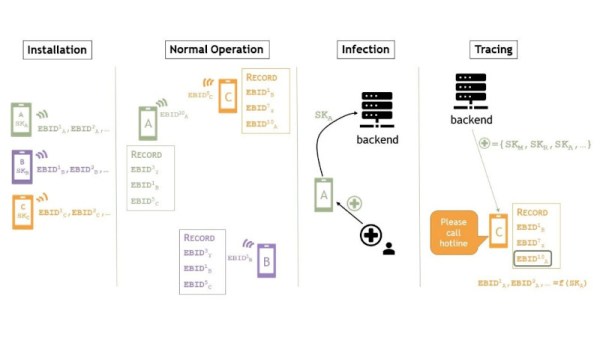
As we continue through the pandemic, whether we are on lockdown or still at work, there is a chance for all of us that we could still pick up the virus from a stray contact. Mapping these infections and tracing those in proximity to patients can present a major problem to infection control authorities, and there have been a variety of proposals for smartphone apps designed to track users’ contacts via the Bluetooth identities their phones encounter. This is a particular concern to privacy advocates, because there is a chance that some governments could use this as an excuse to bring in intrusive personal surveillance by this means. A group of academics from institutions across Europe have come together with a proposal for a decentralised proximity tracing system that allows identification of infection risk without compromising the privacy of those using it.

Where a privacy-intrusive system might use a back-end database tracking all users and recording their locations and interactions, this one uses anonymised tokens stored at the local level rather than at the central server. When a user is infected this is entered at app level rather than at server level, and the centralised part of the system merely distributes the anonymised tokens to the clients. The computation of whether contact has been made with an infected person is thus made on the client, meaning that the operator has no opportunity to collect surveillance data. After the pandemic has passed the system will evaporate as people stop using it, rather than remaining in place harvesting details from installed apps. They are certainly not the first academics to wrestle with this thorny issue, but they seem to have ventured further into the mechanics of it all.

As with all new systems, it’s probably good to subject it to significant scrutiny before deploying it live. Have a read. What do you think?

We are all watching our authorities as they race to respond to the pandemic in an effective manner, and we hope that should they opt for an app that it does an effective job and they resist the temptation to make it too intrusive. Our best course of action meanwhile as the general public is to fully observe all advised public health measures such as self-isolation or the wearing of appropriate personal protective equipment.

Adding RGB To A CRT

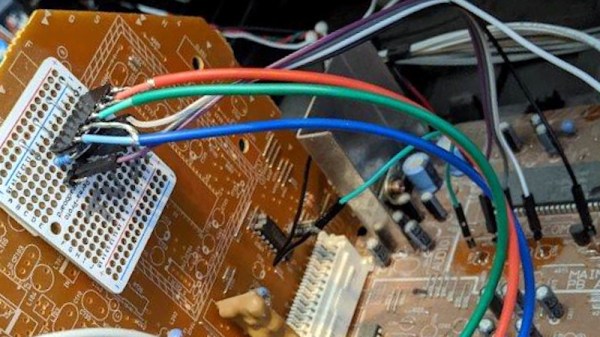
There was a time when all TVs came with only an antenna socket on their backs, and bringing any form of video input to them meant dicing with live-chassis power supplies. Then sets with switch-mode supplies made delving into a CRT TV much safer, and we could bodge in composite video and even RGB sockets by tapping into their circuitry. For Europeans the arrival of the SCART socket gave us ready-made connectivity, but in the rest of the world there was still a need to break out the soldering iron for an RGB input. [Jacques Gagnon] is in Canada, and has treated us to a bit of old-school TV input hacking as he put an RGB socket on his JVC CRT set.

Earlier hacks had inventive incursions into discrete analogue circuitry, but on later sets such as this one the trick was to take advantage of the on-screen-display features. The signal processing chip would usually have an RGB input with a blanking input to turn of the picture during the OSD chip’s output. These could be readily hijacked to provide an RGB input, and this is the course taken here. We see a VGA socket on the rear panel going to a resistor network on a piece of protoboard stuck in a vacant space on the PCB, from which a set of lines then go to the signal processing chip. The result is a CRT gaming monitor for retro consoles, of the highest quality.

For those of us who cut our teeth on CRT TVs it’s always good to see a bit of TV hacking. It’s a mod we’ve seen before, too.