What Everyone Else Did With Eight Bits, The Germans Did With Only One

In the 1980s there was an impetus for the first time for young people to be equipped with computer literacy. A variety of different educational programmes were launched, typically involving a collaboration between a computer manufacturer and a broadcaster, and featuring BASIC programming on one of the 8-bit home computers of the day. One such educational scheme was a bit different though, the German broadcaster WDR produced an educational series using a modular computer featuring an unusual 1-bit processor that was programmed in hexadecimal machine code. [Jens Christian Restemeier] has produced a replica of this machine, that is as close to the original as he can make it. (Video, in German, embedded below.)

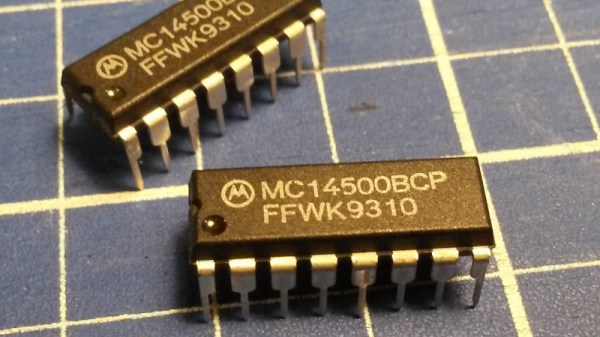
The computer is called the WDR-1, and had its origin in a kit machine before it was taken up by the broadcaster. The unusual 1-bit processor is a Motorola MC14500, which was produced from 1977 onwards for industrial control applications. He takes the viewer in the video below the break through the machine’s parts, explaining the purpose of each daughter card and the motherboard. Lacking an original to copy he instead worked from photographs to replicate the chip placements of the original, substituting pin headers for the unusual sockets used on the 1980s machines. Take a look at his video, below the break.

More information on the WDR-1 can be found online in German (Google translate link). Meanwhile we’ve featured the MC14500 before, in a small embedded computer.

Continue reading “What Everyone Else Did With Eight Bits, The Germans Did With Only One”
A Nano With An Otter’s Bite

The would-be microcontroller experimenter is now faced with a bewildering array of choices when it comes to a tiny development board for their projects. Everything from descendants and clones of the original Arduino through to full-fat Linux powerhouses such as the Raspberry Pi Zero and similar boards can be had, and often for a reasonable price.

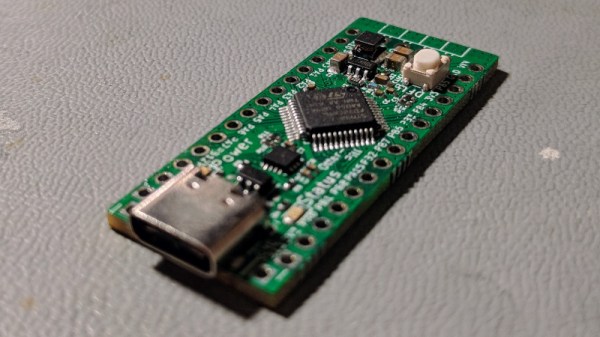
A new entrant has now joined the fray, the OtterPill is an STM32F072-based board with an Arduino-Nano-like pinout, and it comes from the bench of [Jana Marie]. With so many competitors you might ask yourself what it can offer, and it would be a valid point given that a Nano clone can be had for relative pennies. Aside from the Nano shield compatibility and extra power of the ARM Cortex M0 then, it’s an open source development board with USB-PD included from its USB-C socket, and with some elite BoM wizardry she’s managed to get the cost of its components to below three dollars. A USB-PD example firmware is available and a blank firmware is on its way. For now the board exists only in prototype form, but she’s putting together a production run if you would like one too. We saw an early development of it at eth0 back in the autumn, and given the progress since then we’re sure that we won’t have to wait for long.

Regular readers will recognise [Jana Marie]’s work, because otter-themed boards have made their way to these pages before. Our most recent ones were the USB-C replacement board bringing USB-PD to the TS-100 soldering iron, and  a nifty little USB board for addressable LEDs.

This Crossbow Fires Cannonballs!

The would-be invader of a mediaeval kingdom could expect to face some stern opposition from a variety of formidable weaponry. Making modern versions of these deadly curiosities seems to be a popular pursuit, and the bug has bitten [Turbo Conquering Mega Eagle], who’s created what he calls a “Stonebow”, a crossbow on steroids that fires stones or large ball bearings with considerable force.

It uses a couple of leaves from automotive springs, mounted in a welded steel riser with two strings and a pouch for the projectile. The barrel is an oak fencing post, and at its other end is a cocking lever which also forms a stock, and a cleverly designed trigger mechanism. The projectile is loaded, the bow is cocked, and it is fired at a scrap Land Rover radiator in which it places a satisfying impact mark.

Despite two successful firings it’s evident that so much force isn’t easy to contain. The crimps that secure the strings aren’t up to the job, and neither is the oak fence post, which has cracked at the end. We trust that our Essex hacker friend will return having fixed these flaws, and more defenceless scrap car parts will be sacrificed for our entertainment.

We’ve featured [Turbo Conquering Mega Eagle] before, most recently building a mini-bike for his youngsters. Meanwhile, enjoy the Stonebow in the video below the break.

Continue reading “This Crossbow Fires Cannonballs!”

This Is It For The Particle Mesh Network

The long-held dream of wireless network hackers everywhere is to dispense with centralised network infrastructure, and instead rely on a distributed network in which the clients perform the role of distribution and routing of traffic. These so-called mesh networks promise scalability and simplicity on paper, but are in practice never as easy to implement as the theory might suggest. Much venture capital has been burned over the years by startups chasing that particular dream, yet most of our wireless connectivity still follows a hub topology.

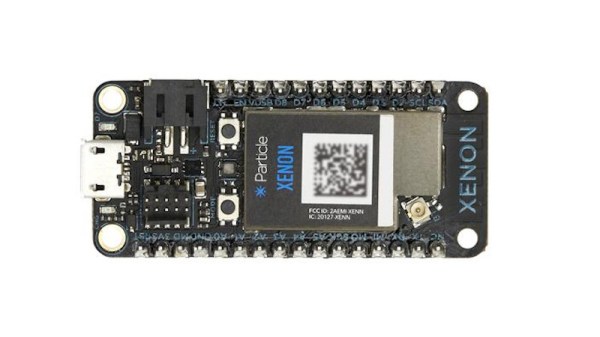
An exciting development in our sphere concerning mesh networking came in early 2018, when Particle, the purveyors of wireless-equipped dev boards, launched their third generation of products. These offered mesh networking alongside their other features, but this week they have announced that they’ll no longer be developing that particular side of their offering. The Wi-Fi-equipped Argon and Cellular-equipped Boron will remain on sale, but they will henceforth discontinue the mesh-only Xenon. Existing owners of the now orphaned board will be compensated with store credit.

Their rationale for discontinuing mesh networking is interesting, and reflects on the sentiment in our first paragraph. Mesh networking is hard, and in particular their attempt to make it work with zero configuration was simply not successful. But then they talk about the realisation that maybe mesh networking was not the right solution for the IoT applications the boards were being used in, and perhaps another technology such as LoRa would be more appropriate.

So the mesh experiment from Particle is over, but the company and its connected dev boards are very much still with us. We salute them for being bold enough to try it, and we wonder when we’ll next find a piece of similar mesh networking hardware.

Retrotechtacular: Teasmade

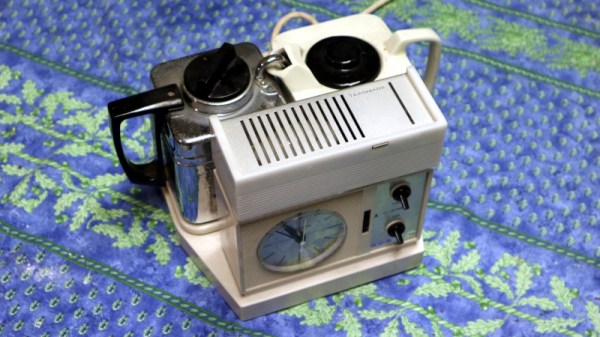
We’re used to our domestic appliances being completely automated in 2020, but not so long ago they were much simpler affairs. Not everything required a human to run it though, an unexpected piece of electromechanical automation could be found in British bedrooms. This is the story of the Goblin Teasmade, an alarm clock with a little bit extra.

Continue reading “Retrotechtacular: Teasmade”

New Part Day: SK6812 Mini-E. A Hand Solderable Neopixel Compatible LED!

Normally when we give you a New Part Day piece, it concerns a component that you will have never seen before. The subject of this find by [Robert Fitzsimons] then is a slight departure from that norm, given that the SK6812 Mini-E is a WS2812 or Neopixel compatible multi-colour LED of a type that has been available for a while now.

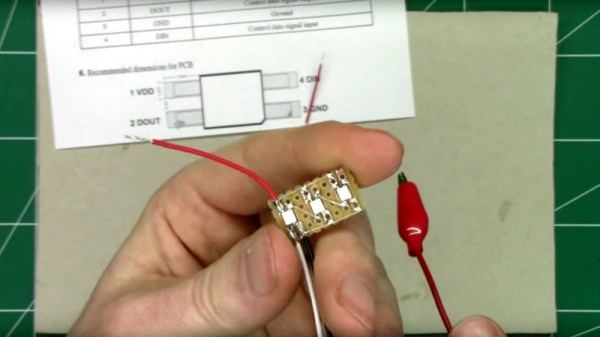
What makes this component new though is its packaging. The Mini-E variant of the SK6812 only appeared last year and has now found its way through to smaller order quantities on AliExpress. Its special feature is that it has a set of flat leads rather than the usual pads on the underside of the package. This means that unlike its predecessors it is readily hand solderable, as he demonstrates by attaching a set of leads to one.

The leads emerge halfway up the side of the device, which seems designed to be mounted recessed within a PCB hole. He demonstrates this with a piece of stripboard, and remarks that they would make a good choice for many small projects such as Shitty Add-On boards.

We’ve touched the leadless SK6812s a few times before, along the way remarking that in some respects they are better than the WS2812 they follow.

Continue reading “New Part Day: SK6812 Mini-E. A Hand Solderable Neopixel Compatible LED!”

Review: SanErYiGo SH72 Soldering Iron

When the Miniware TS100 first emerged from China nearly three years ago, it redefined what we could expect from a soldering iron at an affordable price. The lightweight DC-powered temperature controlled iron brought usable power and advanced features in a diminutive package that was easy in the hand, a combination only previously found in much more expensive soldering stations. All this plus its hackability and accessible hardware made it an immediate hit within our community, and many of us have adopted it as our iron of choice.

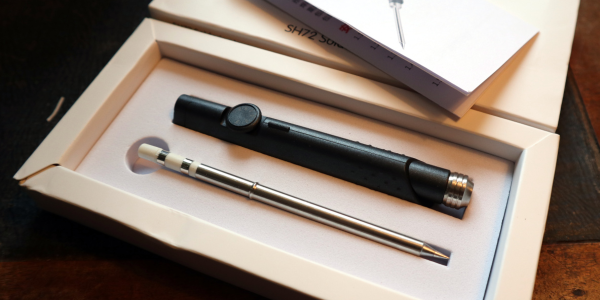
A surprise has been that it has attracted no serious competitors of a similar type, with the only iron mentioned in the same breath as the TS100 being Miniware’s own USB-C powered TS80. Perhaps that is about to change though, as before Christmas I noticed a new Chinese iron with a very similar outline to the TS100. Has the favourite finally generated a knock-off product? I bought one to find out. Continue reading “Review: SanErYiGo SH72 Soldering Iron”