An MSX With A Nintendo Controller

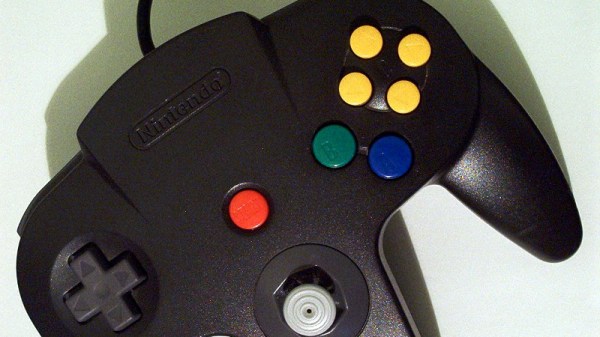
Console owners inhabit their own individual tribes depending upon their manufacturer of choice, and so often never the twain shall meet. But sometimes there are those what-if moments, could Mario have saved the princess more quickly through PlayStation buttons, or how would Sonic the Hedgehog have been with a Nintendo controller? [Danjovic] is finding the answer to one of those questions, with an interface between Nintendo 64 controllers and MSX hardware including the earlier Sega consoles.

In hardware terms, it’s a pretty simple device in the manner of many such projects, an Arduino Nano, a resistor, and a couple of sockets. The clever part lies not in its choice of microcontroller, but in the way it uses the Nano-s timing to ensure the minimum delay between button press and game action. The detail is in the write-up, but in short it makes use of the MSX’s need to attend to video lines to buy extra time for any conversion steps.

The MSX computers have had their share of controller upgrade courtesy of Nintendo hardware in the past, we’ve seen a Wii nunchuck controller talk to them before, as well as a SNES one.

Header image: [mboverload] (Public-domain).
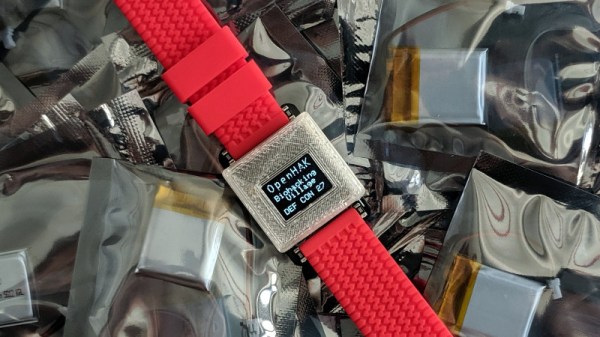
Fitness Trackers Don’t Have To Be Proprietary

Fitness trackers have become a popular piece of consumer electronic equipment, with a range of models from a variety of manufacturers. Many of these commercial offerings, however, leave the consumer with the prospect of their data being drawn off to a cloud server and sold to the highest bidder, trading convenience for a loss of privacy. If only there were a fitness tracker offering complete control!

The OpenHAK is an open-source fitness tracker in a 3D printed wristwatch case that measures your heart rate and counts your steps, offering the resultant data for you to collect via Bluetooth. At its heart is a Sparkfun Simblee module, with heart rate sensing through a Maxim MAX30101 and step counting .by a Bocsh BMI160. It’s designed for expandability from the start with a header bringing out useful interface lines. In the prototype, they’ve used this to support a small OLED display. The result is a fitness tracker watch that may not match some of the well-known proprietary devices, but which remains completely open and probably costs a lot less too.

We’ve seen quite a few fitness tracker apps over the years, including a conversion to an EEG, and custom firmware for some commercial trackers.

In The Fast Moving World Of CNC, This Restored Router Is An Antique

Large machine tools are often built to last a very long time, so it is not uncommon to find a lathe made in the 19th century still providing faithful service. The fundamental job of a lathe has not changed significantly in the intervening years, even though a modern lathe will have more features than its hundred-year-old equivalent.

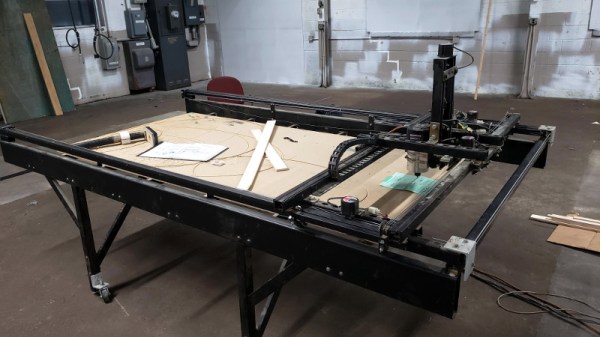
This is not the case for CNC machine tools. When computer numerical control was wedded with old iron machine tools, the control hardware was doomed to quickly become antique or vintage. From the user interfaces to the control circuitry, in the world of electronics new features quickly become obsolete. [Evan] has a ShopBot CNC wood router from the mid 1990s that he describes as an antique, and his tale of its restoration is both a fascinating look at the changes in small-scale CNC control over two decades as well as something of a primer for anyone considering a similar upgrade.

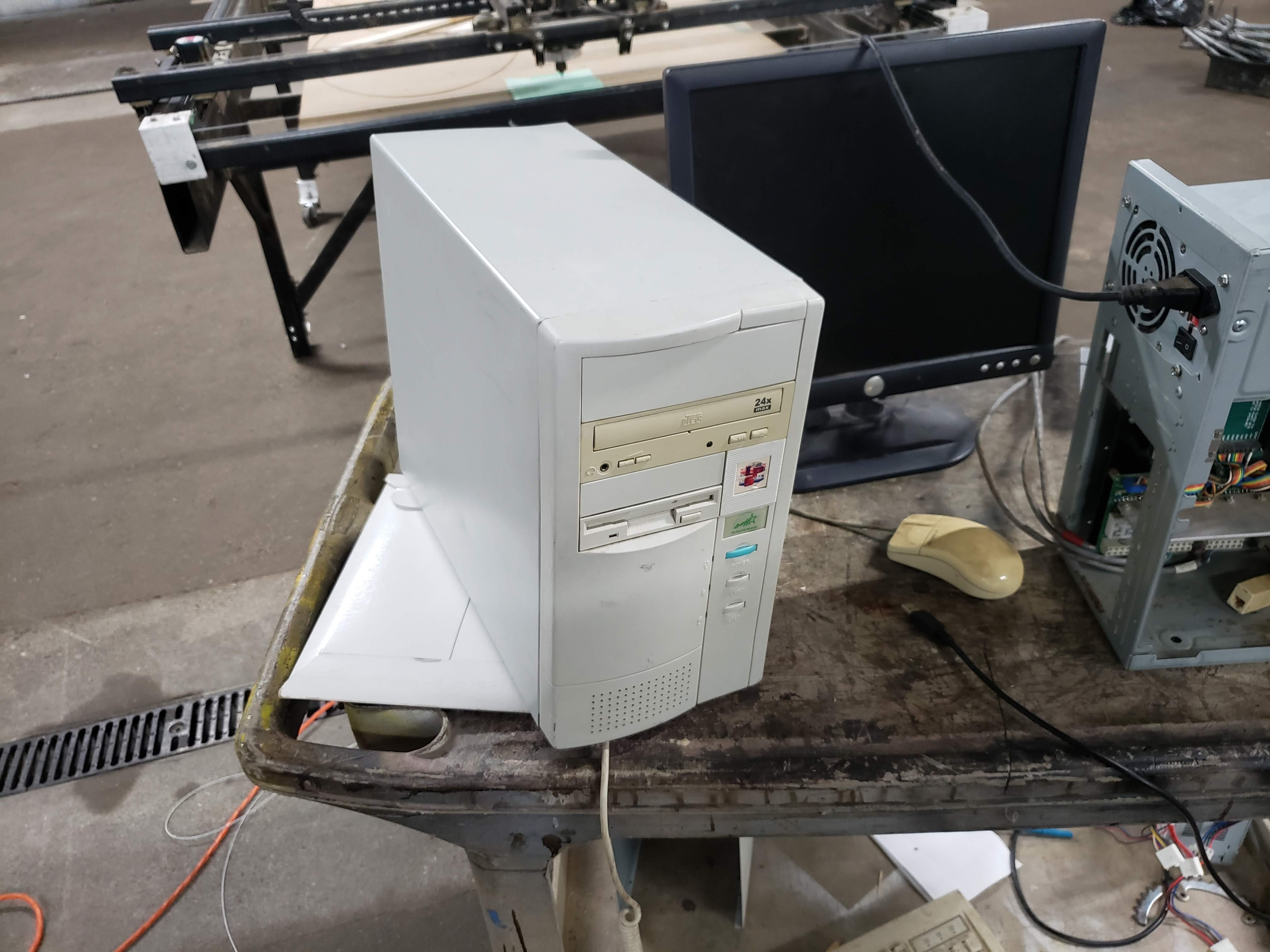
The controller is a pair of beige-box PC cases that scream “I love the 90’s!”. One contains a socket-7 PC running Windows 95, and the other houses the ShopBot controller; an 80c32 dev board with ShopBot firmware, coupled to a set of motor controller boards, which unlike today’s controllers expect raw quadrature inputs. His aim was to replace the vintage hardware with a modern alternative. An Arduino Mega running grbl to talks to the ShopBot controllers by way of a small piece of electronics to condition quadrature data from the step and direction lines it provided. The result may not be as good as a router from 2019, but it did save this aging tool from retirement.

A Keyboard Interface For Your SInclair ZX

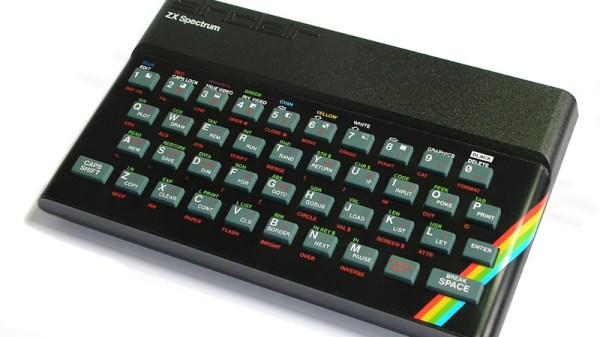
The SInclair ZX 8-bit computers of the early 1980s were masterpieces of economy, getting the most out of minimal hardware. The cassette tape interface was a one-bit port, the video was (on the first two models anyway) created by the processor itself rather than a CRT controller, and the keyboard? No fancy keyboard controllers here, just a key matrix and some diodes between a set of address lines and some data lines. The ZX80 and ZX81 were not very fast as a result of their processors being tied up with all this work, but it ensured that their retail price could break the magic £100 barrier in the British market, something of a feat in 1980.

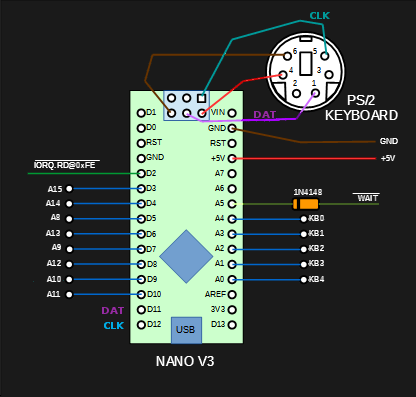
A host of hackers still devote their time to these machines, and among them [Danjovic] has updated that ZX keyboard by producing an interface between that matrix and a PS/2 keyboard. As you might expect it uses a modern microcontroller board, in this case an Arduino Nano but it doesn’t stretch the imagination to think that a USB equipped board might perform the same task. It sits upon the relevant lines, and performs the necessary logical connection between them depending upon the serial input from an attached PS/2 keyboard. The project goes into some detail on PS/2 to ZX mappings, but perhaps of most interest is its explanation of the bus timings involved. The Arduino makes use of the ZX WAIT line to hold the Z80 and ensure that there is enough time for it to perform its task, it would be interesting to note whether or not this has a visible impact on BASIC program timing.

We are more used to seeing ZX keyboards being attached to PCs, rather than this way round.

ZX Spectrum image: Bill Bertram [CC BY-SA 2.5].

3D-Printed Extension For Extreme Macro Photography Includes Lens Electronic Control

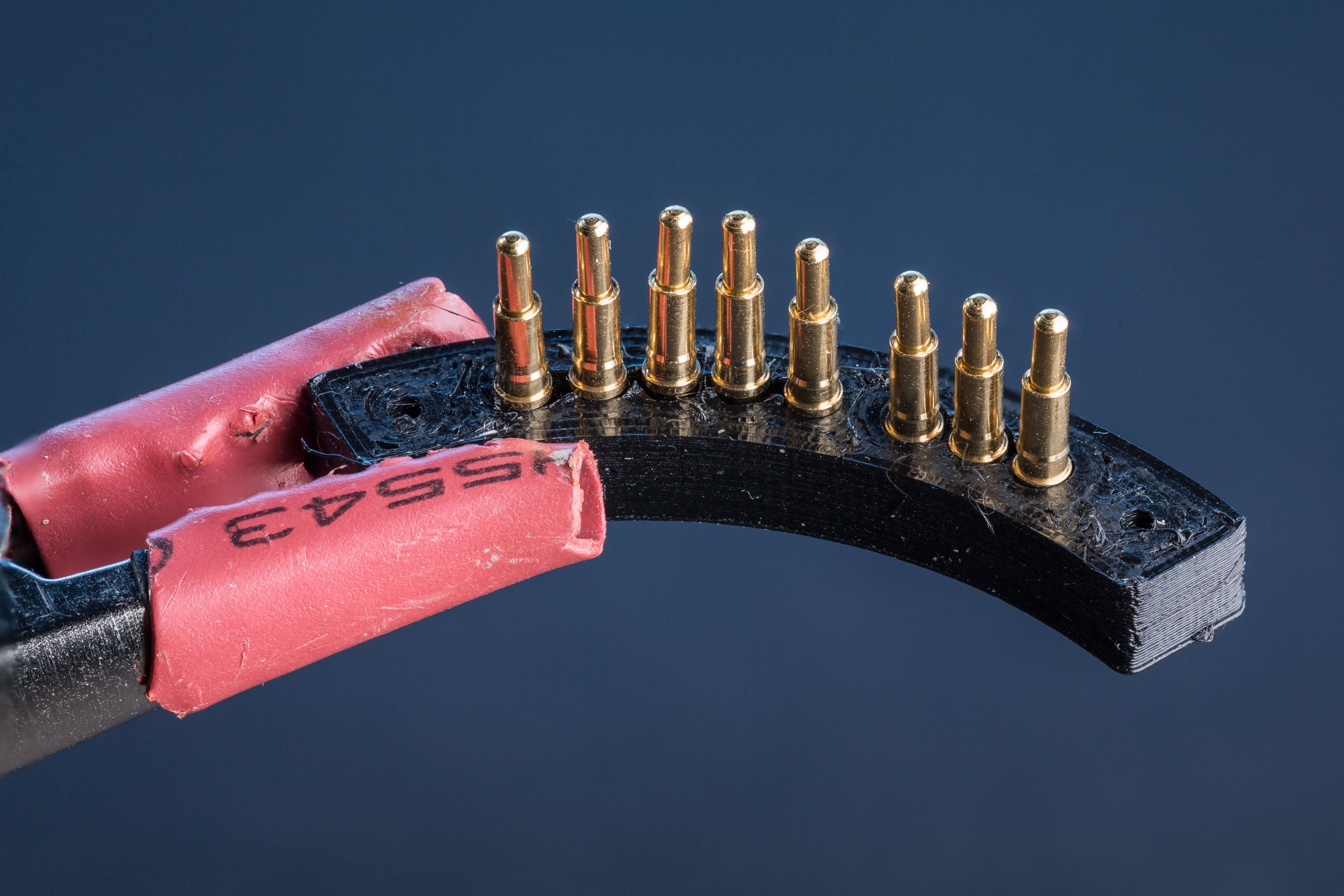
Macro photography — the art of taking pictures of tiny things — can be an expensive pastime. Good lenses aren’t cheap, and greater magnification inflates the price even further. One way to release a bit more performance from your optics comes in the form of an extension tube, which mounts your lens further from the camera to zoom in a little on the image. Back in the day with a film SLR you could make a rough and ready tube with cardboard and tape, but in the age of the digital camera the lens has become as much a computer peripheral as an optical device. [Nicholas Sherlock] has solved this problem by creating a 3D-printed extension tube for his Canon that preserves connections between camera and lens.

More details of this 300mm monster’s construction go so far beyond a plastic tub formed of two threaded sections with adapter plates at the ends. He’s using off-the-shelf metal rings to fit camera and lens just right, but making the electronic contacts is where it gets interesting. On end uses pogo pins, the other provides a contact block made of nail heads. In both cases the 3D-printed parts are designed to provide mounting points for the pins and nails. The assembly technique is worth a look both because of the design and as an example of how to document all the juicy details we’re constantly looking for in a great hack.

The results speak for themselves, in that the photography provides an impressive level of close-up detail. If you would like to build your own tube, it is available on Thingiverse.

Macro extensions seem far between here, but we’ve brought you a few lens repairs in our time.

[via /r/photography]

Espionage On Display As GCHQ Hosts A Temporary Exhibit

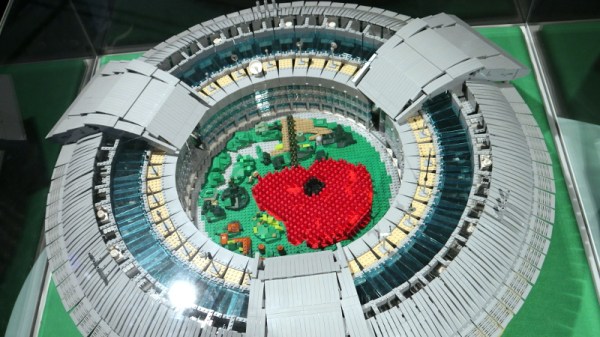
At the top of the British electronic intelligence agency is the Government Communications Headquarters (GCHQ), a very public entity whose circular building can easily be found by any inquisitive soul prepared to drive just off the A40 in Cheltenham which is about two hours west of London. But due to the nature of its work it is also one of the most secretive of UK agencies, from which very little public information is released. With over a century of history behind it and with some truly groundbreaking inventions under its belt it is rumoured to maintain a clandestine technology museum that would rewrite a few history books and no doubt fascinate the Hackaday readership.

Perhaps the most famous of all its secrets was the wartime Colossus, the first all-electronic stored program digital computer, which took an unauthorised book in the 1970s to bring to public attention. Otherwise its historical artifacts have been tantalisingly out-of-reach, hinted at but never shown.

A temporary exhibition at the Science Museum in London then should be a must-visit for anyone with an interest in clandestine technology. Top Secret: From ciphers to cyber security occupies the basement gallery, and includes among other exhibits a fascinating selection of artifacts from the Government agency. On a trip to London I met up with a friend, and we went along to take a look.

Continue reading “Espionage On Display As GCHQ Hosts A Temporary Exhibit”

A Tiny Train Departure Board, Just Like The Real Thing

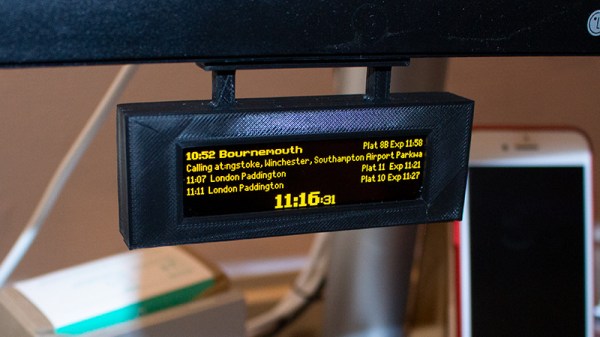
If you travel on the British rail system, you’ll be familiar with the ubiquitous orange dot-matrix departure display boards. At a glance they tell you the expected arrival times of the next few trains, where they are headed, and at the bottom the current time.  [Chris Crocker-White] was inspired by a Tweet to recreate one of these displays in miniature and hang it under his monitor.

The hardware is a Raspberry Pi Zero with an OLED screen, in a custom 3D-printed case. A soldered USB cable takes power from the monitor’s USB ports. Software wise it’s a demonstration vehicle for the Balena cloud service that pulls its data from their transport API, but the choice of dot matrix typeface is perfect and absolutely looks the part.

There is some question as to whether a project such as this one should need a cloud service as its backend, and of course it serves as a demonstration piece rather than a definitive way to enact a departure board. It does however bring a ready-packaged API for transport data, which given that many data sources can be opaque, is a useful feature.

Train time displays seem to be a popular choice on the Eastern side of the Atlantic, here’s another British one, and one from Ireland.

Thanks [Pyrofer] for the tip.